Thursday, 7 August 2008

Lightning


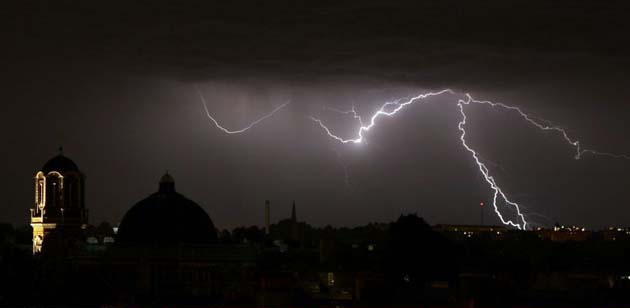
That was London last night.

We had night thunder in Norfolk too. Lightning striking fairly close, some two or three seconds away, the double neon flash, then that croaky barrelling sound, much like heavy gunfire. A few moments and the whole process repeated now further, now closer.

In 1989 the Hungarian Writers Union treated C and me to a week at Szígliget, one of their retreats consisting of an adapted ex-Esterházy residence complete with grounds by Lake Balaton. It was the first week of March. The state was slipping if not yet crumbling, but a major flashpoint was coming up the following week: 15 March, the anniversary of the outbreak of the 1848 revolution. One writer we met had advised us to store up enough food for a couple of weeks. He expected violence. The mood everywhere was anxiety and occasional exhilaration. Seeing a state shift was like watching heavy furniture gradually moving itself across the floor.

Szígliget is beautiful. A ruined castle sits on top of a high hill, the retreat being further down the steep slope, about half-way between the castle and the lake shore. We had the finest room - the guest room - with an ornate balcony and an enormous white faience stove complete with putti. Outside in the plain corridor moved Hungarian writers who were working in smaller plainer rooms, none of whom we knew but got to know a little over endless games of table tennis that were to strain my back for the next six weeks. The next president of Hungary introduced himself as we sat on a bench. We had no idea he would be the first president of the new republic less than a year later, nor did he I suppose. He wore a blue tracksuit. He wrote short stories and translated fiction from English into Hungarian. He turned out to be a very good thing.

We could see some of the lake from the balcony. There are occasionally spectacular storms over it. One night we woke and thought we were in the middle of a cannonade. I think the lake must amplify the sound. We looked out to check that it was in fact thunder. So it was.

There was a brief storm this afternoon too but its approach promised more, was nicely grandiose and operatic. We could see the cumulus swimming towards us, a mountain of relatively amiable grey growing darker and denser as it rose. Then the grumbles began but no rain. The lightning was always elsewhere, the barrelling never too close, yet the sky continued to darken and, finally, eventually, spat out a few drops of rain, hammering the yard for a minute or two, offering brief violence before moving on. Bright again now.

Later this month we shall be back in Szígliget for a writers' meeting where I do an interview.

I have finished the proof-reading and am back to translating, thinking I should be writing. I will be writing.


We now have RSS


Look! We can deliver directly to your door, along with milk and copies of The Watchtower. See buttons at bottom left of page. Try pressing them.

This is all very modern. I think I have finally entered the world of steam.


GUEST POST 1: From Hunter-Gatherer to Global Citizen


As I have sometimes done before, I would like to present the occasional guest post. This one comes about through a long car journey and conversation with the author, Anne Osbourn, who is Professor of Plant Biology at the John Innes Centre and head of the Department of Metalogic Biology. She is also a poet. Here she considers GM among other things.

*

We used to be hunter-gatherers. That kept us pretty fully occupied. We didn’t have time to settle, build civilizations and invent the Wii. Then someone decided that it might be a good idea to collect seed from the odd grass here and there and plant it so that they knew where to gather next time. Things took off. Agriculture was born. Grasses underwent chance encounters. The brush of pollen against stigma led to new types of grasses that grew better and had higher yields. We settled down, cleared forests, and started growing monocultures (small scale at first, of course). We changed the face of the landscape.

The Roman Empire came and went, seed was transported round the world, yields continued to increase. The industrial revolution led to larger-scale farming. Bigger monocultures. Imports and exports. And then in the twentieth century we took on plant breeding big-time, producing ever-improved crops using various tricks – introducing different plant species to each other and encouraging them to have sex, rescuing the hybrid embryo from abortion using colchicine (a chromosome doubling drug from autumn crocus). We used mutagenic chemicals and irradiation to introduce more genetic variation into the breeder’s palette, so pushing the genetic resources further. We discovered the dwarfing gene. Judicious breeding of this into selected lines by crossing led to the green revolution – less straw, more yield. Cereal crops no longer grew waist high. We brought in a battery of fertilizers, fungicides, pesticides and herbicides to maximize output. Despite all of these efforts there is no respite when it comes to food production. Today yield increases are plateauing and new crop varieties continue to be overcome by ever- evolving pests and diseases. Herbicides are losing their efficacy. Our land is brimming with chemicals. The production of new varieties that will provide food security is a never-ending treadmill. There is no room for complacency.

Today many are starving because they cannot access local or transported sources of food. The reasons for this are complex and various. Elsewhere there is a huge amount of food wastage. Consumption of meat is increasing in parts of the world where incomes are rising, putting further demands on grain production. Demands on land for biofuel crops and record oil prices have all contributed to increases in the cost of food. On top of this the targets for plant breeding are moving. We know that the climate is changing but we can only hazard a guess about the kinds of conditions that the plants of the future will need to be able to tolerate - and about how far away the future is. We urgently need to move to more sustainable high productivity agricultural systems. There will be around 9 billion people on planet Earth in 2050 and as the population expands we will need more effective means of farming.

In writing this I do not mean to bring gloom and despair. Rather to highlight the fact that agriculture is not “natural” – although clearly the need to feed ourselves is. Humans have been engaging in genetic modification of crops since they first started cultivating plants. We have literally inherited the earth. We – the global community - must look objectively at the tools and resources that we have in hand and make responsible decisions about how to feed the world. This does not mean saying “Organic farming good; GM bad”. It means looking at all of the strings that we have to our bow and making responsible decisions - decisions that we are accountable for. This is not the time to bicker about the phase of the moon, small-scale farming, wide crosses, genetic engineering and biotech. These are just words. There are no scapegoats and by engaging in such bickering we leave people to starve and blame others for their demise. We have inherited the earth. And we have the power to change things. The responsibility for the future lies with us. Productive dialogue, baggage aside. Evidence-based advances. No loose words.


On agriculture

A chance encounter between grasses in ancient Mesopotamia.
Bread wheat.

The beginning of agriculture.
The foundation of civilization.

Kiwis to Norwich.
Food parcels to Africa.


See “On the brink of starvation” by Nick Danziger on the BBC at the following link:

http://news.bbc.co.uk/today/hi/today/newsid_7522000/7522795.stm


Wednesday, 6 August 2008

Dreaming John Pilger


...is much the same as reading John Pilger.

In my dream he says that Japan was ready to surrender but that they were nuked by the US because that's the sort of thing the US always does. I don't think he need prove this in the dream. Neither does he. In my dream he explains that this is so because there is no greater evil than the USA with the UK coming in a close second. The rest of the West follows.

It follows that all the authoritarian regimes set up by the USA or the West are evil, even those that are not authoritarian. All authoritarian regimes that have not been set up by the USA on the other hand, are fine, heroic, innocent. So China, the Soviet Union, North Korea, Sudan, Zimbabwe, Iran, Syria etc etc, (the names roll off in this dream) are innocent victims.

And at the very end of the dream will stand Israel, its fangs dripping with blood, just longing to nuke the rest of the Arab world, because that is what Israel does. And the USA is only a pawn in Israel's game. Or is it vice versa? The dream isn't always clear about this. In any case, when you come down to it, the last image will be a fat, stupid, American standing on a blood-soaked field, grinning inanely, with a Jew sitting on his shoulder, whispering malice in the American's ear.

And that, in this dream, is why the Second World War was only mythically a good war.

Why was it only a mythical good war? Because if the Germans had been allowed to get on with it there would be no Israel at all and all the evil in the world would have been magically snuffed out.

Like that.

There's no point in waking from this dream. It is no different in waking life.


Proof-reading one's life


For the last week or so I have been reading and correcting the proofs of the forthcoming New and Collected Poems. It is - as I expect others who have done this would testify - a strange, disorientating, sometimes depressing, sometimes dizzying, experience. Everything comes back at you- time and self particularly. These are the voices you gave and made, emerging through a clouded mirror to form a compound yet recognisable shape that now appears: a half-familiar alien.

I remember talking to Peter Porter several years ago when he was putting together his first Collected Poems. I wondered how much he edited. He said he would not edit. What he had done, he had done. It was a pact with himself. You may not always like what you were but you should not deny it.

I, for my part, have taken out some poems that I thought - to use the common phrase - were not worth preserving. (Ah, but is any of this worth preserving? your demon whispers.) That was done before the proof stage.

And at proof stage?

I see how at certain stages, particularly in the middle, about the time of Metro (1988) and Bridge Passages (1991), where I am working my way through the Hungarian visits, impressions and memories, there are phrases I want violently to strike out. Just too much detail, too much the sound of material being wedged into too small a space. Private things, incidental things, the world falling about one's head as at some demolition one happens to be standing under.

And yet there are people who regard this as my most characteristic work. Maybe it is. Some of it appears in anthologies. Yes, but surely, those jammed-in verses like rush-hour trains with no sitting space might have been better regulated, run to a more precise timetable, added some seats. More air.

Maybe it's OK. Maybe it is just the oddity of the experience of meeting yourself, not as a figure passed in a mirror but as a figure emerging from one. And then there is the world the figure presents to you, a world that even as it falls about your head, forms itself into representations of all that was solid and spectral at the time and you couldn't quite tell which was what and what was which, but through which people moved like solid bodies. Your own solid body is in there somewhere.

Getting towards the end of proof-reading now. And seeing that I seem to advertising my own productions, I may as well go the whole hog and point to this, John Sears's study of the work, that I have not read and which may well surprise me. I rather hope it does.


NEW WRITING 1: Helen Ivory


As part of the revision of this site I intend using the Notes section to put up poems and bits of very short fiction by invited contemporary writers from the UK and abroad. I may put up the odd translation from Hungarian. The section will be renamed in due course and it may be that a few technical adjustments have to be made. Each contribution will be followed by a very brief piece of biographical or other information.

I hope to have one new piece per week and am delighted to launch this project with a new poem by Helen Ivory who is now working towards her third book.

Not sure whether to put up photos of contributors. I am inclined not to unless anyone advances a strong argument for doing so. Let us keep glamour - both male and female - a good arm's length away. Let it be in the work not the face.


Tuesday, 5 August 2008

Raincoat (Fashion Notes)


Go to buy a raincoat. A serviceable raincoat. For me. I have an old grey one I have been extremely fond of but, well, RIP raincoat.

It is raining.

Go into several likely places (John Lewis, Debenham, Marks & Spencer, Top Shop - etc...). No raincoats. Not really raincoats. Vaguely rain-coatish jackets, vaguely military-style anoraks, nothing below lower bum length. Mostly warm and lined.  It is muggy and warm outside. No proper raincoats.

But this is England, where rain is obligatory on any day with a D in its name.

Not one raincoat anywhere. Not even one. Ask whether they sell umbrellas. Confused smile. It dawns on them I am now in light joking mode. What larks, eh Pip!

Venture into a kind of countryman outfitter's. Only ladies have raincoats here. Gentlemen can choose something that makes them look like the Grim Reaper on a particularly stormy day. I try it on. I smile into the mirror. Still Grim.

Finally into a very old-fashioned Gents' Outfitters. Served by extremely obliging salesman who treats me like a gent. May I bring you this? May I bring you that? Raincoats. 

Now I have a raincoat and a jacket. I am a gent.