Tuesday, 11 November 2014

Singapore Day Three: Moving House


Drive behind the Executive Centre, Fusion Spoon just to the right


Halls. Balconies at night

The next stage of the Singapore residency is moving into the University for the next three weeks. Alvin saw us off and Barrie Sherwood, writer and assistant professor, drove us the distance to Nanyang Technical University. It's a fairly long drive from the centre out to this western point of the island, mostly multi-carriageway. We arrive at the Executive Centre where we find two rooms plus bathroom etc, all perfectly comfortable. We unpack as much as we can quickly, eat a lunch at Fusion Spoon restaurant just behind the Centre. We have to eat it outside on the terrace rather than in the air conditioned interior because there is a private dinner going on there. More on the Fusion Spoon later. Enough for now that the sign for it features a fork rather than a spoon.


After lunch Barrie returns for us and we take a walk. The campus is beautifully laid out with paths, walkways and streets, a large sports centre with running track and pitches, a swimming pool. It is quiet, the last week of term before exams and people are studying. The paths wind to one canteen then to another. There are shops and halls of residence. The university was closed down at an early stage because it was supposed to be a hotbed of communism. It is hard to imagine that now. Since its reopening it has spread itself comfortably in less than austere surroundings.

Here be large kingfishers, hornbills, parakeets, mynahs, crows and snakes. So far we have only seen the kingfisher, the crows and caught a glimpse of parakeets. There are crickets by the million. Beyond the boundary of the university are the remnants of a jungle that is the province of the military. Singapore spends heavily on its military. It would be dangerous to enter its terrain.

We walk over to the College of Humanities where I am to have an office. It is a very recent, light building. It feels as though it could be made of thin translucent card. Barrie introduces us to colleagues and gives us coffee in his office since the keys to mine are yet to be found. We meet New Zealand poet, Jennifer Megan Crawford and share coffee with her.

Then we return to the Centre and work a little before returning to Fusion Spoon for late dinner. The menu is essentially western, intended for foreign professors and visiting staff. There is some linguistic confusion about our order. We get one soup instead of two, the second arrives late. I get to wait. When it comes to the second course again one arrives later than the other. This time Clarissa waits. It's all friendly but a little desolate, like the restaurant at the end of the world. It looks like a squash court turned into a disco with a line of incongruous chandeliers. It is where we are to have our breakfasts.


I don't want to disparage it. I don't want to disparage anything because it is a truly attractive campus and I am lucky to be here. I might even grow fond of Fusion Spoon. Perhaps I already am.


In the meantime there is the constant possibility of the monsoon unleashing a furious devout drench on us. Thunder mutters, the sky darkens and lightens, the clouds clot then vanish to be replaced by more cloud.


Monday, 10 November 2014

Singapore Day Two: Sunday with Lopez, non-Theroux, Dyer and a closing party

Barry Logan and theme

All my firm obligations having been fulfilled on Saturday we thought to attend as much of the major things as possible, at least from 11:30 onwards. First on was Barry Lopez's lecture, Nature and Human Nature, packed out at the National Museum Gallery. Lopez is the highly acclaimed author of Arctic Dreams, Of Wolves and Men and many other books including works of fiction. Our eyes had briefly met in the hotel lobby the first evening but I didn't know who he was then just a gentle looking man with a grey beard and an amiable expression. On Saturday we were at the same lunch-time table but didn't have  a chance to talk.

The lecture began with the coming ecological disasters that he described as a tsunami. He gave us facts about sea pollution and temperature rise. What should we do then, what now, we, the human race? He did not suggest we burn our cars or turn our lights off but rather that we should pay attention to stories. What kind of stories then we should expect a writer to write?

It was not necessary, he argued, for a writer to be an activist or propagandist, not to be a Cassandra as such, but - and this was the key point - the stories should help.  He did not fully specifiy in what way the writer should help, who he should help or what nature of help might be offered, but he did go on to offer some distinctions.

First, the writer should respect the reader chiefly by not speaking only to himself (I know I could say 'herself' and he was careful to vary the genders throughout, but since he was a man I'll go with him for now). Writing that was about us was real writing; writing just about the writer was not. Some writing was authentic, some inauthentic. Some writing was commercial and shallow, some was visionary and deep. Some helped, some didn't.

One way writing might help, he elucidated, was by connecting us to memory by way of metaphor and pattern. Another was by reuniting the disparate realms of science (modern, materialistic Western) and art (ancient, spiritual, possibly Eastern. One should write about science with integrity and through the imagination.

Artists are not a sideshow. Art is rooted in shamanism, he concluded. What can we, the audience, the general mass of humankind do? We should 'take care of each other. and make sure that 'none of us is missing'.


There was little to disagree with in any of this though I was not so sure of those firm distinctions. It is sceince that gives us the worrying figures. The scientist working in the scientific realm is not obliged to be a story teller or a shaman. On the other hand the writer setting out 'to help' should be reasonably clear about what he help, if any, he is passing on. A writer talking about or rather through some pretty personal experience of himself or herself communicates with us because we identify with the persona or voice he or she offers. That writer is never alone in the world. The pattern Lopez was talking about is partly a product of mind working on language (and this point did come out later in his lecture), but memory is far from a simple tribal thing, if we can talk of such a thing as a clear isolatable memory at all .

So I am earnestly listening and making notes and, finally, asking the question about what kind of help a writer might be expected to give, but there was no simple answer to that, if answer at all. The fact is - or so I think - is that almost anything that sounds like an answer is probably not one.

*

Paul Theroux was so packed out we were turned away at the door along with a good many other people.

*


Geoff Dyer always delights me. What does that mean? I certainly find him funny but it is more than that. The sense of slowly mounting, exasperated, impotent fury raises his best set-pieces to the level of apparently self-defeating catharsis. The world is mad but overwhelmingly powerful. It should have order, ideally an order of grace, but such an order (like the orderly queue in Death in Varanasi) is not only impossible, its lack is the very condition of life.

I know that Dyer has learned deep lessons from Thomas Bernhard but those rhythms and cadences are his own and so beautifully crafted that they are like poetry in construction. They are not the equivalent of John Cleese beating his car with a fallen bough, but of an artist - a dancer say - moving against the odds like Chaplin in Modern Times. The reason he delights - the reason that he is essentially uplifting - is the same in all art. It is not the catharsis but the grace. The grace of the writing is the triumph of the imagination and, in Lopez's terms, the triumph of the spirit.

Dyer is far more than a humorist of course. He is, at core, a negotiator with ideas and paradoxes. It is the paradoxes that begat the humour. But the humour is engaged with the extensive material of life-as-you-find it. A last questioner asked him whether he had dropped the engagement with Berger and Adorno. He hadn't, Dyer replied, and he was in fact working on Adorno in a current book.

And there's the political / philosophical / social interest,  the extra ingredient that makes the whole. I am still not quite sure how it works within the oeuvre but I can see it makes sense being there and think that if I put my ear very close to it I could hear it humming in the background.


*

Then the party, most of it in the big tent, some of it in the green room at the back of it. Food, drinks, wine and a rather beautiful whisky whose name I now forget. I talk to a Indran, a Chennai poet, to Geoff, to Alvin, to Krip Yuson of the Philippines, to a good number of younger Singapore poets.  One talks, one carries on talking and, not too dramatically, drinking. Alvin drops us back at the hotel. I am writing this from the hotel at Nanyang Technological University were we are for the next three weeks. More on that in due course.


Sunday, 9 November 2014

Singapore: Festival and Feast


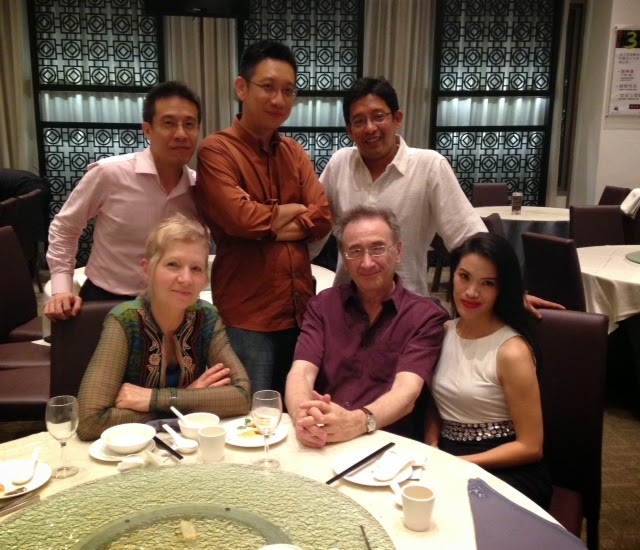
Restaurant scene: Toh Hsieng Min, Alvin Pang, Eddin Khoo; Clarissa, myself and Pauline Fan

I pick up this blog from Singapore almost a month after my last entry, writing from the Grand Park Central in downtown Singapore about fifteen minutes walk from the various Writers Festival venues where, today, we hope to hear Barry Lopez, Paul Theroux, and Geoff Dyer. All my three events were yesterday - a panel on translation, a conversation-cum-reading with Alvin Pang, and another panel on globalisation and literature, finally attending an editors' panel on the idea of poetry anthologies. Everything has been surprisingly well attended and mostly by the young. Although the Singaporean educational system can hardly be said to favour the arts the young seem to have gone into reaction and are lapping it up.They are keen, intelligent, and books - of poetry too - outsell the UK by a factor of two or three without much press or media coverage - that's with a national population a little more than half the size of London. I even get to sign a few books, including the big New and Collected of 2008. That seems unduly charitable of the young readers.

What to make of Singapore? Too early for proper impressions - a hotel room and a few adjacent venues are no guide. The city itself is more or less what we expect a modern Asian city to look like, a mixture of the grandly modern and post-modern and the old colonial, the latter mostly sparkling white, leisurely and imperial in feel - colonnades, wide arches, classical proportions. The festival takes place mostly in a couple of large marquees in the grounds of the Singapore Management University, one of three universities on the island, the others being the general one (NUS) and the technological one (NTU) where I am to be writer in residence over the next three weeks.  The roads are wide and mostly straight, the cars moving in packed ranks up and down them. Traffic is mannerly. People wait at lights rather than crossing at a clear moment. No great natural disasters here, someone said, except the occasional flash flood. When? During monsoon season.

It is monsoon season now, so not quite as hot as it might be the rest of the year but hot enough and muggy. The monsoon is a matter of intermittent fury, the rain released as if by a great fist that hurls it down to the accompaniment of thunder and lightning that clears the air for a while before it all begins again. Interiors are, inevitably, air conditioned to the extent that I am wearing my jacket as I type since it is positively cool in the room.

Our great friend Alvin Pang lives here and has been very willing to show us around - though most of that is to come. We have been extra fortunate that our other dear friends, from Malaysia, Eddin Khoo and Pauline Fan took time to see us, not just for the event. but also for dinner. They are both in their normal throes of furious activity, Eddin dashing round the world meeting people, lecturing, addressing audiences, and Pauline running most of Pusaka herself while this is going on, as well as writing beautiful articles for the press. What is Pusaka? I wrote about it last year while we were in Malaysia but more of that later.

Alvin arranged the dinner. Eating here is not just a matter of assuaging hunger but a cultural, emotional, nostalgic art form involving a great many local and regional styles of cooking. The five of us in the photograph above drove down and enjoyed a marvellous meal made up of the following - details kindly supplied by Alvin.


Teochew Cold Crab
Teochew Braised Goose
Teochew-style Steamed Pomfret
Ngoh Hiang (Five Spice) Roll
"Eight Treasures" - abalone, mushroom, sea cucumber, fish maw bamboo shoot, broccoli etc.
King Prawn with Chives and dried salted fish
Teochew fried Mee Sua (noodles)
Yam Paste and Pumpkin pudding
Tao Suan (soya bean sweet) with Gingko Nut

Tie Guan Yin (Iron Goddess of Mercy) tea

All consumed here.
  
There was also a very fine Muscadet brought by Hsien Min for the occasion. Hsien Min was president of the Oxford University Poetry Society some years ago and he had invited me to read there. Now he is both poet and banker. It is a small world. I hope to learn more about Singapore cuisine as rtime passes - I might ask Alvin to write a paragraph about it at some point. What I can say without any question is that the meal was delicious - subtle, light, fresh, everything you could possibly want - especially so since I was not a great lover of fish in my youth but have come round to it. This was complete conversion.

I'll leave the blog here for today. I hope to continue on a daily basis. Jetlag left me with very irregular brief bouts of sleep which did however leave me plenty of time for dead hours writing. More of that later too. Here is a picture in the black box of Centre 42 where two of my own events took place. In the picture my very sweet and efficient liaison, Jamie, Clarissa (a touch jet lagged as were we both), and Amanda and Emily, both former winners of the Foyles Young Poets award that I was judging that year, some dozen years ago or more, with Colette Bryce. Now here they both are. And Hsien Min. How marvellous!


Jamie, Clarissa, Amanda, Emily


Thursday, 16 October 2014

The Grey Sweater / About Time
Poems by Sonata Paliulyte


The Grey Sweater

As the rain ruptures
         the grey sky
a man leans on his hands
         against the windowpane
and consoles the wind
         with ice-cold eyes -
On the quiet, I am looking
         at his back.

The sweater is grey, one sleeve
         unravelling.
A rain of icy needles drizzles
         down behind the collar.
Step by step I'm slinking
         up to the heart -
stealthily along the sweater
         like a frozen cat.


About Time

High amid the birches
the branch-beribboned moon
pours a rill of silver light
into my room.

Lying back on the bedspread
splashed with the night's mosaic,
I touch the slough of time
slithering between the minutes.

So calm, just the hammer
hammering in the clock's forge,
nailing one more nail
into the passing of time.


         both poems translated by Kerry Shawn Keys


As with Keijiro Suga I am fully aware that this is a translation of Sonata Paliulyte's poems so it is worth asking - yet again - what is lost, what is gained, and what remains in a translated poem. Or, since space here is limited, just sticking to what remains and venturing a little further.

Ideas and images remain. The man leaning against the windowpane, the speaker looking at his back, the unravelling sweater, the cold rain, the idea of slinking like a frozen cat along the sweater up to the heart are all there irrespective of modifiers. This series of events would remain whatever the other adjustments of language. The skeleton of the poem is in place.

The modifiers - their precision, their pitch, register, their subtle associations - must naturally undergo metamorphosis in translation but we might be able to gauge them by how they work to flesh out the skeleton. No skeleton: no poem.

The flesh may be distributed slightly differently but it moves with the skeleton and we may be persuaded to take it on trust. Reading any poem, responding to any work of art, is partly a matter of trust. It is no different with a translation.

But it's the poem, the poem as I read it above, that I am truly concerned with, and here are some marvellous things. In The Grey Sweater there is the way the man with the ice-cold eyes consoles the wind, the way the icy needles of rain drizzle down behind his collar, the way the speaker slinks along the sweater like a frozen cat. I trust the translation because I trust precisely these images and am convinced they correspond to the cumulative effect of the original.

The skeleton in About Time involves the moon, the figure lying on a bed mottled by moonlight, the way the figure becomes aware of time as something between minutes, then the idea of the clock beating nails into time.  The two original fresh thoughts here concern time between minutes and the clock as a kind of blacksmith with his nails. Everything hinges on these two elements.

Here, I am persuaded, the language of the translation is charged to the extent the original is charged. That branch-beribboned moon and that rill of silver light correspond to an excitement in the original. Splashed, mosaic, slough, slithering, hammer hammering are all part of the excitement.

Most poetry is concerned with the fresh registering of customary things: a particular angle of the moon, a particular sense of time, the movement of a body, the way its clothes hang. At best it is as if we were living for the first time. That is essentially the lyric project. These are two fine lyric poems.

*

I have put two poems of Paliulyte here because they are so short. Here is another link to her biog. The poems are taken from her chapbook, Still Life, published by Colin Will's Calder Wood Press I am aware these posts are becoming longer and fuller. I don't want to shortchange my first poets it's just that one loosens up and gets into the swing of things. 


Tuesday, 14 October 2014

from Walking Poems, No 5
A poem by Keijiro Suga


Walking 5


Autumn comes walking with the infallible feet of the wind,

Through the shallow marshland, through the narrow openings of the tall, silver grass.

We too are walking, speechless

With the intention of welcoming this autumn that has come too early.

Walking on this narrow wooden boardwalk we see the shapes of the faraway mountains,

In the shade of the tall silver grass dragonflies with cheerful knowledge dance wildly.

Hiding in the shades are the living of what past periods?

Did you break ice here?

Did you burn stones here?

Under the orange sun of which season and under what kind of rain clouds?

Did you sing songs?

Did you play the pipes and strings?

Did you capture flocking birds?

My ears cannot reach the old melodies buried under the silver grass

But there's no need to give up your hope that is humming like clouds.

I am addressing all of you.


Poem translated by the poet.


*

This poem is one of eight in a booklet Keijiro Suga gave me. I am always wary of making any judgment on translated text since one is judging the translation as much as the original, indeed sometimes more the translation, and I am especially wary of judging translation from a language that is so different from those I know, whose history, traditions and expectations are unfamiliar to me.

Not entirely unfamiliar in this case perhaps. I have of course read poems translated from languages and cultures far removed from mine and, as concerns Japanese verse, I have the kind of glancing acquaintance with it expected from someone who reads other Japanese poems in translation in individual collections or anthologies such as the Penguin Book of Japanese Verse.

Keijiro Suga is a well known and prize winning Japanese poet. There is something about him here along with other translated poems. This poem, like the others at the link, consists of single lines rather than joined up text - that, at least is how I read them - with a little space of silence around them. The lines are often statements and the poem itself walks, moving forward step by step in a space that is partly thought, partly meditative condition, a way of proceeding through nature and understanding it or rather, perhaps more accurately, perceiving the conditions under which man and nature meet.

In many respects it is not unlike the tradition we sense in old Japanese forms such as the haiku, the tanka or the renga, but here the sensibility takes on a more direct, more modernist, more improvised slant. Less is assumed, there is less formal addressing of a historical body of common experience. We have instead a way of walking, a slow proceeding, in which nature has to be re-experienced and handled somewhat gingerly. The poem begins with statements then moves to a series of questions addressed directly to the past but also, by extension, to us - as is made clear in that last line.

And all the time we are brought to see things: the silver grass, the orange sun, the boardwalk, the dragonflies. The poem is more than the record of a hike. It is a philosophical journey towards hope of communication: the human in the natural. It has a calm gravity that does not take itself for granted.


Sunday, 12 October 2014

Inventing Life / Perpetuum Mobile:
From Another Hotel Room


Legend of speed. Etching. George Szirtes (back in the 70s/80s)

A brief interruption to the poems from Druskininskai with two, maybe three more to go. I am in Manchester overnight to do some recording for BBC's The Verb. I am to talk about Frigyes Karinthy's highly popular, though now often criticised and questioned, translation of Winnie the Pooh in terms of both cultural and linguistic change.

I seem to be a kind of odd job poet of the media - a curious status - so I produce, to commision, an article or two about this or that aspect of poetry or translation, record a discussion of World War 1 poetry from countries other than the UK on radio; am commissioned (or rather was) to write a very brief film noir script in verse also for radio, to introduce Tarr's Sarantango to a cinema audience, to produce a piece on Jewish Budapest for a journal, to write an oratorio for one composer here, the text for an opera for another. None of this makes me rich or gravely famous.

Today in Manchester. On Wednesday to Nottingham to talk to two Hungarian writers about the state of Hungarian literature. On Saturday to Ilkley to read from the New Don Juan and to address a cultural meeting. Then to Ealing for a very unusual event where all the family gets to perform, the following Saturday to London to read at Rich Mix, then back to London to speak for Rimbaud at another London event, and, beyond that to do a reading in Norfolk, to come to London again for a book prize meeting then to jet off to Singapore for a festival then a residency. In between that I must spend an hour or so at Imperial College researching for some more commissioned poems, and also record a poem commissioned for Anself Kiefer at the Royal Academy, both in London of course. This is all in the next two and a half weeks.

I nearly always say Yes when invited to do something, generally for fear of never being asked again. The result is I am asked to do many things because people think I can do them. I am not sure I can but then I have to so it seems I can which then leads to more requests to do more things. So goes the perpetuum mobile.

I must have energy enough for all this because I seem to be doing it - and more. Maybe I just tick over very fast and always have. The poems I write are bred out of the same tempo, at quiet moments between the pressure. I can't tell, or at least be certain, about their long term weight and other people's evaluation of them often confuses me. I do know I have never been the slow meditative type: my meditations are intense and compressed.

Life too seems intense and compressed, of a glowing, almost white-hot brightness. I have grown to love it ever more without wanting to hold on to it for any time beyond its useful length. I know - and am fortunate beyond words to know - that I am loved by those I most care for. I know that the love is vital but that it is best based not on a puppyish craving but on consideration, kindness and a wild sense of the uncertainty of life, or indeed of anything.

This is a moment along the way, as are all moments. One invents life as one goes along, or it invents one. Hard to know which. One hopes to invent poems that can be part of life's own invention.


Saturday, 11 October 2014

TWO MODEL CITIES:
Poem by Donna Stonecipher


Model City [1]

It was like taking the train across a border between two countries with disparate languages, one built like a fortress and one slinky as a river, and thinking about how orderly languages are, keeping within borders.

*

It was like anticipating how the station-names will change abruptly from words stout as fortresses to words slinky as rivers right after the border, as if each language lived in a world untroubled by the existence of the other.

*

It was like crossing the border and trying to feel it underneath the train, to feel this instance of division, of order, of force, of fate. But the border was an abstraction ordering other abstractions, like stout and slinky languages.

*

It was like noticing the train has stopped at the border and seeing a man outside with the wrong passport apprehended by police — and remembering the luxury of forgetting the brute ordering force of abstractions.


Model City [2]

It was like going to see “The Unbuilt City,” an exhibition of architectural plans and models for transforming your city — grids, towers, monumental ministries, vast plazas — that ultimately came to nothing.

    *   

It was like wandering through the exhibit looking at futuristic drawings that figure the erasure of the nineteenth-century four-story architecture you love, and feeling pleased the plans came to nothing.

*

It was like taking note of a resistance in yourself to the futuristic, the futuresque, the future — while not denying a certain nostalgia for antiquated visions of the world of tomorrow.

*

It was like looking at the futuristic models and thinking about the unbearableness of the present, and realizing there are two kinds of people: those who can’t wait for the future, and those who can’t wait for the past.

*


The poems above made their first appearance in the Paris Review last year as a group of four. This is just two of them. I hadn't come across Stonecipher's poems before, that being a reflection on me not on her work, but seeing and hearing her poems in Druskininskai (why do I always want to write Drunkininskai?) I was immediately excited by them.


Why did the poems strike me so?

In the first place because they accorded with my own sense of the balance between reportage and the state of mind we call imagination. They were undoubtedly about ideas and states but were so light on their feet that the very lightness constituted a poetic condition. There are devices here, such as the repeated phrase of 'It was like' that seem to be almost anti-poetic, a clear invitation to do something that poetry will generally do - to compare - without invitation. Few poems can use direct simile with confidence. Here they have an insistent but dreamlike effect. The sentences start much like prose sentences - indeed they are in prose - but are vehicles for registering something that is both thought and reverie. The words are selected with great delicacy and precision, so the idea of a series of thoughts driving towards an argument is relieved of its burden. One floats in them while sensing that something true and demanding is being said about the world.

My own experiments with reiterated phrases and the use of prose as a counterpoint to the essentially poetic sense ofperception draws me to her work. And that isn't just because of Drunkininskai. She has a book coming in England with Shearsman. One to get.