
Monday, 8 February 2010
Late back again
Drove down to London to father's house. K waiting for us. It was a warm meeting, one of our warmest. Most of the day spent sorting through papers - a mixture of the emotional and the sensible. There is such a lot to do. We have arranged the funeral for Thursday. A small affair, secular, we'll do the lot ourselves. I have to plan it over the next two days, which won't be easy because of time pressure.
In the evening to Westminster to the Migrants' Centre to do a reading and talk with Mimi Khalvati for Nii Parkes and PEN. Arrived a few minutes late. Of course I said nothing about dad to them - I had had to postpone the session once before. Lovely people - from Bosnia, Eritrea, Sudan, Iran, Iraq, Italy, Belorus, Spain and more. As soon as one begins to talk about poetry it immediately occupies the mind.
And the mind is likely to be very occupied for a while yet. But the biography project will go ahead in occasional bits and pieces.
Pre-publication copies of Fortinbras at the Fishhouses arrived on Saturday.
Now gone midnight.


Sunday, 7 February 2010
My father, László Szirtes 1917-2010

My father died yesterday.He was ninety-two and would have been ninety-three in August. His death was quite sudden after a long period of acute illness from which he seemed to be recovering. I don't want to say very much about it now but I will use this space to compile a kind of obituary for him out of the conversations we shared, particularly after my mother's death. I will illustrate it with a few photographs - and maybe some parts of the many poems I wrote for and about him. I will add parts intermittently, not every day, but it will be a thread running through the blog from now on. I have many tapes, of which I have transcribed about a third.
It is a strange space to be announcing things like this but he wasn't a public man, at least not once we arrived in England. I can't imagine how I would persuade a newspaper to print anything worthwhile. Nevertheless, his life was more than substantial, often exciting in the worst possible way. I have just had a lovely email from the daughter of a friend of his who had met him, in which she says "I remember thinking: this man has a twinkle in his eye when he speaks, as if he finds life an amusing adventure. It was just an impression. I didn't know him well."
Well, yes - my father had no religious faith except perhaps a faith in the power of good spirits. It was more than a matter of principle with him. He clung to good spirits the way others might cling to God. And this super/meta-principle saw him through times when good spirits were all anyone had at their disposal.
It is, to repeat, a strange space for such personal matters, but I am a writer. It is my job to give some shape in language to whatever happens. That shape is, inevitably, a public shape. A blog is a peculiarly floating space - both public and intimate - but it is a space where such things might be shaped. I will try.
Friday, 5 February 2010
Class struggle and class reconciliation - a scene in Márai
I looked him over carefully out of the side of my eye. You could see he was at the end of the road. Old clothes, a shirt he’d clearly been wearing for days, and those glassy eyes behind the glasses. It didn’t need careful examination to see that this man, who had to be addressed as doctor – that’s what I remember – who after the siege on the Danube embankment had left her standing there, as if she weren’t the woman he’d gone crazy over, but someone who once worked for him that he had no more use for - this man was now strictly lower class. And he still thinks he’s superior? I could feel the gorge rising in my throat and had to keep swallowing. I was all worked up inside like I’d never been. If this big shot left the bar now without confessing that the game was up and that it was me who had come out on top… You understand? I was afraid there’d be trouble. He gave me the Lincoln.
‘It’s for three,’ he said. He took his glasses off and polished them. He stared straight ahead in that shortsighted way. The bill said three-sixty. I handed back one-forty. He waved me away.
‘Keep it, Ede. It’s yours.’
This was it. The flashpoint! But he wasn’t looking at me - he was trying to stand up. That wasn’t too easy for him and he had to clutch at the counter. I looked at the one-forty in my palm and wondered whether to throw it in his face. But I couldn’t speak. Eventually, after a good deal of trouble, he managed to straighten up.
‘You parked far away, doctor?’ I asked.
He shook his head and gave a smoker’s cough.
‘I don’t have a car. I’ll use the subway.’
I answered him as firmly as I could.
‘Mine’s parked nearby. It’s new. I’ll drive you home.’
No,’ he hiccupped. ‘The subway is fine. Takes me right home.’
‘Now you listen to me, buddy!’ I bellowed at him. ‘I’ll drive you home in my new car! Me, the stinking prole.’
I came out from behind the counter and took a step towards him. If he refuses, I thought, I’ll knock his teeth out. Because, in the end, you just have to.
It was like the cat got his tongue. He squinted up at me.
‘OK,’ he said and nodded. ‘Take me home, you stinking prole.’
I put my arms around him and helped him through the door, the comradely way only men know, the kind of men who’ve slept with the same woman. Now that’s real democracy for you.
He got out at Hundredth, just before the Arab quarter. He disappeared, like concrete in the river. I never saw him again.
*
That's exactly the way I see John Terry and Wayne Bridge walking off, arms round each other. Now that's real democracy for you.
I have read two female columnists saying exactly the opposite thing. One says men have too much sympathy for JT, the thick bastards, the other says she admires JT's metaphorical balls. What both see - what everybody sees - is the suffering of JT's wife. Wayne Bridge gets no mention there, or anywhere much, except for three of the foreign players at Manchester City who wear T-shirts with his name on, but otherwise he's left blank. As for 'the other woman' - I can't be bothered to check her name - she gets no mention at all. Did she have any idea what she was doing? Was she in no way to blame? It doesn't seem so. No-one is saying so. Case dismissed.
Thursday, 4 February 2010
Faces
In Rilke's The Notebooks of Malte Laurids Brigge there is a passage about faces - I quote here from Stephen Mitchell's translation, one I like very much.
Have I said it before? I am learning to see. Yes, I am beginning. It's still going badly. But I intend to make the most of my time.
For example, it never occurred to me before how many faces there are. There are multitudes of people, but there are many more faces, because each person has several of them. There are people who wear the same face for years; naturally it wears out, gets dirty, splits at the seams, stretches like gloves worn during a long journey. They are thrifty, uncomplicated people; they never change it, never even have it cleaned. It's good enough, they say, and who can convince them of the contrary? Of course, since they have several faces, you might wonder what they do with the other ones. They keep them in storage. Their children will wear them. But sometimes it also happens that their dogs go out wearing them. And why not? A face is a face.
The next paragraph is about those who change their faces too often and too fast. The last one is worn through in a week, has holes in it, and then, little by little, the lining shows through, the non-face, and they walk around with that on.
The third and fourth is about a particular derelict woman on the corner of the rue Notre-Dame-des-Champs, who has her face in her hands, but his movement startles her and she sits up frightened, pulls out of herself too quickly, too violently, so that her face was left in her two hands. I shuddered, says Rilke's Brigge, to see a face from the inside, but I was much more afraid of that bare flayed head waiting there, faceless.
*
No one is faceless, of course. Yesterday I was walking down the high street in W, just where the pavement narrows and there is room for a car to pull in and wait. Sitting in the driver's seat was a woman. She was clearly very old but had dyed her hair black or was wearing a wig, a little Audrey Hepburn-ish wig. Her face was thin and fine boned. It wore an enigmatic, childish expression, between a smile and a squint. She wasn't looking at anything particular, but seemed lost in herself. She was an exotic, an extra out of some film noir such as Sunset Boulevard. My eyes were stuck to her face for a second - I am aware of the awkwardness of that phrase but it seems appropriate. I couldn't quite let go of her, and held her for what would have been longer than was decent in the open street, if she had noticed me. She was on the other side of age, as if she had fallen through the mirror and had found herself a child again, but with the same body and the same face. Maybe her strange smile was a sign of her sheer astonishment that this could be at all, that such a thing could happen to her.
Today, in Norwich, I passed the man who has been on the same spot every day ever since we moved to Norfolk almost sixteen years ago. He is a well known local character and has been noted in diaries here and there. He is a busking derelict. All he has is a monkey hand-puppet and an ancient ghetto-blaster on which he plays forgotten, or semi-forgotten, pop tunes. As the music plays he simply waggles the hand with the monkey on it. His own body is loose, loose and floppy as the monkey's. He spends the whole day there - in sun, in snow, in driving rain. It is more than a little surprising that he is still alive. But the reason I mention him is because, later that day, I walked to the bus station and suddenly there he was ahead of me, exchanging remarks with a couple of people, one derelict like himself, the other a bus employee. They seemed to be larking with him. And the oddest thing about this was not him - nor them - but me. I had never imagined the man living somewhere a bus ride away. I had never imagined him with his ghetto blaster and monkey puppet travelling anywhere. His face? It was Rilke's idea of the non-face glimpsed through the lining. Almost unfocusable. But a real face all the same, even in its non-face way. It was the face of a man with a name.
And lastly, today, having got off the bus in W, I passed a very young woman, maybe no more than nineteen. Quite pretty, blonde, short haired. But the way she was walking and something about her face, was much older: older in the way a child looks older, not the way an old person actually looks old. It was as if, under the young face, you could already see the ghost of the older one waiting to show through, the walk of the old woman preparing itself several years in advance in the walk of the young one. For a second I thought of the old woman in the car and put them next to each other, almost transposing one over the other. It was a touch unheimlich - disturbing. Then it was gone. Both of them were gone. There was nothing in the least macabre about this. It was just a passage of time enacted between two women, with the busker in the middle.
Then, of course, there is my own face and whatever it shows, to whomsoever it shows what they think it shows. I sometimes look at it with real curiosity. It's not vanity - I don't think much of it in terms of beauty - but it is, undeniably, there, and it does hold an interest. My interest, at least. Then it's gone. I am not aware of it as I type.
And my mind goes back to when I was about seventeen and thinking grand metaphysical thoughts, wondering which part of my physical self was 'it' - the thing I was. If I lost a finger or had it cut off, would the finger be me, or what was left? Or an arm? Say I lost both arms? Both legs too? Were those lost parts not me - the 'it' - the thing I was? How far can we go before there is nothing left? What is the meaning of the balance in which most of the actual body is missing but the small part that remains still functions? Consider the heads in the basket at the guillotine? Is it the head or the body that is the self, the 'it', the thing that you meet, really meet, as in dreams? Adolescent speculations.
Maybe it is the face, the eyes above all, the thing that looks out at you through them. Maybe that is the thing we encounter in the street, in the car, at the afternoon bus-station, the whole thing moving between face and non-face, just as mine is moving, and always has moved, between the two.
Wednesday, 3 February 2010
Iran
I would say this was an important and brave dialogue, conducted with an understandably pseudonymous correspondent, Darius, currently at Harry's Place. Very much worth following, at a time when we hear of the executions of protesters against Ahmadinejad's regime. Two were executed on 28 January. You can put a face to one in the first link. Nine more have been condemned. I am working from home all day today and will be calling in regularly. Anyone can ask a question.
Sample answer:
...Unfortunately, probably tens of thousands have been killed by the authorities since 1979 and according to various sources 4 to 6 million Iranians have had to leave the country during the last 31 years which, as far as I know, is a world record. Yearly, some 200,000 Iranians are leaving the country, mostly the young and educated part of the population.
It's good to know that sterling folk like George Galloway, and all who associate with him, approve and applaud the regime responsible for all this.
Tuesday, 2 February 2010
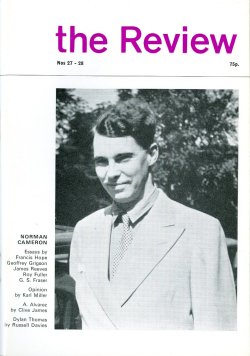
A little more Cameron
Robert Graves's Introduction to the Collected Poems of his late friend, Norman Cameron, says:
We met first at Oxford in 1927; he had gone there from Fettes, and was then President of the Oxford English Club, reading English, playing shove-halfpenny at the Chequers, and occasionally turning out for an Oriel rugger team.... After coming down, he lived near me for a while in St. Peter's Square, Hammersmith; and next, not having done too well in his Finals, accepted a job as Education Officer in Southern Nigeria.
What strikes me about that - apart from Cameron having been an alumnus of Tony Blair's old school - is the easy step from failing one's Finals to accepting a job as Education Officer in Southern Nigeria. I mean the part about playing shove-halfpenny is rather nice, and - considering that Cameron was never very strong, the idea of him playing rugger is surprising (presumably scrum-half rather than in the pack, though he might just have been hooker) - but that almost natural-sounding step from Finals to Southern Nigeria has a heart stopping pathos to it. Maybe it was the way they did things back in the days of the Empire when the map of the world was mostly coloured red; maybe they said to themselves: That blighter who flunked his Finals, sounds just the sort of chap for Southern Nigeria, what? Drive the poetry out of the silly ass!
Then off goes slightly frail Cameron and writes things like this in his letters to Graves:
I certainly haven't met anybody lovable or likeable on this ship so I hope for good results when the voyage is over. The two young men who are going out to the same kind of job as me seem rather to think that I'm going to share a house with them. A jolly bloody little snuggery that would be...
This is a nice house, and all to myself, and I'm feeling much better than when I wrote to you last. A fellow came aboard and asked if he could be my cook. I also chose as steward a chap who had tattoo-marks or something all over his face, because he seemed to be rough stuff and independent...
The girls are most lovely. But I find that you can't look at them or you get let in. I had a sad experience when a girl I bought some bananas from (I shouldn't have done that - gents leave banana buying to their menials) made a gesture which I thought was a sort of technical blessing. So I said 'bless you' and smiled at her, and went upstairs to my house. But she followed me up and started to make a sexual demonstration. So I daren't smile at any Aftican girls any more...
It's all lovely stuff like that and you get ten pages of letters in the Introduction. I think another Cameron poem is appropriate:
In the Queen's Room
In smoky outhouses of the court of love
I chattered, a recalcitrant underling
Living on scraps. 'Below stairs or above,
All's one,' I said. 'We valets have our fling.'
Now I am come, by a chance beyond reach,
Into your room, my body smoky and soiled
And on my tongue the taint of chattering speech,
Tell me, Queen, am I irredeemably spoiled?
Now I recall, that is one of the poems Martin Bell first showed me in 1971 or so. I cannot express how grateful I am to the late Martin. It is the best thing that could happen to a young poet that an elder, much admired poet, puts a poem into your hands and says, Read this.
Monday, 1 February 2010
Thin ice and Norman Cameron
Monday is one of my two days in at UEA -officially. In fact I am often there on other days. As I was leaving today, at the relatively early hour of 5pm, the ice in the car park looked like a skim of glass, everyone treading carefully, raising their feet high so the foot comes down flat and does not slide. It's a delicate, touching, clumsy process. There is something dreamlike about it in the dark. Perhaps it's car parks generally. Places of transit. Few people stop and stare and have conversations in car parks. We are either thinking of arriving or leaving, and, on the ice, perform this awkward little dance.
It is, as ever, the odd non-fitting things that fascinate. I work in my office. I mark work, I have tutorials and supervisions and meetings. That is Life One. But Life Two - the car park, the ice, the odd, dreamlike, dancing awkwardness - is no less real. Perhaps that is Life One and the office is Life Two. Life One plus Life Two must, I suppose, add up to Life Three, which is where the writing gets done.
Ah, but there is Norman Cameron:
Psychologists discovered that Miss B
Suffered from a split personality.
She had B-1, B-2, 3,4 and 5,
All of them struggling in one body alive.
B-1 got tipsy and B-2 fell ill,
B-3 got pregnant, B-4 paid the bill.
Well, that's enough of that. What about me?
I have, at least, N-1, N-2, N-3.
N-1 is a glutton, N-2 is a miser,
N-3 is different, but not much wiser.
Well, that's enough of that. What of N-0?
That's the N I'd really like to know.
The poem is called Nostalgia for Death, alas. Poor Cameron was a lovely poet. Martin Bell introduced me to his work. I have his Collected Poems, introduced by Robert Graves, second impression 1967, the first being in 1957. The Collected Poems is 72pp long but the poems only begin on p.25. He was forty-eight when he died. I have his translation of Villon too - a gorgeous thing. There's not a bad poem in the Collected, and many are memorable. Some are classics. Died in the same year as Dylan Thomas. Everyone remembers Thomas, said Martin. Life is unfair.
Subscribe to:
Posts (Atom)