Wednesday, 22 April 2015

IDEA at Inönü University, Malatya 2: Prequel

The Double Tree Hilton. I was on the sixth floor - at the back

I was going to write a number of posts from Malatya as the conference went on but days were so full and wifi contact being only available first thing n the morning and last thing at night, it grew impossible.

Furthermore, as soon as I returned on Sunday, I was committed to going back to London on Monday for the presentation of the Wingate / Jewish Quarterly Book Prize of which I was one of the judges and had to report back in a little detail on two books as well as say something of poetry on the long list and read one of my own poems. It's quite a long trip down to London and one gets back late so today is the first day I can take a shot at getting some of it down.

Even so I am doing it while reviewing the new Penguin Book of Russian Poetry for the New Statesman and reading the work of about twenty poets in preparation for the day of Oxford teaching and reading on Monday at Kellogg College (staying overnight Sunday and Monday). Tomorrow night I am in London again, reading at Keats's House. Once back from Oxford I am reading in London (with Katharine Kilea and Mona Arshi) the following Friday and taking part in a conversation at the South Bank on Saturday before rocketing off to Lumb Bank to teach a solid week of the Arvon Course with novelist Monique Roffey, and back in London again on Sunday to read at Imperial College in a reprise of the Mathematics of Freedom project.

Sometimes it is hard to get one's breath.

*

Let me, all the same, put down as much as I can about my stay in Malatya, about the conference, the themes, the papers, the people, the evenings and days.

I should preface this all by saying it was a terrific conference with something like 120 papers, three keynote addresses, of which I gave one, as did Ian Galbraith and John Stotesbury, special sessions on the hundredth anniversary of Gallipoli with Australian poet Robyn Rowland and others. The presenters included poets, playwrights, novelists, scholars, and students at various levels from doctorate down to masters.

All this takes serious organising and co-ordinating and if timetabling in Turkey is a flexible enterprise nevertheless everything gets done.

The whole was helped along by marvellous students generally - and rightly - referred to as 'angels' Such sweet, warm and efficient people deserve the highest praise. And since I expect some of them might be reading this I want to thank them, as I do all the senior academics who brought us together.

*

Having been part of the Writing and Reading in the Digital Era session with James Knight and Mauricio Montiel at the London Book Fair on the 14th the first flight I could get was 22:30. I had had to get up pretty early to get to Olympia for the LBF. It was a surprisingly warm day and if pushing my red trolley along while wearing a raincoat was a little uncomfortable on train, underground and bus it was even less comfortable inside Olympia which is very much like Baudelaire's 'fourmillante cité', a proper ant-swarming city. I have already said something about the event in a previous post so all that remains to say is that after a lovely lunch with Mauricio and James and Mauricio's friend, Ana, I made my way to Heathrow 2 and hung about for several hours before boarding.


The flight is about three and a half hours and sleep is not really an option since a meal is served at just the point one might fall asleep. Landing at Istanbul I made my way to domestic flights for the plane to Malatya. That's another two hours or so in less luxurious style than in the international part of the airport. The passengers were different too. Gnarled old men and women, the women veiled and scarved, one or two young men, a couple of men in business suits and hardly any girls. That's another hour and a half flight, still awake.

At Malatya I was met by one of the angels, Hurize, and one of the professors over from Ankara, a very nice guy with whom we kept up a conversation, along with some others arriving at the same time. By the time we arrived at the hotel I was walking dead. I had been awake for twenty-four hours. The idea was to take me straight to the conference to hear the first keynote (originally to have been given by me) by Ian Galbraith, but I asked if I could miss the morning sessions and grab some sleep, if only an hour. I was sorry to do this but had seen from the programme that, straight after the day finished we'd be taken to a reception at a hotel some way from town for abig meal. That was impossible.

So I went to my large room with all its mod cons, showered, and lay down on the bed, setting the alarm in time to be picked up in time for lunch.

I'll proceed from there in the next post.


Thursday, 16 April 2015

IDEA at Inônü University, Malatya 1


After a sleep of an hour or two I was ready to enter the fray at the University. Berkan drove me in. I got to know him when he spent a semester at UEA and we became friends.  He is one of the people running the show here, IDEA being a large conference running over several days with over a hundred papers, that moves around the universities of the country.

A little about Malatya first. As I wrote yesterday it is chielfy known for its marvellous apricots which, the brochure tells us:

  • Helps the brain function and reduces stress
  • Cures the damaged tissues of liver
  • Makes bones shapelier and stronger
  • etc. Right through another eight cardinal virtues and blessings. Besides which apricots taste nice.

The city is in the Upper Euphrates Basin in Eastern Anatolia, that is a long way south-east of  semi-European Istanbul. It is mostly high plateau with predictably hot summers and cold winters. It was an important point on various trade routes nd the Silk Road. It has deep history.

The first of the apricot virtues is useful at the conference itself. I have arrived at lunchtime. The first person I meet is Susanne Klinger who, again, I first met at UEA when she was writing her PhD on translation. We chat over coffee, then lunch, and head into the first session. There are always four on offer and one could move between them all but this time I opt for a non-fiction slot that includes papers on Rose Macauley, on Lady Mary Wortley Montague and on Ethos and Persona in Popular Science Texts in the context of rhetoric.

The first two two complement each other, both on aspects of orientalism and the idea of travel writing. The Towers of Trebzon paper given by Fatih Oztürk concentrates on the figure of the monkey and what it signifies in Macauley but I m not fully hearing as I am still waking up. The seond, by Julia Szoltysey is in many respects a feminist paper about the perception of the harem as presented by Wortley Montague and by Edmondo de Amici. It's a beautifully constructed talk ending with Ingres. Afterwars I chat to Julia briefly about other western artists' representation of the harem, thinking Delacroix but time is short.

The third of the papers by Sarah Orgun-Perrault from the USA is about the way we trust or do not / should or should not trust scientists. The terms of rhetoric she refers to concern technical knowledge but also the relationsip between ytechniocal athority and its context among peers as well as its relationship to public. It's very clear and animated. At bottom it comes down to concerns about capitalism and climate change. It is a whirlwind guide to the rhetorical reading of science and potential interest. Because it is whirlwind it has to present science as an undisputed, undifferentiated whole, and the moral scepticism that should question at as similarly coherent and totalised. There are, in effect, bad scientists paid off by the petro-chemical industry and good, socially conscious opponents. My suspicion is that both the science and its audience are split. I am essentially in agreement with her but a - probably unavoidable - simplified account of anything touches a slightly discordant chord with me.

The trouble is however I count myself of the left-liberal persuasion I resist its polarised rhetoric as much as I do that of the right, however more dispiriting and dangerous I find the right. I say 'the trouble is' but it gets me into trouble with both sides. But if that's where you have to be, that is where you have to be.

The session afterwards about the relationship autobiography and biography and fiction, and readings of Julian Barnes's England England in the context of Baudrillard was gorgeous and exciting but I can't write it up now as I have to be down in the lobby to be taken back to the conference and make my own keynote. I'll return to Barnes, Baudrillard and biography as and when I can,

Now wish me luck.  A picture to follow plus any typo editing.


Wednesday, 15 April 2015

Arriving in Malatya via the London Book Fair

I am writing this about 20:15 local time in the Hilton at Malatya. It has been a long two days.

Yesterday, Tuesday, I woke very early about 4:45am, and stayed awake knowing I'd have to catch the 8:16 from Wymondham to Olympia via Stratford, and then, after the London Book Fair, scuttle off to Heathrow. This actually entailed two separate trips. I won't go into detail but getting to Olympia involves a change at Shepherds Bush where the right trains are infrequent. I had to be there before 12:30 since I was doing a spot with the Mexican writer, Mauricio Montiel, known on Twitter as El Hombre de Tweed, and the English poet James Knight, also known as The Bird King and @badbadpoet.

Bird King, Hombre de Tweed and a character calling himself George Szirtes

I had never met either before but we had been in plenty of correspondence via Twitter, reading each other's work. This being Mexico's year at the London Book Fair, Mauricio was able to invite both James and I for a 45 minute reading and conversation at Author HQ, a very well attended spot in the ordered chaos that is LBF. My problem is that I was dragging my trolley fwith clothes and other stuff for the Turkey conference as well as wearing a raincoat as an in-case over the next four or five days. Controlling the trolley was like having a big red dog at one's heels, not easy to steer through great crowds.

Neither man looked exactly as I had imagined he would though elegant Mauricio was within in my imagined spectrum. I thought James would be more freaky, wild-haired or shorn-headed, an ear and nose-rings type but he was a tall, handsome young gentleman of impeccable politeness. He had kept his real identity quite separate from his Twitter persona or poet mask, as had Mauricio, the Man of Tweed (appropriately wearing a tweed jacket). Mauricio, it turned out, had already composed a novel of some 400pp in the Tweed voice and character, a novel that might stretch to as much as 650pp, entirely in Tweets. Mauricio'svery sweet friend Ana who worked with Book Fairs was with him too.

Our event came. We read and talked and answered questions from a large audience. The most interesting question came from our chair, Julio, who asked how far the internet, and in particular Twitter, had changed the way we - and people generally - think. That is a very big subject but we had a brief shot at it. I might write more about that later.

In the audience, poet Clarissa Aykyord and, on the way out, poet and writer Richard Gwyn whom I had first met in India. But there was time only for a few words as everyone was caught up in business and crowds.

Afterwards we went for a late lunch somewhere nearby (as Mauricio's guests) and continued a conversation that could have gone on far longer. I suspect it will.

*

This is dully written stuff just recording what happened. What happened next was the trains to Heathrow, hours of waiting at the airport for the 22:30 flight, writing a little in the main lounge, then the three and a half hour flight on a very comfortable modern plane the only difficulty being that they served an evening meal about midnight. Landing at Istanbul I had to transfer to an nternal flight, which was another hour and more of waiting with a distinctly non-international group of passengers in headscarves and fur caps, very old women in versions of village wear, men with not quite tidy  cultivated stubble, then onto a smaller but perfectly comfortable plane to Malatya.

By this time I had been up about 22 hours so was feeling the lack of sleep. I and others were at met at the arrivals lounge and driven quite a long way to the hotel. That was about 8 local time. The idea was that we would be rushed straight to the conference but I was exhausted and asked to have an hour or two to lie down. After a little concern that I would miss the first keynote lecture by the translator Ian Galbraith (I did in fact miss it), it was agreed that I should rest because it was perfectly obvious how exhausted I was by just looking at me.

So Berkan Ulu, the kindly writer who had invited me, called for me at the hotel at 12:30 and drove me to the university, which is where the account of the conference will begin in the next post.

What did I see of Malatya? Broad highways in hazy sun, much building-in-progress, little sign of inner city life. It was like the outskirts of Erbil in Northern Iraq or of Kuala Lumpur in Malaysia. Raw, expanding, rural and only just urban. Malatya is a big apricot growing region and a major army base but I saw neither apricots nor military, only miles of highway and unfinished construction. Something sandy about the light too.


Thursday, 9 April 2015

Travelling man


From Norwich to Canterbury via Stratford International yesterday morning to examine a PhD. Train packed to crowded standing only because of earlier cancelled train, hence meet Nick who had booked the earlier train and whom I had not expected to bump into, which allows for a nice chat on the train which is over twenty minutes late into Stratford which means a scramble to catch my connection at the International which, fortunately, is also a mite late. But all is OK in the end. The fast train cruises through Ebbsleigh and Ashford Internationals and arrives on time in Canterbury. I hop into taxi with friendly driver and am plonked down at the Rutherford building.

It is too warm for a winter coat and two heavy shoulder bags. Bad strategic decision.

Time for conversation and a sandwich with Caroline, the internal examiner, before launching into an hour and a half or so of viva, which is intense, fun, and very demanding of concentration but it goes well for the candidate, then it's nibbles and a glass of celebratory champagne in the university cafe, before being given a kind lift back to the station.

I only go as far as Stratford Int, then make my way to Tom's house where I am to stay the night. Tom is out and I am tired so I sit and lie down before deciding to pick up a frozen meal (a korma) at Tesco. Into the microwave with it, add a little diced apple, consume and wait, listening to the R3 concert and reading. Tom returns about 10 and we sit up talking till about 1 am.

Night but so-so. An ideal of 5 hrs a night would be a good thing.

Today morning on the Overground for another meeting at about 10:30 that ends about 3pm, return to Stratford, change at Chemsford, back to Norwich, onto bus to see Rich and Helen and the grandchildren who are a delight. Lukas greets me all big eyes and smile and exclamations. There is chance for some snatched conversation with H and R but soon enough Clarissa, who has been looking after Marlie all day, returns with her andwe both read to them etc and wait till they're dispatched to bed, then we drive back.

Once home to bed, we both lie down sleep an hour before a light supper of omelette and toast.


Occasionally I notice I am getting older and that the type 2 diabetes does bite now and then.

Head and heart are as busy as ever but the flesh is bruckle and (time) the feynd is slee.  Not so much timor mortis, as timber mortice.

A quiet few days before the London Book Fair (more on that later) and the flight to Turkey to deliver a talk at a conference, on return from which two events in London one after the other in short order.

Meanwhile, reviewing the new Penguin Book of Russian Poetry for The New Statesman. Very good as far as I have read.

Translating. Writing. Corresponding.

The usual.


Sunday, 15 March 2015

On Isolation and Interstices


This is a piece I was asked to write for the Hong Kong based publication, Stationary.  It's an excellent collection of short prose edited by Heman Chong and Christina Li, some 165pp by many writers. The subject was broadly given. The magazine is now out.


On Isolation and Interstices
J the wrestler


There have always been interstices, gaps to fall through and there are more now than before. As worlds accelerate and shrink gaps appear with greater frequency.

J was an amateur wrestler in the Hungarian army, an Olympic-standard protected lower-rank officer groomed for international success but then the revolution came and he fled into exile. He arrived in England in 1956 and was immediately signed by a promoter. Within a few days he was in the professional ring learning the grunts and groans of the wrestling circus, part of what the sport itself termed ‘a sporting entertainment’. This was a world of beer, sweat, fury, pantomime, parable, and masked shadows. His skill and strength quickly raised him to prominence. Soon he was on television, attracting vast audiences, winning trophies. But his wife left him, his son was estranged and, as he aged - he was twenty-eight by the time he arrived in the country - his role diminished from straight hero to ‘rabbit‘ or loser, thrown across the ring by ever heavier men. He never made much money and went to live with his younger brother’s family in a poor part of London. He lost the sight of an eye. He was set up to manage a London pub that failed and he died of cancer in his fifties.

His English remained broken all that time. He was neither here nor there; public in the ring, private outside it; physically articulate but verbally hobbled. He was both muscle and flotsam.

I can’t quite find him on the map. I can’t quite hear his voice or trace his movements. Yet I remember his presence sitting next to me on the bed in the disused barracks that were used as a brief temporary gathering place for refugees during our first few days in the country. I was just eight and he was talking to my father about something, probably his future career.

I would like to find him on the map because I suspect he could tell me something useful about myself now. We were both between languages, between cultures, between histories but he was a man and I was a child.

Solitude is a vital element in any writer’s life. It is hard to write in company unless one has the ability to isolate oneself for short intense periods (I do, but these are essentially short). Boredom may well be where writing comes from, the mind liberated by no specific thing to do, no urgent task to complete, or - even if there is some urgent task - adjusted to its own procrastination and displacements. Isolation, however, is different.

Isolation is as much an inner condition as a physical one. Isolation is a product of lack - lack of ready emotional companionship, lack of common assumptions, lack of certainty in one’s psychological dealings. It is mind as gap. J’s cultural isolation is such a central feature of his condition as I imagine it, that it feels something like pain. In fact it feels like the condition of my mother whose own troughs and precipices were, I suspect, the result of the same isolation. For J, the world of roaring fans, of fancy-dress staged violence, would have been a wall of noise against which his own voice would have sounded lost and unfamiliar. For my mother the isolation was primarily emotional. Nobody around her felt the world the way she did. Not even I. I was pliably intelligent. I had become anglicised in a way she never could be. Both J and my mother lived in gaps that grew deeper as they grew older. In the end they fell through, alone. What they knew they knew intensely and consisted of the solid ground around them, something they could almost reach out and touch. Almost but not quite.

My own case of isolation is hardly to be compared with theirs. In England Hungarian, in Hungary English may be the worst of it but there are far worse things. Nevertheless, I am aware of the gap I sit in: I hear it as a faint white noise that is the condition of many in the modern world.  Our white noise is specific to each of us but we are many - in fact we are legion. Not that that helps, if help is what is needed. The solid parts of the world are ever denser, its sides ever steeper.

The gaps are potentially productive. Out of them grow sounds and images - but oddly without foundation, or so we feel, our feet not quite touching the ground. I sit at my desk opposite a fence licked by sunlight. Leaves flutter nervously in the wind. We are hovering.


Thursday, 12 March 2015

The True Confessions of a Retired Tutor in Creative Writing


So I was reading this piece in The Guardian - and the comments after it and, having done so, felt that though I had explored this territory often enough before, there were some things that maybe I should have said more clearly, so I am trying again. First, a confession.


Confession!!

I confess! I taught creative writing. I enjoyed it. I inhaled and am still inhaling. I also seem to have written a lot of books. But surely, they must be crap, otherwise I wouldn't have been caught dead teaching on such an obvious scam. I confess this crime but I would like the following mitigating factors to be taken into account:


Mitigation

1
As a young poet I had no access to courses such as creative writing but was lucky to find poets who helped me both in the small groups they ran and as friends. Very lucky indeed. I would like it if others were as lucky as I was. I can't guarantee that they will be, which may be my fault, but it won't be for lack of trying on my part. The poets who helped me in youth joined the poets I had read and loved and already lived in my head as well as those the live poets introduced me to. I hoped to do something similar for my students.

2
People who complain that creative writing courses produce relatively few writers don't complain that history degrees produce few historians, that music schools produce relatively few world renowned soloists, that art departments don't necessarily produce a lot of major artists. I spent 16 years in schools teaching art. Are people asking how many of those are 'great' artists now? I sincerely can't see why writing is different from any other art.

3
The principle of creative writing? Simple. Put those who want to write together with a writer who can both write and teach. The students learn from each other under the chairmanship of the writer. Thinking about writing also helps to think about reading since what is being read had to be written first. The skill of writing is as much in the reading as in the writing itself.

4
The history of any subject is that those sharing a mutual interest in it get together, formally or informally. I think of the Renaissance courts, or the idea of masters and guilds; I also think of those groups of writer friends like Keats and Leigh Hunt and Reynolds , or indeed Pope and Swift, who would get together to discuss their writing if only because they were interested in and respected each other. It is not outrageous to suggest that people may stand a better chance of writing well if they have access to intelligent opinion and discussion as they develop.

5
Contrary to rumour, students are not promised anything except the opportunity to conduct intelligent discussion of what they care about with other people who care about it. There is no guaranteed outcome. Courses are not a version of show biz or target led business. Nevertheless the courses seem to have consistently risen in popularity and even straight English degrees seem to do better when there is Creative Writing involved. For reasons for that see (3) above.

6.
Objections to creative writing come from two chief sources:
a) writers (generally novelists, not poets) who have made a living in writing without any course and are for one or other reason financially independent (albeit possibly supported by a partner or with family money). They like to keep a certain mystery about their dark art. They regard themselves - and they may well be right - as especially gifted people who have achieved everything through individual genius and the sweat of their noble brow. They couldn't possibly discuss their art because it is too high for normal people to understand and maybe they themselves prefer not to understand it or even think much about it. (There is something genuine and true in the notion that the arts and their procedures work by a sort of mystery but not all who proclaim themselves as possessors of secret gifts actually possess them.)

Such successful and comfortable writers resent both the courses and the writers who teach on them because the writers who teach are not properly struggling, not alone, the way they think they were alone and struggled, and because they think (not having taught such courses) that the writers are teaching systems and tricks. Systems and tricks are, I myself freely declare, quite useless and furthermore, having examined a decent number of other MA courses in the past I can declare that I haven't come across a single one that offered a bunch of tricks as a prescription for success.

b) people who know nothing about writing and probably read very few books. These include a number of commenters on such subjects (see the comments under The Guardian piece). The level of intelligence shown in discussing Creative Writing by such people is roughly the same as that found in comments following a Chelsea defeat.

7.
These are my true confessions. Further let it be known that a number of people - many of whom I have never met - keep sending me their work for an opinion in one form or another and that I still go to meet younger writers when they think they'd like to show me work in progress. I find that flattering but also exciting. It's nice being with the young - putting aside children and grandchildren the rest of my life tends to be with my own age group. I can't devote my life to the young orindeed others with manuscripts on the go (I never could) but when it is possible I would like to continue seeing and reading others.

There is in fact a list of witnesses I would call should the court require it in order that it might lighten my punishment but I will not ask for such witnesses now (it would be somewhat distasteful), nevertheless I want to assure the court that such a list exists.

One last list in link form as a mitigating plea. Not my list but the list of a single university, the UEA, where I was proud to teach. Let them be witnesses too. And beyond them all those who did not become famous and maybe never published much but whose experience of reading and writing on the various courses enhanced their human pleasure and potential and who might yet go on to publish and be successful later.

Click here for the alumni and explore.


Monday, 9 March 2015

Sedona: a poem, its sources, and its shaping


Sedona

You are travelling

into fantasy terrain

in a white Buick,

eyes fixed on the road,

the central reservation,

and the dust rising,

so you might dream it

or remember it perhaps,

passing Sedona

with Sonny Terry

and Brownie McGhee, the light

dazzling and constant,

to Sonny Terry's

harmonica, with blind eyes,

into the desert,

if that is desert

before you on the straight road

and not a mirage -

- a filling station,

a Navajo store, a bar...

Did these once exist?

And if they did, what

was it about Sedona?

What was your name then?

Were you ever there

or anywhere where time is?

Was Sedona real?

And this photograph,

or that photograph, is that

your tongue, your closed eyes?


Occasion and source

This is one of those poems that starts about 4 am after an hour of lying awake. I have had a few broken nights recently since I sprained my wrist about eight days ago. I wake as I might normally do but the wrist hurts and I can't get into a position that is comfortable so I read what I can in that condition having put aside whatever is too heavy or carrying too long a narrative and resort to the brevities of Twitter which is a godsend if only because there are so many fascinating scraps of writing and imagery on it.

The poem itself began after reading a line by Alice Bishop, an Australian writer and editor I hadn't heard of before. That line, in prose, was: "Her eyes, they're roadside scrub and well-fuelled flame". I thought that was lovely. I didn't know who the 'she' referred to was but Bishop's avatar showed a well dressed young woman leaning against a cliff by a dirt road, turning away from the road. The image together with the line offered something deeply packed and intriguing.

My first instinct was to do something I hadn't done before, which was to take the line and build something from it, while fully acknowledging the author by tagging her in, but that is a complex procedure on a platform as tiny as Twitter, especially at four in the morning. Nevertheless I played with it as a possible first line and a half (my longer narratives recently have all been on the 5-7-5 syllabic pattern and usually comprising ten verses) but then dropped it because I felt anything I might say about the female figure in Bishop's line, however I removed her from that context and placed her in one in my own imagination, she might turn out to be a second-hand figure for me. I could see her but couldn't smell her. It was in the process of thinking that and droppping the idea that the clue to a subject of my own arose.

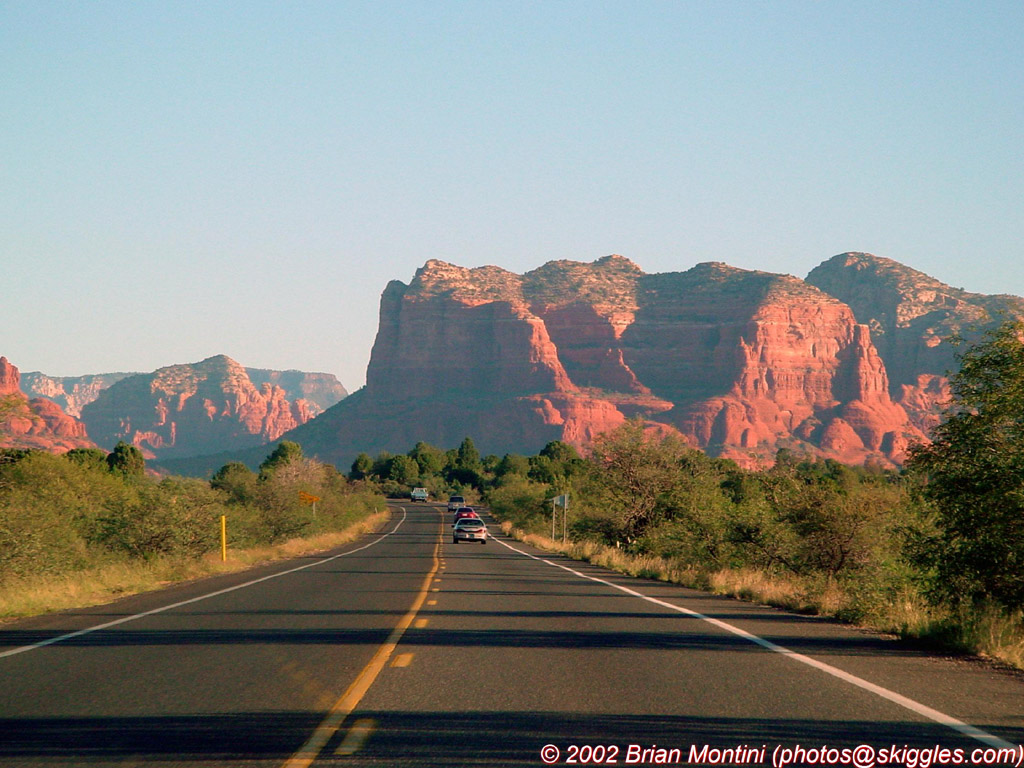
In 1997 Ian Duhig, the late and much loved Julia Darling, Athony Thwaite and I were doing a British Council tour of Arizona. We had the use of a white Buick and drove up and down the state to various reading venues. On one occasion we got lost on a road fringing the desert and ran into the beginnings of a dust storm; on another we drove through Sedona with its red rocks. I remember feeling vaguely unhappy in Sedona, as though I were lost within myself.

This was what I needed to get started. I just had to visualise being on the road again, almost any road, a road at any rate through a desert in some compartment of the memory and I immediately felt I was on to something. A possible montage of images opened up like a chaotic map with no clear road only the sense of being on the road.  I could smell the road. I began writing.


Redrafting and shaping


So the verse with which the first draft started and which is now second emerged. There is the careful driving and the dust though I don't actually remember a central reservation. Maybe it was an odd linguistic slip referring to another part of the same journey, a visit to the Navajo 'reservation' that inserted itself here, though that experience was something different in kind and I wrote about that at the time.

All this is composed impromptu, verse by verse, each verse immediately appearing on Twitter as a free-standing text. (I should explain that, for me, there is a certain creative tension in writing in this half-exposed manner. It is something to do with being on full alert, at the edge of things, not quite in the court of the self.)

Having finished a run of eleven verses (the ten I had did not seem quite complete so I added an eleventh) I copied the lot out with a few changes and left it overnight.

When I woke up and re-read it I felt the poem wasn't quite right.

The problem was twofold: the first problem being the reiteration of information - the white Buick in particular; the second a matter of pace, flow and opening. The questions and recapitulations half way through had the effect of stopping the poem before restarting it.

The electric charge that should carry the poem through was fading before recovering.

So to the bureaucratic details.
  • The first verse moved down one. and the verse that followed it in the first draft (and one white Buick / automatic, a tape deck, / mountains either side) was cut, though I liked it in itself.
  • The two verses following that verse still do follow it in the new version above, but the one after it has been moved so it is now the penultimate verse of the whole.
  • The one that followed that one originally is now the first verse because it floated a little free of the narrative where it stood but made better sense as an introduction.
To be brief about this, the various verses got rearranged in the redraft which also entailed other minor changes though the material remained what it was but a little clearer, a little more open to the experience it was constructing as it went along, which was, essentially a sense of desolation in Sedona, a feeling that one might have anywhere in the world, except this time it was in Sedona in a white Buick.


So what?

I am writing this down as much for myself as for anyone else in an attempt to understand articulately that which I do instinctively. That can only be done in retrospect. I could not write with a retrospecive formal consciousness. One has to keep moving forward.

More importantly perhaps I talk about the core feeling of the poem, the driving force of it, as a memory of desolation but 'desolation' is an approximate term: it is the poem that is the real feeling and that feeling unpacks itself as it goes along, dragging a lot of other unnamed unidentifiable, almost incidental feelings in its wake. And that is, I suspect, what all poetry is even once one discards the well-known items of 'lyrical' baggage.

The point is you can't take the baggage with you. You have to discover it along the way.