Tuesday, 12 May 2015

The Artist in Real and Virtual Company 5:
Social media and the net


Kardashians in a row

The development of the internet accelerated certain established tendencies and habits of mind. The art of letter writing, of writing in long hand, of amassing archives that were purely on paper all diminished without quite vanishing. The opening of newspaper columns to commenters anonymised behind pseudonyms and avatars released some from the constraints of epistolary manners and, owing to the immediacy of communication, often ended in the visual equivalent of shouting and face pulling. Just as being behind the wheel of a car, surrounded by a metal shell, encourages people to behave in ways they might not person-to-person so the hard metallic armour of the pseudonym enabled some to indulge in new forms of behaviour.

Once social media became available more new forms of behaviour became possible. Let’s take two extremes. On the one hand appliances like Facebook extended the possibility of confessional behaviour and confessional writing already explored in what is called ‘reality’ television where people are deliberately exposed in the midst of crises of one sort or another and encouraged to bellow and scream at each other. Their personal sphere becomes the public sphere. Their persons become their personae: the self as perceived and exposed. So on Facebook we hear of break-ups, illnesses, doubts, triumphs and cries of friendship that may begin as contact between personae on a virtual level but can extend to physical contact of both welcome and unwelcome kinds.

At the other extreme the anonymising of the individual figure could lead less to an exposure of what we might assume to be a real kind, more to the wholesale invention of an entirely new figure that was mostly persona, mostly fiction, mostly a mode of discourse. The perfectly normal human habit of adopting slightly different voices and identities for different social situations - one speaks one way to a child, to one’s partner, to the policeman, to the stranger at the door - is extended by the offer of the possibility of none or any of these, These avatars were already available in theatre, in role games, and in the world of the Sim. The idea of seeking semi-mythological roles in terms of fulfilment (as described by Barthes in his ‘Mythologies’) was already present in the world of advertising, but the new virtual stage enabled a far wider range of roles.

There is a now a generation - that of my students and my children, who have grown up with the internet, and can move about it like human ghosts within a familiar and amenable machine. The poet Sam Riviere’s PhD thesis turned out to be his first Faber collection, 81 Austerities. Riviere’s first degree was in Cultural Studies and he had a sophisticated theoretical intelligence that adapted readily to the sensibility - or one of the sensibilities - available on the net. His central interest, as evidenced by the book, was the nature of anonymity or mask, a sort of emptying out whereby the vacuous or mischievous discourses of politics, commerce and self might constitute a new sincerity by reassimilation. The poems in 81 Austerities are mostly in voices other than ‘his‘, that is to say of Riviere as a figure the reader might identify with the voices in the poems. Instead of a personal voice Riviere offered the products of an excellent identifiable ear: a phonic unity. The new book (which I have yet to read) titled Kim Kardashian’s Marriage (also Faber) promises a journey from a different angle. The construction of Riviere’s poems takes place in a space haunted by hollow voices who form a permanent company that has to be negotiated. They are not Dylan Thomas’s lovers, not Li Po’s drunken companions, not even Jean Valentine’s other solitary selves. They are figments and fragments, a virtual company of presences stripped down to personae.


The Artist in Real and Virtual Company 4:
Performativeness and performance


Not I


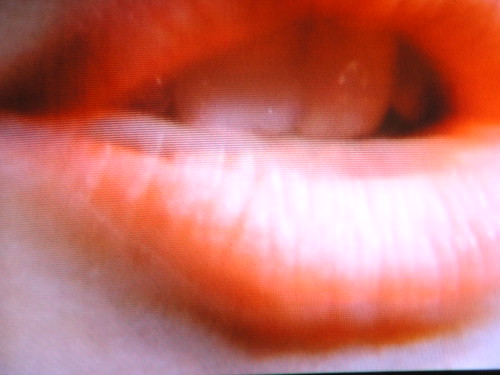
Poetry is performative in ways that fiction as novel is not. Story tellers have always existed of course but novels are more than stories in that we don’t expect novelists to read us entire books orexcerpts as though they were whole. We do however expect poets to read complete poems. That is partly a matter of brevity but also of a certain expectation, not just of orality, meaning the poem may be memorised or spoken or sung, but that we are aware that at its most effective it exists in the mouth, that the mouth is not just a vehicle for the sound but a miniature physical theatre where sound performs itself.

A poem is in some ways a mouth dance: the movements of the mouth producing the sound are an essential feature of the meaning, an enactment of meaning in which the complex emotions of the body are transmitted as expression in the same way as a grimace or a grin or a scream or a whisper articulate the body’s condition. We might perhaps imagine the movement of the mouth as a microscosm of the effects of the world upon both body and mind, as a laboratory or theatre, where the auditory becomes auditorium.

Poetry depends on a physicality of presence. People read poems to each other and listen with a particular kind of attention. Reading alound or silently is an act of trust just as suspension of belief in stage and actors constituties an act of trust.  Poetry resists cheap staginess: it is its own stage. Even when we are dealing with poems whose central concern appears to be the page, as for example concrete poetry, or poetry whose visual aspect is an important aspect of our experience in reading it, such as the visual wit of e e cummings, or the long lines of Carolyn Forché or W C Williams , or in terms of sheer shape as in George Herbert’s Easter Wings, we are aware that visual space has it equivalent in sound. In any case, the power of the poem to conjure association through imagery prompts the visual imagination, its pitch and rhythms conjure the emotionalism of music, its manners register on the social level as forms of address,  and its cloud of developing ideas spreads like weather across the landscape of the receiving mind.

That receiving mind is required to imagine the physicality of the poem’s production - the mouth dance, the mouth’s own auditorium: it is invited to indulge its imaginary senses and inhabit its own inner landscape more fully.

Reading a poem to another person is an act of assumed intimacy. A reading among friends is part chamber music,  part entertainment. A reading to an audience of strangers is both those things but also potentially a sermon, a political meeting, a ritual, a circus, a cabaret, or a party. It is an essentially communal act.

The increasing popularity of the slam and the comedy-performance circuit often drives the poetry into the arms of party entertainment, a turn by someone particullarly good at doing a turn. Applause is courted and affirms both the applauder and the applauder.  There are shared values and shared emotions. That which is known is confirmed. If I am not much drawn to this aspect of public performance it is because I feel it betrays the first cause of lyric poetry which is a turning away from social roles towards a communing with something beyond the accepted and known. I feel much the same about the poet on a political platform, or what used to be known as agit-prop. If the poem merely confirms what everyone already thinks it may be clever but it no longer questions itself. Cabaret, circus and ritual do more than this: they do not exhaust the public space but leave it hanging at the edge of something less determined.

Which is where Dylan Thomas, Li Po and Jean Valentine were. Their solitude engaged with a virtual other, not with a party of paying guests wanting to feel good about themselves. The magic circle of communality is best served with magic that wakens the intelligence and the senses not soothes them. That communal magic, like music, is best served with ritual, circus and cabaret, the more dangerous spaces of performance and performance, one way or the other, whether in the mouth, in the cafe or the public arena, is central to the experience of poetry.


The Artist in Real and Virtual Company 3:
Working alongside an auditory presence

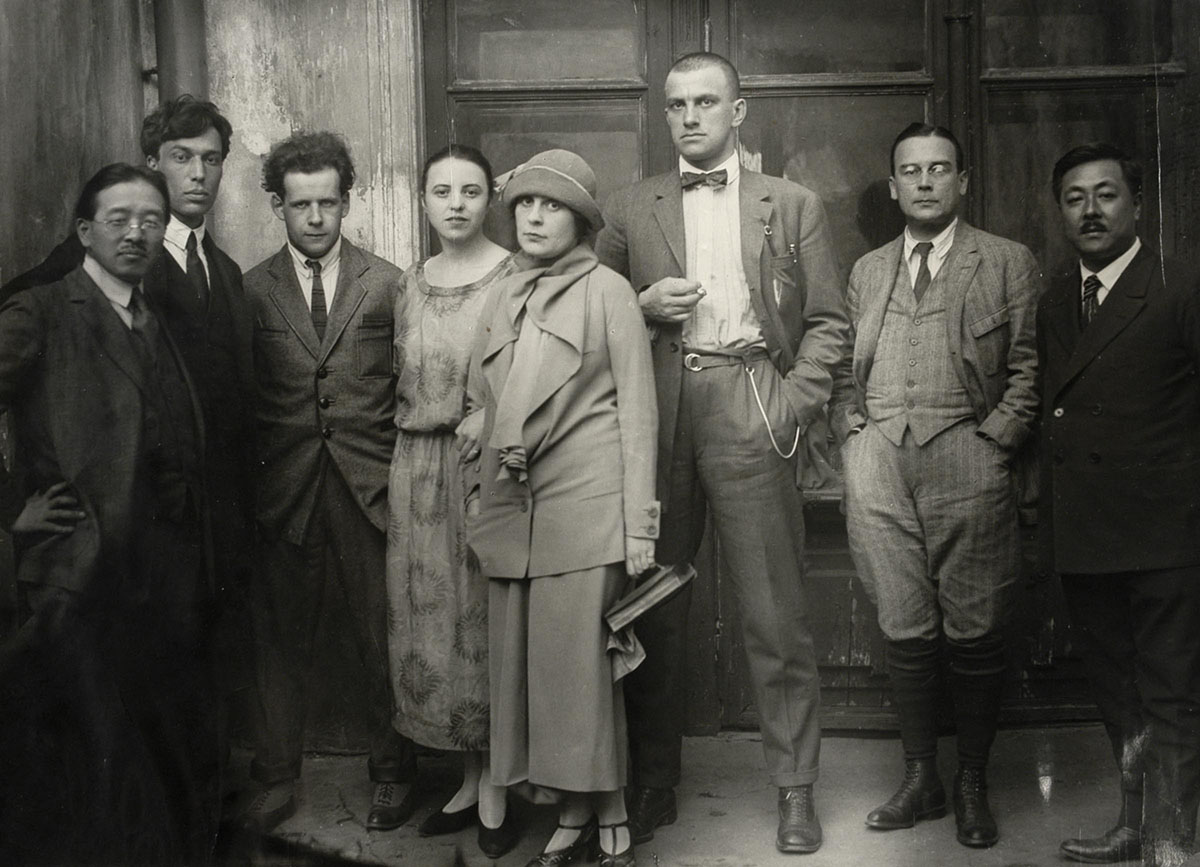
Pasternak, Einsenstein, Brik, Mayakovsky

Writers are not always alone, not as people, not even as writers. Writers, like other artists, have tended to congregate with those of a similar outlook. This is partly for company, partly for political or economic reason. They have formed groups, editorial panels, sometimes because they shared a patron, whether that patron was an individual or an isntitution or a state. Some of these groupings or associations are purely practical. The medieval guild system was intended to protect the status of its members by providing standards and apprenticeships, as was the case of a number of crafts but also of arts such as painting and sculpture before a distinction was made between craft and art.

In a visual artist’s studio there would be assistants and apprentices who might begin by providing very basic services such as cleaning the studio or grinding paint, progressing to painting the less critical parts of a major work, such as the sky. The assistants would be required to do ever more demanding parts of the painting such as vegetation or animals. The great Flemish painter Peter Paul Rubens employed other important artists such as, for example Paulus Potter, to paint dogs and horses while Rubens concentrated on the composition and the figures. All this assumed the primacy of the master and the task of others to imitate him or at least facilitate his work by filling in within the terms of the master’s style. It was only when state or royal academies took over that ideas and techniques took on a less personal direction.

But of course there had been Renaissance courts where poets, artists, philosophers, musicians and scholars gathered under wealthy patronage not so much to produce a single work but to explore areas of mutual interest, the Medici and the Sforza families in Italy being among the best known of these patrons. The idea of individual genius developed under circumstances such as these, the idea of the group being to nurture such genius in so far as it produced what was commonly agreed - but chiefly by the patron - to be valuable.  So we know, for example, that Poliziano’s poems provided subject matter for Botticelli’s paintings and that Dante and Giotto would have had access to ech other’s work.

Beyond the institutional and the patronage-led there remained individuals whose ideas coincided at some stage and we know these by the terms that are generally retrospectively applied to their common vision particularly from the nineteenth century onward once monolithic patronage was pushed aside by new technologies and idea of free enterprise. So the development of capitalism in 17C Amsterdam leads artists into individual or family specialisations, looking to exploit corners of the market. From then on artists are united on the basis of new ideas and, increasingly often, on the basis of going against the market. So we have Pre-Raphaelitism, Impressionism, Neo-Impressism. Post Impressioism, Fauvism, Cubism and the rest.

For writers with less tangible products to sell the occasions for gathering would be the development of smaller salons where they could meet and discuss ideas and affairs that concerned them, on anything from ideas about nature and politics to the latest scientific theories and developments. Nevertheless we can talk perfectly sensibly of Grub Street, of the circle of Dr Johnson, of the Lake Poets, and of John Keats’s friends such as Reynolds and Leigh Hunt who set each other themes for poetry. There had been examples of collaboration in dramatic writing earlier, for example the plays of Beaumont and Fletcher, and Shakespeare’s co-writers, but the core idea of writing as the product of individual genius remained. The Imagists could congregate around a certain idea, as could Dadaists and Surrealists, and many other schools we could name but, as far as product was concerned, it was the work of the individuals within the group that achieved prominence.

Poets talk to each other, write to each other, exchange views and ideas though it is rarer to do so while engaged in the act of composition. There are projects that involve exchanges of poems; there are even collaborative cycles of poems. Octoavio Paz produced a book with the British poet Charles Tomlinson, called Airborn where one sent the other a poem, the other responded, returned the response for the first to reply with a response of his own. I myself have worked in this way with the poet Carol Watts in which we alternated poems, first reducing the lines by one each time from twenty-eight, then having got down to one line building up to twenty-eight again. The result is a forthcoming book titled, naturally enough, Fifty-Six.

The presence of the concrete Other serves as an echo and sounding board off which the pair launch themselves into new production through a continuing process.


The Artist in Real and Virtual Company 2:
The imagined auditory presence


One of the most common questions any writer gets is: who do you write for?  In some cases the answer would appear simple: the poem is overtly dedicated to an individual or group. Love poems are to the beloved. A political poem is addressed to a cause or to those in a position to support or oppose the cause. We have poems addressed to friends, to patrons, to people the poet has never met but admires, or to other specifics, but  there remains a nagging something or someone beyond the overt address. One might facetiously respond to the enquirer that it is you, sir or madam, I am writing for you, but this would be recognised as facetious or even intrusive.

What does it mean for Dylan Thomas to be addressing those unnamed and probably conjectural lovers? What part do the drunken companions play in the solitary figure of Li Po? What can be known of the other solitaries in Jean Valentine’s poem? In what way is Coleridge’s sleeping babe an audience?

I have had two standard answers to the question of who one writes for. The first is to indicate a class of people with whom I tend to identify: people on trains, I say, aware of the range of reasons people might be on trains, aware that people on trains are between places, aware that trains, unlike aeroplanes are in contact with the ground and pass through landscapes. The companionship of these fellow travellers is as notional as Thomas’s lovers. We are aware that travellers alight at various points of their journeys and that our contact with them is not necessarily personal: it is just that we share a suspended condition that is distinct from the business of life and identity we are obliged to lead once we have arrived. Different poets will have different answers but they may be of the kind that refers to a shared condition. Jean Valentine’s solitary speaks to the shared condition of a fellow solitary .

But there is another answer we might give and I do occasionally give which is that we write for quite specific auditors, an audience that is much more active and is composed of those writers or writings that have meant something special to us. This is an audience that has had a direct part in our own development and have taken their places in our writing selves, who consciously or otherwise are part of the writier’s navigating system when it comes to deciding what makes a line or indeed an entire poem. When there is just one towering figure in this audience we may find ourselves talking of the anxiety of influence which some interpret as a variant on the Oedipus complex. In other words we have to kill them before we can proceed. That may indeed be a stage in the devlopment of a writer, but at some stage the various towering figures begin to move in a certain constellation, not all in agreement, and it is out of these that are audience , our unconscious or semi-conscious navigation system is constructed.

There are always others beside the writer-as-solitary, those who are present not just as social context but as presences in the very act. The lovers, the drunken companions, the fellow soitary, the sleeping child are all notionally present, but so are those other figures who have made our writing what it is: the sound of nursery rhymes, thevoices in sacred texts, the sound of the first poets whose voices arrested us and those who followed. These virtual companions stand to one side of time, watching it flow past them. We who are in the stream may find them accompanying us for part of the journey: our fellow swimming contemporaries, the ghosts on passing currents, the vast edifices on the bank whose shadow remains with us long after we have passed them and those whose domain extends along vast stretches of the river. They are virtual but present. We don’t think of them but we are not altogether unconscious of them.

Our fellow travellers, those with whose condition we identify are, like us, receivers, listeners. Those who have entered our heads as influences are transmitters, just as we are transmitters: we hear them as we transmit.


Saturday, 9 May 2015

The Artist in Real and Virtual Company 1
edited text of keynote delivered
at Inonu University, Turkey


In my craft or sullen art
Exercised in the still night
When only the moon rages
And the lovers lie abed
With all their griefs in their arms,
I labour by singing light
Not for ambition or bread
Or the strut and trade of charms
On the ivory stages
But for the common wages
of their most secret heart.

So begins Dylan Thomas’s famous poem that is referred to by its first line “In my craft or sullen art”. The craft or sullen art is exercised at night under the moon by a solitary poet. The poet labours by singing light: the lovers for whom he sings represent the common wages of a secret heart.
The Chinese poet, Li Po, rises after a drunken wine party and writes

When I arose, still drunken,
The birds had all gone to their nests,
And there remained but few of my comrades.
I went along the river—alone in the moonlight.

The American poet, Jean Valentine, in her poem ‘Sanctuary’ writes of

The uses of solitude. To imagine; to hear.
Learning braille. To imagine other solitudes.

It is not only poets who value solitude of course. Most tasks that require concentration involve a shutting out of distractions. Dylan Thomas’s lovers are elsewhere, Li Po leaves his drunken companions asleep and the very purpose of Jean Valentine’s studying of silence, or what she calls “learning braille” is to communicate with other solitudes elsewhere. The rages of the moon in Thomas isolate the individual, affirm his solitude. Everything is ‘elsewhere’.

Nevertheless the others involved in this act of concentration - the lovers, the drunken sleeping companions, the other solitudes - constitute a presence-in-absence, or, as my title has it, virtual presence. These figures are imagined and, usually, unspecific or, if specific, unaware of the condition of the poet. In one of the most beautiful poems of solitude, Coleridge’s Frost at Midnight, Coleridge is alone with his sleeping infant, conjuring solitude at the side of a precious unspeking other, his infant son..

Dear Babe, that sleepest cradled by my side,
Whose gentle breathings, heard in this deep calm,
Fill up the intersperséd vacancies
And momentary pauses of the thought!

The poem ends with the fanous “secret ministry of frost” and, once again, the moon, We might argue that this vision of writing alone, by moonlight, with a sense of sleeping or absent others is a specifically Romantic trope and there may be something in that, but it is not only the poets of the Romantic period who employ it.  Li Po and Jean Valentine are not Romantic poets, neither is Alexander Pope who writes an early Ode to Solitude, nor for that matter are T S Eliot or Michael Hofmann who also write about and out of the condition of being alone.

We should, of course, mark a difference between the writer as a figure in a condition of social isolation and the kind of isolation involved in the act of writing. Writing itself, the act of writing is,  so most people think, ideally conducted in isolation. Proust’s famous cork-lined room, Schiller sealing himself off behind a drawerful of rotten apples, the very idea of avoiding distractions or at least reducing the number of distractions seems more than sensible, somehow necessary.

My aim in this talk is to bring together, or at least touch on, the isolated act of writing with the notional presence of others under four particular headings: the sense of an audience or auditor in the solitary act; the idea of writing alongside others, the idea of performing writing as in slams and cabaret, and as a function of new technologies. I am deeply aware that this is to stretch material very thin, but since these areas seem to me to be related, I would like to think of it as a relatively large scale map that one might occasionally zoom in to.


At Lumb Bank 4


Walk along the river, mroning

This from home, about a five hour journey. I generally attend my fellow tutor's sessions but the pattern this time was not to do so, however I did attend Monique's workshop on persona and character which began with archetypes as the basis of all fiction and moved onto stereotypes. We considered the relationship between persona and character-as-reality, and how the former would slip under stress to reveal the latter.. We looked at two pieces of literature: the entrance of Sally Bowles in Isherwood's Goodbye to Berlin, and the very beginning of John Kennedy Toole's A Confederacy of Dunces. We were then invited to consider the figures of Bowles and Ignatius J Reilly in terms of archetype and how the characters became fascinating through their departure from but reference to archetype (Bowles as whore, Reilly as clown).

After that Monique asked us to choose from among a series of photographs of people and to fill in a questionaire relating to pissible background, character traits and so on. It was very interesting and I'm sure everyone found it helpful.

I'm not a novelist, of course, and it may be because I have no great belief in the idea of a 'real' character under a specific 'persona'. I don't expect that is the only reason though I fully accept that it is what makes fiction work. It may also explain why I am not primarily a reader of fiction.  The great books are, of course, the great books, and outstanding novels are outstanding. They do, no doubt, involve the creation of great characters but have always seemed to me the creation of a world that does not claim to be a copy of ours but the creation of a new one that is a product of the imagination.

My doubts about persona and character, other than as conventions, proceed out of the suspicion that we have various personae in various situations and have little sense of the character as truth. I have no real grasp on the 'real' character of even my nearest and dearest, not even of myself. A proposition such as 'the braggart X is eventually shown to be a coward' fills me with uncertainty about either side of that proposition.

It is the convention of realistic fiction that hazes me a little.  The 'let's pretend it's real' element is too conspicuous for me. Mine is a purely personal feeling, of course and is probably what made me a poet than a novelist in the first place.

Having said that both Toole and Isherwood are wonderful writers and afford enormous pleasure at real depth. That is, in all likelihood, a product of the archetypes at play (I have no quarrel with archetypes at all) but also becaue both writers are in thrall to something in the world itself, in other words, with a sort of poetry.

I am aware that this is far from a convincing case but the truth I am seeking is somewhere in it.

But the chief point of Monique's workshop is absolutely convincing: it is hard work, proper research, sheer graft. No short cuts, no just starting and hoping. Very true.

The afternoon one-to-ones were followed by the evening readings. Spirits did not needto be raised but these would have raised anyone's. People just starting to write had made enormous strides - not so much strides as leaps. How extraordinary that thin line between between incomprehension to understanding, from little idea to shows of considerable skill. It is, I think, not so much the gaining of something new but a removal of something that serves as an obstacle.

This morning the farewells, warm and genuine. I am a firm believer in Arvon. I should try to write another post explaining why. In the meantime thank you, Arvon, thank you dear students, thank you, Monique.


Friday, 8 May 2015

Interlude: face it, do it!


A bigger loss than anticipated.

You ask yourself where you live. It is a country of raised eyebrows, deep scepticism, and of keeping things as they are in case they get worse. It is a country that believes in the NHS but will risk its future because it is sceptical about threats to demolish it. It is a country with a fragmented working class base with a fragmented sense of identity. It has no great opinion of itself but will not be told by others that it should have a low opinion of itself. Fuck you, it replies. It is several countries not one. Its sleep too is fragmented. In the morning it raises its eyebrows while one part then another breaks off. It needs to be addressed patiently, with deadly honesty, with some appreciation of its intelligence, even with some affection, especially by those who want it to change, to move from acts of individual altruism (of which it has plenty) to one of socially cohesive altruism. It needs stop raising its eyebrows. It needs to see the greater good against the cost. It needs to say, now and then, fuck the cost. The gain is greater.

Go on Labour! Address it!