Monday, 25 June 2018

Worlds on Orwell and Writing:
1 Political Purpose


Poet as Journalist and / or Insurrectionist
George Szirtes


“What I have most wanted to do throughout the past ten years is to make political writing into an art. My starting point is always a feeling of partisanship, a sense of injustice. When I sit down to write a book, I do not say to myself, ‘I am going to produce a work of art’. I write it because there is some lie that I want to expose, some fact to which I want to draw attention, and my initial concern is to get a hearing.” - George Orwell, Why I Write.

In previous years I felt no impulse, as Orwell put it, “to make political writing into an art”. As a poet I would secretly have agreed with Auden’s In Memory of W B Yeats, where he says that poetry makes nothing happen but survives in the valley of its saying, a way of happening, a mouth; and would have argued that that precisely was the point of poetry, that it did not set out with a specific intention to achieve an aim, but was deeper, more various and more troubling than that: an intuitive enquiry, through language, into some kind of intuitive truth. 

And I would have backed that up with Keats’s feeling that we hated poetry that had “a palpable design on us”. Poetry was not an advertisement for our views but an exploration of the nature of things, standing at an angle to action, not a spur to it, or means of it. That which Keats called ‘negative capability’ seemed to be the whole raison d’être of poetry.. 

It wasn’t that I felt that poetry should be closeted away from the public world but that its necessary engagement with it would be on other terms: as witness, clown, or prophet. Auden himself, in the same poem, suggested what the witness role might be when he wrote:

In the nightmare of the dark 
All the dogs of Europe bark, 
And the living nations wait, 
Each sequestered in its hate…

That I understood very well. That was just the kind of Europe I was born into in 1948. It was journalism not agit-prop I liked and instinctively practised.

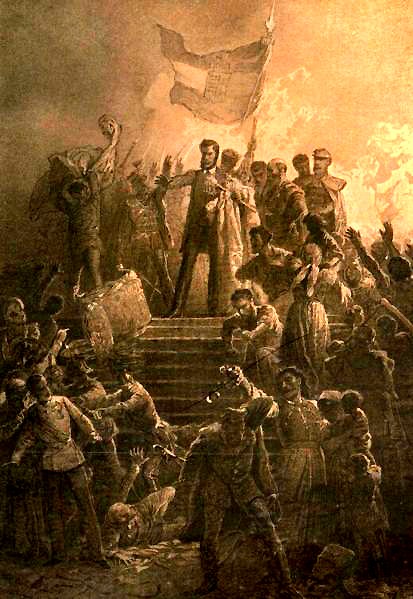
Hungary, my land of birth, has, like her neighbours, a nineteenth century tradition of revolutionary poetry, usually by poets very highly regarded at home and almost unknown elsewhere. Such poetry would usually go with a stirring tune like the Marsellaise and it would be as much the tune as the words that would enable the song to function as an anthem, as a kind of Liberty leading the people on the barricades. The trouble is that both sides of a conflict have anthems: for every Internationale there is a Horst Wessel song: the fierce absolutist moods they conjure have much in common.

There was an alternative way of addressing politics of course, as developed under Stalinism, either as samizdat and therefore dangerous, or couched in terms of fable, or surreal anecdote. The Penguin Modern European Poetry series of the 1970s was packed with examples of it in poets like Herbert, Holub, Bobrowski, Popa and so forth. Its excitement lay partly in its wit and sense of danger. We in Britain had next to no political pressure to say or not say such things: unlike, say Akhmatova or Mandelstam, we risked nothing. Our readership was not united by fear, poverty or other forms of repression: ever more they were disunited, free-floating political entities. 

There was class of course and regionalism, issues addressed by poets like Tony Harrison, and a lighter form of sharp but knockabout partisan politics as written and performed by Adrian Mitchell. Later we had Benjamin Zephaniah and Linton Kwesi Johnson.  But all these were poets writing as representatives of class or ethnic groups. I was not of any coherent British group: the more the groups were located the more I felt a permanent refugee visitor, an outsider.

I was suspicious of most things that presented themselves as obviously and absolutely right and in relation to which one had to demonstrate that one’s heart was in the right place. Not that it was in the wrong place but that the demonstration  always seemed on the edge of a dangerous, mob-rousing falsehood.

It was, I thought, different for fiction: novels, by virtue of their interest in character, action, and setting, were bound, in one way or another, to be political. They could embody views. Not necessarily in the polemic sense that Uncle Tom’s Cabin, Upton Sinclair’s The Jungle, or Orwell’s own 1984 did but simply in that they were about action: what people did and what happened to them. Poetry was a more philosophical form, concerned less with the moral imperatives of what happens next, more with the very nature, in Auden’s terms, of happening. 

*

Although I would have argued this then, and still could, I feel less secure with the argument.  Too much is happening now to be secure of anything. Too much has changed. Hungary, like much of Eastern Europe, has turned against our notions of democracy. The current Prime Minister, Viktor Orbán, announced his preference for what he calls “illiberal democracy” at a party summer camp some four years ago. The ‘illiberal’ part of that may be construed as simply an extreme form of social conservatism that despises qualities such as tolerance, diversity and the freedom to think and articulate one’s thoughts in public. There are echoes of this elsewhere in Europe, in Russia, Turkey, China, the USA and here too. Events move fast: the trajectory, it seems to me, is steep.

What can we, as writers, do in the face of this?  I have openly expressed views on platforms such as blogs or Facebook and have written articles in various branches of the press including The Guardian, most particularly on the reception of migrants and about Hungary, for which latter I receive foul but low-level abuse. It is low-level because I am simply not that important. But it’s worth noting that I don’t write those articles specifically as a poet. I am simply a writer who has some specialist knowledge of Hungary. Being a poet is secondary.

The poetry part of it is difficult. The trouble is that the poetry I have written on the subject, or at least that part of it which strays beyond the journalistic sense of Auden’s dogs barking in the dark, is not necessarily good poetry as I have long understood and felt it. Sometimes it is what I like to think of as a wittier kind of doggerel with pretensions to genuine satire but writing it feels as though I am weaponising that which, at best, goes unarmed and naked.

The leads me back to the tension between what Orwell called aesthetic enthusiasm and political purpose. The poem that Orwell himself provides in his essay is a lively if heavy-footed example of it.

A happy vicar I might have been
Two hundred years ago
To preach upon eternal doom
And watch my walnuts grow;
But born, alas, in an evil time,
I missed that pleasant haven,
For the hair has grown on my upper lip
And the clergy are all clean-shaven.

It’s fun but he did not persist with it. The pre-Spain Auden of 1935 was doing it far better in his Beggars Song,

"O for doors to be open and an invite with gilded edges
To dine with Lord Lobcock and Count Asthma on the platinum benches
With somersaults and fireworks, the roast and the smacking kisses"

Cried the cripples to the silent statue,
The six beggared cripples.


Last week I was at Lumb Bank tutoring developing poets among whom was a seasoned foreign correspondent who had spent extended periods in Liberia and Rwanda reporting on the carnage there. Having come back he was turning to poetry to find a way of understanding events of which he had given factual accounts. It seemed vital for him to do so. The poetry is harrowing but formal and disciplined. It is not polemical. It is another kind of reportage as filtered through memory and the wounded imagination.

But the combatants in those wars were listening to different songs and different words, such as those sung by revolutionary maid, Jenny, in Brecht’s Dreigroschenoper.


…And hundreds will swarm ashore around noon
And will step into the shadows
And catch all those folk by their door
And bind them in chains and bring them before me
And ask: Which should we kill?
It will be midday and quiet at the harbour
And when they ask, who has to die.
People will  hear me say: All of them! The lot!
And as each head rolls, I'll whisper: Hopp-la!

And the ship with eight sails
And fifty cannons
Will sail off with me.


Alle! Hopp-la!

It is extraordinarily powerful, the power behind the polemic. Hearing it I feel ashamed and terrified and excited all at the same time. I no longer trust myself. I dread and envy Jenny.

Hopp-la! Hopp-la!


Worlds on Orwell and Writing :
1 Introduction and Political Purpose (1)


There are various reasons one might write. George Orwell, in his essay, Why I Write (1946) suggested four reasons. These are the four. 


“(i) Sheer egoism. Desire to seem clever, to be talked about, to be remembered after death, to get your own back on the grown-ups who snubbed you in childhood, etc., etc. It is humbug to pretend this is not a motive, and a strong one. Writers share this characteristic with scientists, artists, politicians, lawyers, soldiers, successful businessmen — in short, with the whole top crust of humanity. The great mass of human beings are not acutely selfish. After the age of about thirty they almost abandon the sense of being individuals at all — and live chiefly for others, or are simply smothered under drudgery. But there is also the minority of gifted, willful people who are determined to live their own lives to the end, and writers belong in this class. Serious writers, I should say, are on the whole more vain and self-centered than journalists, though less interested in money.
(ii) Aesthetic enthusiasm. Perception of beauty in the external world, or, on the other hand, in words and their right arrangement. Pleasure in the impact of one sound on another, in the firmness of good prose or the rhythm of a good story. Desire to share an experience which one feels is valuable and ought not to be missed. The aesthetic motive is very feeble in a lot of writers, but even a pamphleteer or writer of textbooks will have pet words and phrases which appeal to him for non-utilitarian reasons; or he may feel strongly about typography, width of margins, etc. Above the level of a railway guide, no book is quite free from aesthetic considerations.
 (iii) Historical impulse. Desire to see things as they are, to find out true facts and store them up for the use of posterity.
(iv) Political purpose. — Using the word ‘political’ in the widest possible sense. Desire to push the world in a certain direction, to alter other peoples’ idea of the kind of society that they should strive after. Once again, no book is genuinely free from political bias. The opinion that art should have nothing to do with politics is itself a political attitude.”


Each of Orwell’s reasons was the subject of a pair of provocations in the form of ten-minute thoughts or riffs offered for general discussion. Those discussions took the form of eight conversations, two on each of Orwell's reasons.   

‘Conversations’ seems the appropriate word because unlike, say, a formal enquiry or academic conference, conversations can range far and wide and the ostensible subject can develop in a variety of ways. Like a creature growing legs it may scamper off altogether elsewhere. But that’s the joy of conversation: it releases startling ideas and possibilities.

The conference was a sum of those provocations, possibilities, focusings and scamperings-off, with Jon Cook in the Chair and I as the recording less-than-angel. This is the record as a took it, editing it as best I can, trying to mark all the main points and hoping to be true to the character of the sessions.


The last shall be first it was decided and political purpose took precedence. There may be all kinds of reasons for this, including our heightened awareness of frightening political developments in many parts of the world at the same time.


First Provocation: Political Purpose 1

Since the first paper was given by me, it is hard to give a proper account of the discussion that followed but at the heart of the provocation was a practical question. How does the writer respond to worrying developments in a given political situation as a matter of urgency? 

Writers may of course lobby or collect signatures for petitions (as indeed I did) but one needn’t be a writer to do that. What does help, if one has access to the press, is the raising of issues through articles. 


For poets, however, the provocation suggested, quoting Auden and Keats, there may be a problem in the very nature of the medium, something that resists its utilisation for a set political purpose.  There were of course revolutionary anthems and, under repressive conditions, as in thirties Russia and in post-war Eastern Europe, poems of subtle and ironic political resistance. The provocation showed a certain distrust of the former. This was not to suggest that poetry should not deal with politics but that it should be wary of being used by specific groups as propaganda.


Political purpose, as Orwell defined it, consisted of the desire to push the world in a certain direction. Was poetry the right vehicle for that?


*


The discussion that followed did not focus on the specifics of poetry – there were few poets in the room - but concentrated on the ways different kinds of politics might be addressed by fiction and non-fiction, looking away from the urgency of the practical issue at hand (in the case of the provocation, as situated in Hungary) towards the deeper roots of what constituted the moral and political imagination and the fierce moral currents surging through contemporary literature.

There was talk of the relationship between art and propaganda. There was discussion of Orwell and gender. Who is the writer, the ‘I’ that makes the observations, that is at the centre of events. Does the figure that does the observing represent anyone else, some other group.  We considered revolutionary poetry in, say South America, the work of Shelley in The Masque of Anarchy as both a direct response to a political event but also as a disruption of a courtly form and its shifting onto a democratic sphere.


Wednesday, 2 May 2018

Redneck


-->


How it might go among the rednecks

You and your folk have been here for generations. Sometimes they did well, sometimes less well. You had your family ways and your community ways. You weren’t great at school but you had some skill so you could either do what your folks had done before like work on the land or at the factory or the warehouse or on the road or rail; you could heave stuff, drive stuff, climb stuff, fit stuff, mend stuff. And because this got dull at times you drank on a Friday or Saturday night, sometimes other nights too, the rest of the time there was the wife, the kids, the sport on TV or visits to malls. Folks in the city might think you were dumb but you managed.

Then times changed. You lost your job or had to transfer, things got tense at home which led to more drinking and to the occasional fight which, according to you, went both ways. There was a lot less money and everything cost more. You were beginning to rot away and resenting it. Now you weren’t considered just dumb but also reprehensible. Your old religion, if you had any left, your old attitudes and whatever other ground you stood on, and some of it might have been pretty bad ground but you don’t want others, especially smart privileged people telling you that (and as time went on they told you that more and more) was eroded. You were not only worthless but a drag on ‘civilisation’. Your attitude to race was deeply wrong (even just the jokes, maybe especially the jokes), your attitude to women, especially the smart women, was not only reprehensible but wicked, contemptible even (don’t even start a joke about that).

And of course you are told you have been gifted with white male privilege. The person telling you this is a middle-class educated young woman or some smartass guy who is repeating her line. You are, they tell you, the most privileged creature on earth. You have, they tell you, been exploiting and treading on everyone especially that nice, angry middle-class girl with her nice apartment, nice car, nice clothes and nice career. You, according to her and her kind, including the presidential candidate, are in fact nothing but yet another bad broken egg in a basket of deplorables.

Then along comes one rich smart guy called Trump. And he ignores those that despise you and ignores all they stand for. He farts in their faces. He tells some home truths and some lies but even the lies are a kind of hitting back. And you want to hit back because you still don’t have a job, you still live in a slum, you still can’t afford health care, you still drink and scrap, and as for the environment, the environment is where you live and where you must scrape some kind of life.  This life is not much like the lives of those used to swimming with dolphins.

And you do have a gun if nothing else.  Because  those others – the liberals – they have nothing to say to you and never have had. Who you gonna shoot? Yourself? Others? Maybe no one at all.
-->

Friday, 6 April 2018

All Too Human
Tate Britain 26 Feb - 27 Aug 2018


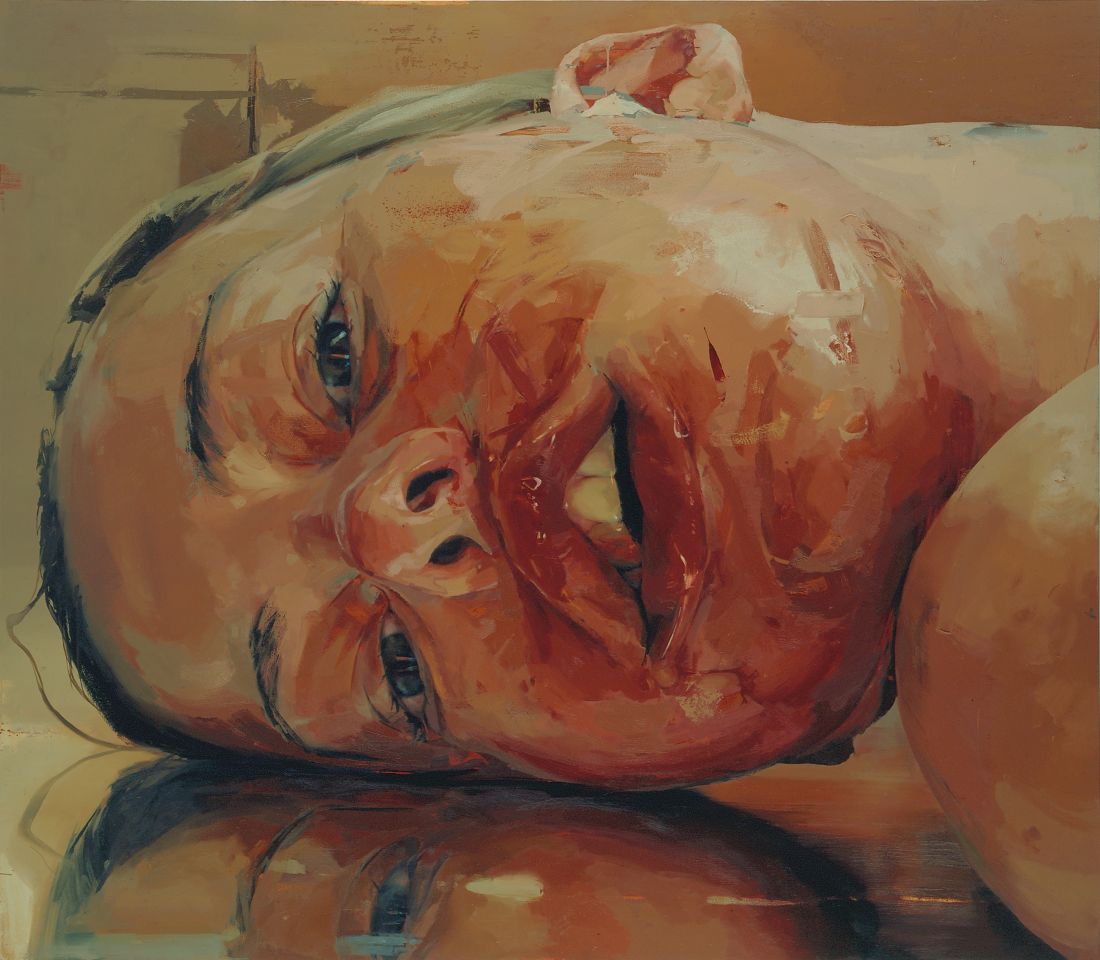
Jenny Saville; Reverse 2002-3

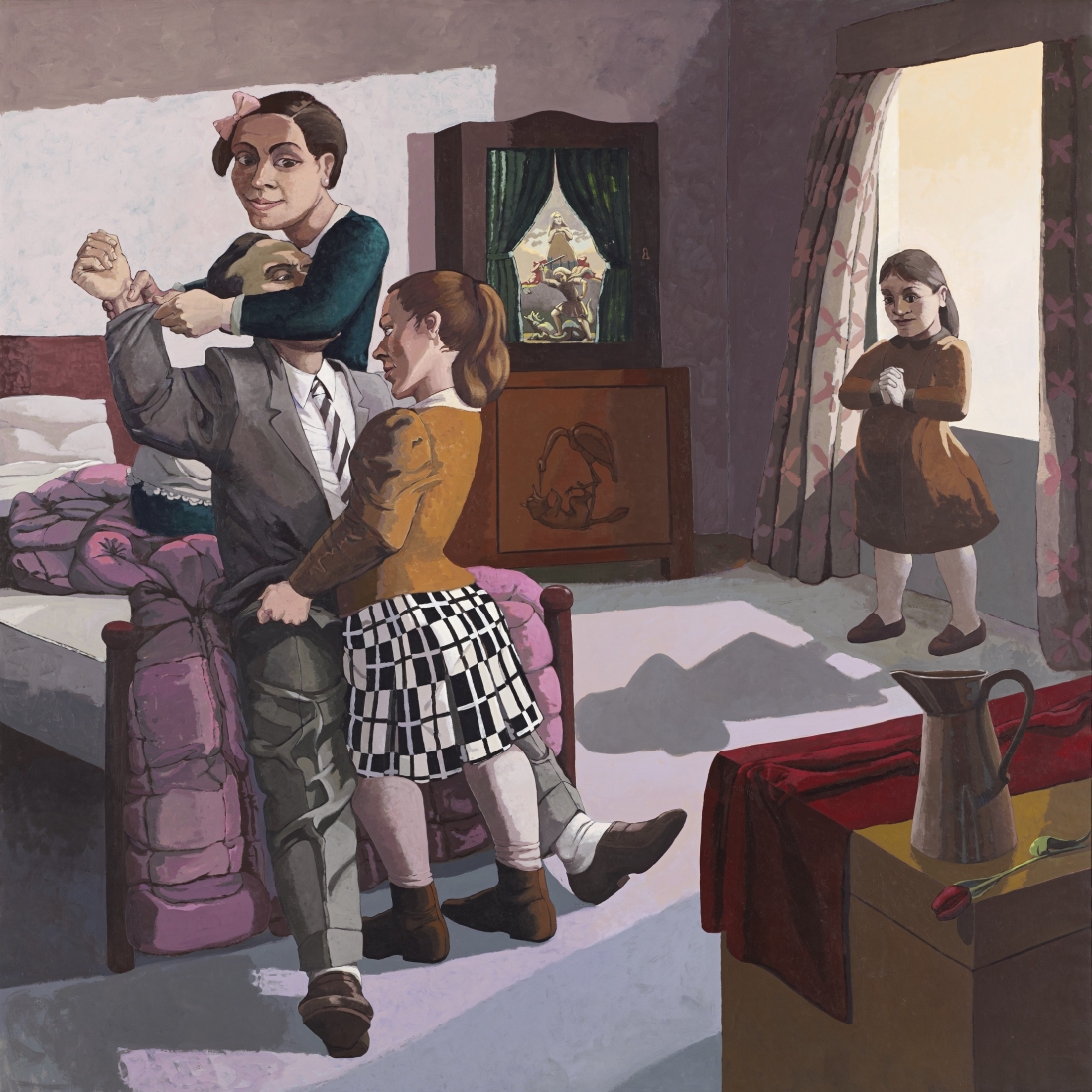
The show is a survey, if necessarily incomplete, of what the catalogue deems to be 'painterly' approaches to the human figure by artists in Britain from Walter Sickert through to Jenny Savill, Celia Paul, Cecily Brown and LynetteYiadom-Boakye (which last room, apart from the marvellous Paula Rego then covers the lack of women and diversity, apart from F N Souza, elsewhere), the exhibition dips its feet into Sickert and Stanley Spencer, Chaim Soutine (is he an artist in Britain?) and, slightly oddly R B Kitaj, whose presence I welcome partly because he tends to get a bad press now for reasons I'd like to explore in the light of this show and partly because I was a fan of his work as a young working artist myself.

Putting aside Bacon for now, the major figures to emerge are Freud and Rego, with Bomberg, Auerbach, Kossof and Michael Andrews in the rank immediately behind, though Jenny Saville's enormous single work, Reverse, is major enough to guarantee a prominent place for her among the others in the exhibition. I have never been able to develop a serious liking for either Ewan Uglow or William Coldstream whose concentration on recording simply doesn't engage or move me.


The pre-eminence of Freud and Rego is based upon their mastery in drawing with paint, and their unerring sense of the potential of the human figure. The human figures, in their work, are subtle but profound articulations of our condition. In Freud it is as if flesh and paint were the same thing. He seems actually to be making the flesh before our eyes. In that respect the artists he shares most with are the later Rembrandt, Rouault and Soutine, who must  be in the exhibition only because his treatment of flesh and paint bears some relation to Freud and Auerbach's use of the medium. The condition in Freud is essentially a raw animality that is emphasised by the inclusion of dogs. 'We are such stuff as dogs are made of' is the underlying perception. We are vulnerable animals with basic appetites: we are made of the same paint. It is a deeply haunting perception.


Rego's figures are products of will and muscle. They are seldom if ever relaxed because should they ever relax they would immediately become victims. The price of life is constant tension. This, like Freud's, is a version of people in animal terms but their engagement in life is not purely through the body but through psychological perceptions. The paint in Rego is not quite like Freud's in becoming total nakedness: it is essentially descriptive but the description itself has a fearsome physicality. Rego's great predecessor in terms of drawing is Goya, her figures short, feet firmly planted, heavy-bottomed, fully earthbound, pressing against the ground. There are also hints of Beckmann and Balthus in terms of draughtsmanship and the handling of paint, but she stands clear of them.


The big difference - and this is why I am writing the blog - lies in the use of narrative. Rego's works are, and have from the start, been based on narrative. The pictures tell stories, not overtly, not in clearly traceable referential terms, but with personal fields of reference, in personal retellings of preceding, iconic stories. Freud's do not present narratives. The studio is the narrative. People enter, remove their clothes and slob out without ever quite relaxing. That is the story. They slob out in their different ways, imposing different presences on us, but they do not invite a more detailed speculation. They are existential figures inhabiting an existential space.

The twentieth century critical preference has been towards the non-narrative, the kind of painting that does not refer to events outside the painting or, if they do so, do it in obscure, metaphorical terms. The public has tended to feel different. They are not purists and like a story, so Grayson Perry suits them to the ground. So, for similar reasons, does Rego. The sneer at art schools in a certain period was that some particular painting was not art but illustration. It was like programme music as against symphonic form.

In an age of deconstruction and theoretical reading the narrative has made something of a come-back, at least in political terms, and there is less elevation of what seem to be abstract values. The new narrative reading is not based on the popular idea of narrative-as-anecdote (it will never want to be popular in that way) but it still wants to use image as text.

I am putting Francis Bacon aside as he is his own constant interpreter. After the war, in the immediate shadow of the bomb, the sense of mere physical existence - man as a poor bare forked animal - had come to the fore. Flesh was disturbing in its vulnerability and its own tendency to horror. Bacon focused on the horror and the physical, fleshly, caged beauty of that horror.


Bomberg, Auerbach and Kossof use paint like soil and press it this way and that so you feel they are trying to emerge out of a morass by sheer force, constructing the world as blunt, deep, flawed matter. Narrative-as-story or anecdote is of no interest to them. It is the physical world that has to be remade after so much violent unmaking. Michael Andrews grows more on me at every viewing. There is a sadness and glow to his best work that I find appealing.

Celia Paul should be  much better known. She emerges out of Kathe Kollwitz and Gwen John in my mind. She is on the Freud side of the equation not the Rego or Kitaj.

Kitaj has suffered the worst of both the anti- and pro-narrative critics, chiefly because his narratives are relatively clear, high-serious, and literary and that combination associates him with a would-be-significant sort of 'illustration'. Some of that may be true but I don't care. What he is looking to articulate seems to me important and the ways he does it are intriguing. Besides, after roomfuls of narrow palettes based on earth and flesh he is a wonderful blast of colour.

Interesting to note, in the light of our struggles with nationalism, how many of these artists were either not born in Britain or came from immigrant families.


What I am Losing by Leaving the EU 3


I am not in any position to consider the economic repercussions though I should say I feel none too assured by those who would assure me in the heartiest tones. Good. I hope it works. I hope there is no growth in unemployment, no great rise in prices (er, there already is), no jobs that can't be filled for lack of those willing to do them, no hospitals denuded of EU citizen staff (85% of those tending to me at Papworth were EU agency staff). I hope that the atmosphere of hostility to foreigners does not intensify towards non-Europeans, that there will be no rise in hostility to Commonwealth, African and Asian citizens. I hope for all the good those promising good hope for, bar of course the extensive privatisations some have in mind.

I feel pretty sure I am losing the confidence of European friends who live here and European friends elsewhere. Those who are leaving are disappointed. Some are wrecked. Some are having to break up families. This is not some calamitous vision of the future. It is happening now. And when I go there, with my brand new patriotic all-singing all-dancing blue-black passport (and possibly my visa) I will come as a member of the divorced side of the family. We sued for divorce, we got it, we weakened you, where is my warm welcome and big hug? We told them we would be so much better off without them. They are civilised people of course and will be polite enough but something a little awkward will follow our progress.

And what sort of England will be left? I say England because that is where I am, not Scotland, Wales or Northern Ireland. A little smugger, a little more on the defensive, a little more likely to be hostile, to be living out the tail-days of its imperial history with an uneasy mixture of guilt and pomp.

I will continue to love it for all it has been to me. I will be counted among those who will defend it against wilder accusations. I will be prepared to perform the foreign anglophile role because, in many respects, that is exactly what I am.

But it will be more work and a little hollower because what I loved was the England I have grown up in. I never loved it because it was the seat of all virtue. I loved it because it seemed - and was - accommodating, slow to anger, not prey to demagoguery, and actually rather humane and kindly in its personal dealings whatever its offices or corporations did. Those seemed worthwhile qualities. I am curious to see what will happen to them.


What I am Losing by Leaving the EU 2


That loss, not just for me, but for many other Remainers I expect, is essentially symbolic but it has political, social and economic aspects.

We live in a globalised world in which global powers - some national, some supra-national, some sub-national - exercise great influence. Very few conflicts of interest or conflicts generally can be restricted to the local turf on which it is fought. Even a regional conflict, broad as that may be, hasrepercussions very quickly felt beyond itself.

Europe may be one thing and the EU another but they are not entirely distinct: there is a considerable if hard-to-define overlap. Europe as the EU is a political entity as well as an economic one. There are common interests - some economic, some political, some cultural - represented in it. Europe, broadly speaking, is under the umbrella of NATO and, less formally, the USA but the USA has its own interests and NATO may not be as effective as it was in the old dispensation with the old technology. Some form of solidarity is more than desirable; it is vital. Europe as a political entity is weakening and becoming worryingly fragile in the east, is unstable in the south and is now losing us in the west. I understand all kinds of security arrangements may continue to exist after we leave but they too will be more fragile, more fraught, more vulnerable. Are we stronger, better and more secure divided? No one ever is. Whom might we be divided against? You name it, any of the great powers would do, as would - thanks to technology - some fairly minor ones.

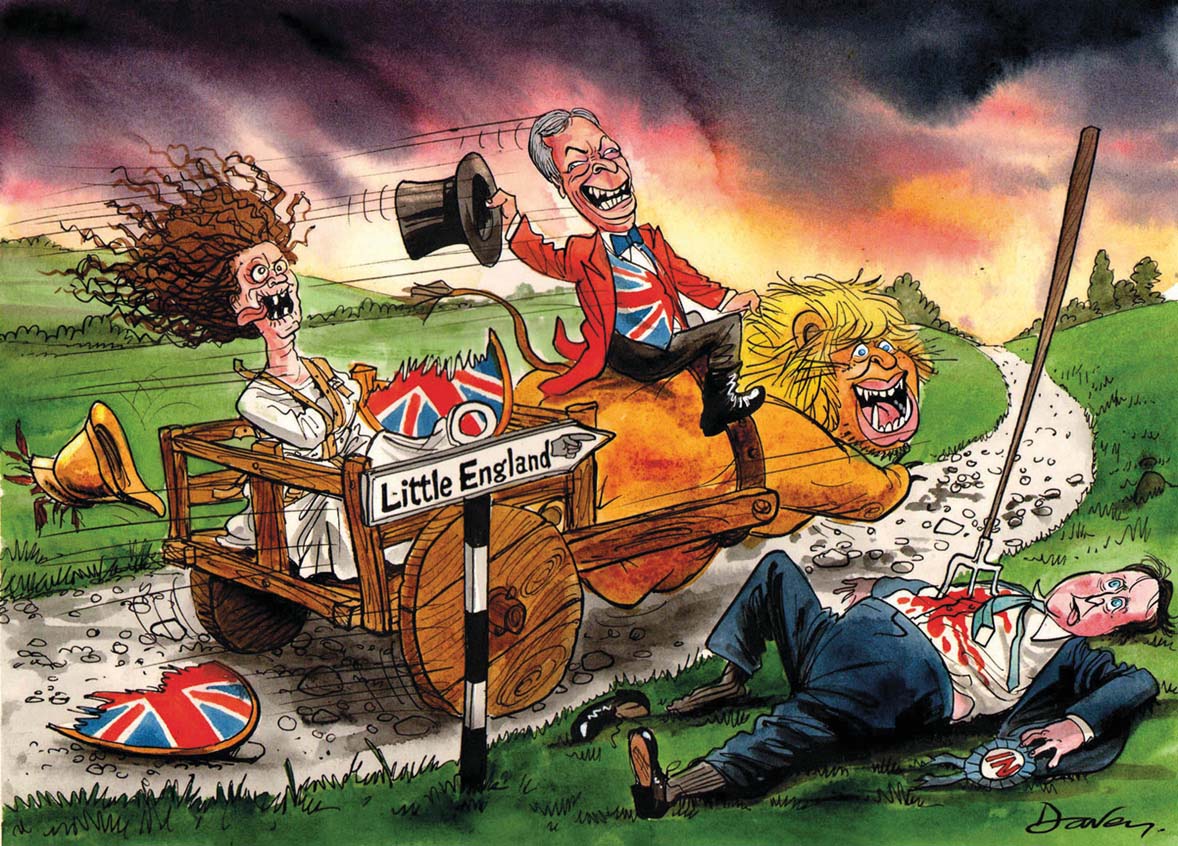
Brexit, from a geopolitical perspective, looks like part of a process of decadence and self-delusion to me. This is where the nostalgia brigade - the WW2 imagery, the Churchillian rhetoric, and the references to traitors and mutineers - seem, well, quite mad to me. As the song in Ghostbusters went: Who you gonna call? The empire? the Commonwealth? Yankee Doodle Dandy (the most likely, possibly only candidate)? Good luck with that Buccaneering Boris, D-Day Davies, and Roaring Rees-Mogg. Let's get those Captain Mannerings into shape!

What about you, Jez? If we are nice to everyone (except Israel of course) will everyone be nice to us? Not my experience, comrade.


What I am Losing by Leaving the EU 1


I thought I had better ask myself this question if only that I might articulate it to myself more clearly by articulating it to others.

In some respects, possibly in the mostly important respect, it is a symbolic loss. Symbols matter because they concentrate a set of related meanings into something concrete. And because that is what a poem does let me begin with a poem (originally a set of three).

*

I am citizen of an overdressed republic
that knows itself as more than an illusion
and will keep donning clothes and moving on.
Sometimes I think I too am overdressed.
I think I should strip naked, walk the street
with nothing on, and face the filthy weather


we emerge from. I think I is another
as we all are. I think it’s getting late
and dark. It’s hard to see. I smell the dust
that’s everywhere and settles. I know it mine.
I am in love. I am standing at the station
waiting to board. I’m not about to panic.

*

The notion of Europe is a matter of identity - a complex 'overdressed' identity. That identity is far from a model of virtues. Europe has both a dark and bright history and my family and the people to which that family belongs - Central European Jews, rootless cosmopolitans - has experienced plenty of the dark side and will probably never be at complete ease with it. But neither are we - my family, my people - models of virtue. We are no more virtuous or innocent than any mortal. But the history is that we have been obliged to move from place to place, from country to country, often by force, sometimes deadly force. So nationalisms - that naturally exclude - always worry us. British nationalism no less than Hungarian nationalism than the nationalism of any nation. No sooner have we decided to assimilate and resolve to be of the nation than the nation wants us out and, it turns out, has always regarded us with suspicion.

Nor is the dark side of Europe entirely restricted to those who are already part of it. Through empire building and colonialism it extends far further. But - and this is important - not AS Europe. Colonialism was never a common European project. It was competition between nations drawing on commonly available resources. European ideologies certainly played a part but nations did not act in concert, in the name of Europe.

Europe in general, however, has usually - not always - offered us - and here I return to my specific tribe - alternative homes. It is a terrain we recognise, to which we have contributed and with which, therefore, we feel an affinity. Without Jews no Christianity. Besides, we are, traditionally, people of the book, and the book represents culture. We are part of it: it is part of us. Products of hand and mind are shared. When we are loyal to the nations in which we live we understand that the nation is not, culturally, an island. It has many specific characteristics, no doubt, characteristics that also become part of us. These local streets are our streets too, our fields and our institutions in that they represent us. They are quite specific objects of love and concern. But we know that at any time they might decide to throw us out.

So, to some degree, our - I should now say 'my,' though I am not religious, not of a religious community, and very rarely consider myself as distinct entity separate from any that might read this page - attachment to Europe is a matter of insecurity.

I grew up with Europe as well as with England. I have grown through Bach, Mozart, Beethoven as well as with Vaughan Williams and Elgar and popular music and all the hybridities of literature, art, craft, any culture comprises. In football I support England and Norwich because that is where I live now. If I lived in Scotland I would possibly support Raith Rovers simply because I like the sound of the name, just as I also support Manchester United because of its historical associations. I am - like most people reading this - both local singular and universal multiple.

But I admit the insecurity. I feel am losing something valuable and vital to my personal existence in Europe. I am being torn from it.

The EU is not the same as Europe of course, I realise this, but the referendum was never about the technical issues of EU membership. It was about much more. It was also about love, or a certain love relationship, a being-in-love relationship with an idealised object as the poem implies at the end.

[to be continued]