Showing posts sorted by relevance for query titian. Sort by date Show all posts

Sunday, 1 July 2012

Titian: Metamorphosis


From 11 July onwards there is a terrific show of Titian at the National Gallery and, to go along with it, an anthology of poetry related to the show, Metamorphosis, with work by Patience Agbabi, Simon Armitage, Wendy Cope, Carol Ann Duffy, Lavinia Greenlaw, Tony Harrison, Seamus Heaney, Frances Leviston, Sinead Morrissey, Don Paterson, Christopher Reid, Jo Shapcott, myself, and Hugo Williams. The book is a sumptuous piece of production and carries an excellent introduction by the Director of the National Gallery, Nicholas Penny, referring particularly to Golding's translation of Ovid.

Each of us was commissioned to write a poem from the show. Many of us chose the above painting, as did I. I won't put the poem up here until the book is clear but perhaps I could talk a little about what the picture meant to me.

*

Titian is our greatest painter of the passions, both sexual and, later, religious. Paint is like flesh in his hands: the colour is voluptuous, the paint glows and is stirred, caressed, pinched, dabbed, blurred and  slapped into depiction. Michelangelo's passion and power - enormously ferocious divine power - is bounded in line, line being an extension of idea (there are no lines around objects, though objects have perceptible boundaries): in Titian there is no line and even boundary is close to collapse.

In this particular picture, one of seven late mythological works, referred to by Titian himself as poesie  (or poetry) painted for Philip II of Spain, we see the moment described in Ovid where Actaeon, a hunter, stumbles on Diana, the goddess of hunting, but also of the moon (she wears a moon-shaped brooch in her hair in the painting). She is a virgin and is bathing with her nymphs in a pool. Being offended by Actaeon she changes him into a stag and he is torn to pieces by his own hounds.

I have long been struck by the flimsiness of the red cloth Actaeon pushes aside. It is quite inadequate for the purpose. It is like a shower curtain of which there is little left. It seems to be hanging on something like a clothes-line that has wondered in from a suburban domestic scene, a Stanley Spencer back-garden for example. The point is that it is flimsy and inadequate: not a serious object.

But it is red, and red is a warning. Handsome young Actaeon has pushed it aside with his elbow and there are the women, some of whom would have been visible well before he moved that cloth. He starts back: they start back, but they are starting back only to recoil with fury. The water continues its gentle gurgling, the nymph with the towelling continues drying Diana's foot. Only a little dog barks back at the bigger hunting dog at Actaeon's heel.


It is an intrusion, an earnest of visual rape. It is the 'male gaze' rebuffed. And yet it is also a glimpse of a world on the edge of becoming a paradise of the senses, the first step in an erotic daydream.  I thought immediately of John Donne's cry in his 20th Elegy on seeing his naked beloved: O, my America, my Newfoundland. And what comes of that thought? Of the conquest of America, of colonialism, of the struggle over, and possession of, land.

But what is Actaeon to do? He comes upon the forbidden unwittingly. He is not like the Elders with Susanna. He has not gone there to spy, but is treated as if he had done so. He is dazzled and as his right hand tells us, guilty and tense. He knows he has crossed a boundary, one marked by that ridiculous flimsy red sheet or shirt.

Everything in that paradisal vignette must turn against him.  He who hunted has found the secret queen of hunting, the hunting principle itself, clad in brilliant, eroticised flesh.  These are the erotics of hunting. Never mind the warm delightful sky, never mind the garments, the trickle of water, the trees, the luxuriance. A glimpse is what we get.

In one respect it is an essentially male glimpse. Looking at the pictures we remember ourselves. It may be that we are not young hunters, that we have hunted and are now no longer hunting. We know our own flesh will be gradually torn from us: that time itself is an aspect of Diana. The memory of the glimpse remains. And that ridiculous red cloth remains, something so gestural you'd think it was an invitation rather than a taboo.

And yet it is not entirely a male experience. The goddess may not age but mortal women do. Here, within the precincts of the picture, the female principle is depicted as several women at once. Diana draws back, the moon rising like a pair of horns on her brow. That horned moon is an earnest of the horns the stag will wear. The mortal woman is also torn apart. That flimsy curtain is no barrier to decay. This moment will not come again for her either.

How can we hold these ideas together: our ideas of birth, youth, desire, punishment and decay? How far does the dog understand such things? How far are we animal? How do we deal with the pain of the encounter and then its loss, its fury, its punishment, its fading into memory? We cannot help being who we are and when we are. Suddenly there is a red sheet in front of us that hardly covers everything behind it. Just touch that red shimmer. How not to elbow it aside?

It's that red shirt, or red sheet, or red stage curtain, that terrible flimsy pretence we blame. And hovering about it, invested in it, the poem with its noise of flesh and paint.

*

I gave an interview to Corriere della Sera on this subject. To my astonishment the half an hour or so was actually about the poem. A big daily newspaper was interested enough in a poem to ring and talk for half an hour about it. I don't know when that will appear, or how much of it will appear, nor do I read Italian. It covered something of this ground but considerably more.


Wednesday, 11 July 2012

Blind Date: a poem for our anniversary


Blind Date


Since there are only so many years of life,
and since the proportion decreases as we go,
I would not have you, dear forty-two years wife,
be less beautiful now for what we know
will happen soon as part of the general plan,
an aspect of the short term ebb and flow
that constitutes our fevered quotidian.
How odd that flesh, the very thing we treat
as self, should be so fickle a companion,
no sooner arrived then rushing off to meet
its end, turning its back on the lost hour
that it can no longer account for or complete.
How sweet to have been drenched under its shower
of endless minutes. How good that we could hold
each other as hot water gushed full power
and soaked us through, and after, when a cold
hand moved inside our bones as a reminder
of our gift and brief, it wasn’t what was sold
as death but something infinitely kinder.
Here’s where we stand, our rendezvous with time,
our blind date, ever ready, ever blinder.


It is our 42nd wedding anniversary today. I always celebrate such occasions with a poem. This is a draft that may be redrafted, it has a part 2 that certainly needs redrafting. Today we go to London. At 2:30 I make a podcast with Jo Shapcott and Christopher Blake for Granta about the Titian poems, and this evening we will be at the National Gallery for the dinner to celebrate the opening of the  Metamorphosis: Titian 2012 show. Kind of them to fix it on our anniversary date!


Thursday, 12 July 2012

The rain that is not there


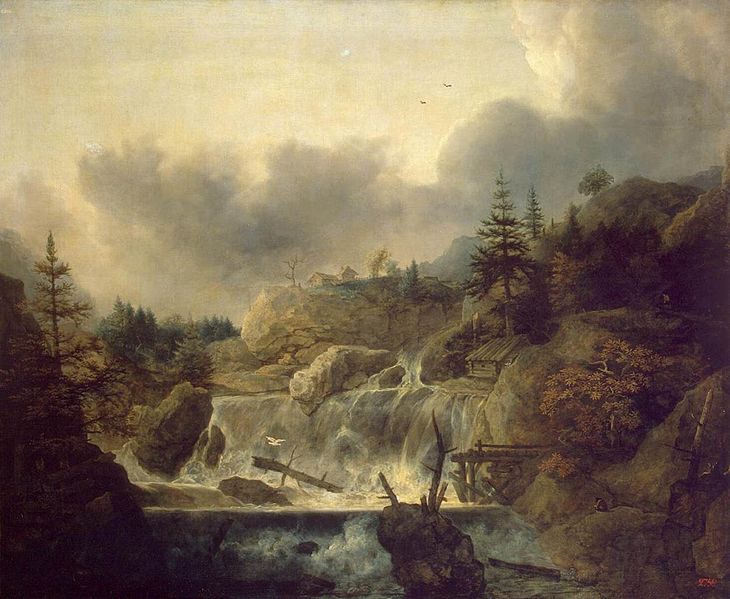
Scandinavian Landscape, Allaert van Everdingen 1621-1675


We have had so much rain in recent weeks I was just beginning to wonder about painters' depiction of rain and realised that there is very little in European art before the nineteenth century. There are tempests (see Giorgione / Titian) and there are dark thunderous clouds, but not the actual rain as it falls or hits earth or water. Maybe Turner's Rain, Steam and Speed is an early 19C example, maybe Corot has something.

Before then I'd look to 17C Dutch art, particularly Salomon or Jacob van Ruysdael, and Salomon does give us an After the Rain 1636 but not the rain itself. The painting above by Allaert van Everdingen might show rainclouds and actually be about rain but it does not show the rain.

So no rain as such. Why is that? The Japanese artist Utaware Hiroshige (1797-1858) managed it in a woodblock but he too is 19th C and he had a graphic tradition that allowed for lines. (Van Gogh copied the one below here)


The lines are a clue. Western artists became interested in landscape and, later, weather, just at the point that paint itself became ever more capable of depicting effect rather than object.

Objects, as far as depiction is concerned, are ideas that may be lineated. An early Renaissance tree is a trunk plus its branches plus its individual leaves. Object + object + object. By the time we move to Titian individual objects have become part of a field of vision that just about allows for linear forms like spears for instance, but not for lines themselves. Depiction is the registration of general presence, not the sum of known components. 

How do you show rain under such circumstances? Rain is the effect of rain not raindrop on top of raindrop. And the effects of rain are best seen if we don't obscure them with rain itself. So away with rain. Show massed clouds, show bending trees, show  umbrellas, show the effects of wind as though it were a gusty shower. In any case, is rain in itself a subject at all? No, not even in the great Flood. It is what rain has done  or is about to do that matters. 

Fire is different: it gives out light rather than obscures it. Fire can be painted. 

Rain is wonderful in films (oh to compile the top ten best rain scenes in movies, let's do it!!) and as a mood for songs. Such as this from several decades ago.


Wednesday, 2 January 2013

2012, a personal recapitulation


Almost a week since the last post. A few things to say, but maybe a very personal summing up of 2012 before it vanishes completely from sight. It has been a mad, sad, bad, but very active year. Please pass on this if you are as uninterested as you have every right to be.


*

On 6 January Lukas is born, our second grandchild, after a very long labour for Helen. A lot of university tutorials and some readings including at Bangor and Letchworth, then the Finzi Lecture at Reading in March,  followed immediately by the LSE debate on Hungary, which goes surprisingly well. That is almost immediately followed by the Norwich Showcase events at UEA. By that time I am making progress guest editing Poetry Review. My translation of Satantango appears in the US in March (May in the UK) - huge success. Roughly the same time my translation of Yudit Kiss's The Summer My Father Died appears here in the UK. 


*

More readings in April. Lukas has his operation. Some more readings, the tuition stint at Oxford Kellog. The performance in Norwich streets of Singing the City in mid-May. A week at Totleigh Barton to teach an Arvon Course with Marilyn Hacker. More readings. Recording BBC programme on Béla Tarr. Poetry Review wrapped up by end of May. Some teaching at the Royal College of Art. Launch of Poetry Review at the end of June at Poetry Parnassus, along with the Muldoon lecture. Working on Camarades collaboration with Carol Watts, performance at festival outside Brighton, the fields as muddy as required on such occasions. The Wymondham Words Festival is being planned throughout this period and into summer. Still in July the opening of the Titian Metamorphosis show at the National Gallery for which I was one of the poets invited to write a poem. Big event, big banquet at the NG, followed by pieces for Granta. 


*

Clarissa contracts psoriasis. Becomes Leopard Woman: her UV treatment begins in the first week of August (and goes on till the end of September, three times a week) scuppering any thoughts of time away. One of her close colleagues develops cancer while on holiday and dies of it all too soon. One or two readings. Early September the judging of the Stephen Spender Poetry Translation Prize. The Wymondham Words Festival begins on 15 September with Poetry Busking and goes on till 23 September, though I am in London at the National Gallery, tutoring a class on Titian with Frances Leviston. Two books appear at this time both published by Salt, In Their Own Words, an anthology of poets writing on their craft, co-edited with Helen Ivory (though she did more work) and In the Land of the Giants, my book of poetry for children, launched in Norwich on 27 September. Launched in Wymondham on 20 October. By this time university is up and running. More readings and travelling. Photographed by Derek Adams, give paper on Hungary to Peripatetics. At the end of the month to Newcastle University for my last stint as examiner on the MA. November: readings at Aldeburgh and Warwick.


*

All this time the condition of Clarissa's mother, Winnie, is deteriorating. Having been called to her deathbed in March, she survives, has another crisis in May, and is on her deathbed again in November before dying the following week on 17 November. The funeral service is put together by Clarissa. The toll this has taken on her in the last three years - she having taken on by far the lion's share of Winnie's legal affairs, financial affairs, healthcare matters, house sale, house clearing,  just as she had taken charge of Bill, her late father's legal affairs four years ago - is enormous. No time for art but a lot of marvellous photographs. Illness. Two grandchildren to help with on a regular basis. No wonder her resistance was low.


*

As for me, teaching classes and marking and supervising. I write the introduction to Catechism, the Pussy Riot anthology. Off to Newcastle University again to examine a PhD, Catch a bad lingering cold / flu (Clarissa catches it too). Attend and, as it turns out, take part in Krasznahorkai's event at the LRB Bookshop, chair the Milosz discussion at the British Academy the next night, then, the next morning, fly to Romania for the Bucharest Literature Festival. All this plus cold. Return. Upgrade a PhD student, dash off to London for the Poetry Society Lunch, then launch In the Land of the Giants at the Poetry Place. Dash off to Dublin to examine another PhD.  Five days later the sudden death of the exemplary and loved Dennis O'Driscoll. On a bright Boxing Day we go to Winterton beach with Amanda, Nick, Veronica and Michael, and visit the seals. Then some quiet. Here endeth 2012.

*

What have I done? Translated a good deal. Written a good deal. Handed in the new book of poems, Bad Machine, to be published here later this month by Bloodaxe and in the USA by Sheep Meadow. It is, by great good fortune and grace, Poetry Book Society Choice, so goes on to the Eliot Short List. The collaboration with Carol Watts - still not quite complete - has been exhilarating, as has the Twitter activity, well over a thousand small exhilarations in verse, or prose, in narrative or non-narrative form. The imagination feels healthy and active. 

One birth, three deaths. Maybe that is the way it has to be once we are over sixty. Now for Clarissa to get her strength back and find more time in the studio. Let's do a book together!


Monday, 25 April 2011

United: on the other hand / a postscript


Still from G W Pabst's Kameradschaft (1931)

An excellent point made by commenter, panther, in which she says:

I think perhaps the main problem with the drama is a problem it could not solve, a problem inherent in the story it was exploring : what happened with the Manchester United team WAS tragic, almost unbearably so. It wasn't a complicated story.

There is something so right with that that it goes much deeper than my sense of revulsion at the cliché of the dialogue. In the post below I talked about the writer's capacity - indeed obligation - to electrify cliché. I complained that the writer in this case hadn't done it.

But one can be wrong, not so much in the detail but in the context of the whole. It wasn't a complicated story, says panther, and that is precisely the point. The point is the degree to which life is simplified into myth. This is where poems are better than prose. I am thinking here of Keith Douglas who wrote in 1941:

Remember me when I am dead
and simplify me when I'm dead.

As the processes of earth
strip off the colour and the skin
take the brown hair and blue eye

and leave me simpler than at birth
when hairless I came howling in
as the moon came in the cold sky.

Of my skeleton perhaps
so stripped, a learned man will say
'He was of such a type and intelligence,' no more.

Thus when in a year collapse
particular memories, you may
deduce, from the long pain I bore

the opinions I held, who was my foe
and what I left, even my appearance
but incidents will be no guide.

Time's wrong-way telescope will show
a minute man ten years hence
and by distance simplified.

Through that lens see if I seem
substance or nothing: of the world
deserving mention or charitable oblivion

not by momentary spleen
or love into decision hurled
leisurely arrive at an opinion.

Remember me when I am dead
and simplify me when I'm dead.

Keith Douglas died in 1944 at the age of twenty-four. He'd have been just the age to be playing football and be on the Munich plane. The simplification he talks about is the eliding of small distinctions into the broader form of myth. When people are young they are naturally more aware of myth than of distinctions. Distinctions are what we learn through experience and general unpredictability. The idea of dying young and leaving a beautiful corpse is the very essence of myth. That is why we remember Keats more than we do Wordsworth. There are major exceptions to this: the older versus the younger Yeats, the older versus the younger Titian, the older versus the younger Shakespeare. But the mind yearns to simplify, because it requires broad shapes to judge itself by, and it may be that the great resurgence of energy in age is another myth that we sometimes forget, if only because it is rarer.

In this respect the United film's choice to present the broad, crude simplicity of tragedy in terms of an enacted set of clichés swelling beyond itself, was perfectly appropriate. The electrification of cliché can happen - and it might have happened, I'm still not sure - over the whole film. I steeled myself to watch over the iPlayer and did so. I steeled myself on two counts: first to ignore the incidental heaviness and flatness in favour of the whole (very hard for a poet) and secondly, more personally, to allow someone else's presentation of a myth that I too believe in to intrude into the space of my own imagination. That may have been the harder thing.

In that respect the play had set itself an impossible task, or rather an impossible task for someone who participates in the myth. The standard the participator sets is always going to be too high.

However, I think the writer missed a trick, or even several tricks. The most interesting character there was Harry Gregg, who entered the film like a battering ram and every so often gave the action a hard prod. The balance between Gregg and Charlton was potentially powerful. Charlton's hero worship of Duncan Edwards was another unexplored area. The idea of a young player being almost in love with a senior team mate is complex. Murphy too was very good (credit to Tennant), but again his relationship to Busby remained mysterious and peripheral.

In the end the problem was that it was never clear whose myth was being addressed. Most likely it was the myth of the team. It was perhaps an appeal to the spirit of comradeship and leadership, very much like a war story, or the story of the Blitz. The sporting and the military are very strongly connected. Was Manchester United being held up as the model of male society? Maybe something like that, with all those mysterious loyalties and love? Or was it more the simple tragic ideal of sudden early death? Not quite, not exactly.

And that was, probably, the unsatisfactory part of something that could not help but be unsatisfactory. Maybe the unsatisfactory is the myth, and we have to make the rest up ourselves.


Sunday, 13 December 2009

Writing for occasion


Titian, Flaying of Marsyas, c.1570s


The wind may blow where it listeth but there are times when it is actually drawn or desired to list here or there: these are what we might call the occasions of verse, and what such occasions may well occasion is occasional verse.

*

One view of poetry posits a world that is mysterious and possesses independent will, or indeed a number of separate, discrete wills. These are the individual, often contrary, wills of spirits that may be addressed, appeased, aroused or summoned. The wind is under their control and bloweth where they listeth. Robert Graves referred to those who were in thrall to them as Muse poets, and pointed to Keats's La Belle Dame sans Merci as the true figure of the Muse. Like the lady of the poem, the Muse was capricious: she rode the poets, possessed them, then left them. The best the poet could do was pray to the moon, to enter the appropriate trance under her influence, and prepare to be discarded. In this version of poetry it is not exactly an engagement with the irrational, but whatever reason there is in it lies beyond mortal wits. The Muse poets line up with Dionysos.

And you can see why they, and any poet, might do so. You cannot, they would rightly argue, reason your way to a poem. There is about the act something instinctive and capricious: now it works and now it doesn't for no known reason, and even when it does work you can't tell exactly what it does. And since the cult of Dionysos is an ecstatic, drunken cult, the best thing you can do is to go out of your head then stick your head into the wind and hope the wind listeth your way. You do, don't you, want a total disordering of all the senses, along with Rimbaud? The rest is nothing.

Flaws? Getting drunk or stoned or out of your head in any way you choose does not make you a poet. Nor does lying by the road hoping for La Belle Dame to come along. Excuse me, lady, you look very like La Belle Dame... but then so do you, madam... You do understand your serious calling to be a Muse, don't you? You do understand it is a privilege to feel my inspired hand on your inspiring etcetera? Won't wash. A bad poet isn't a better poet for being drunk or for imitating Nature grown wild.

*

In the opposite camp is the poet of parallelograms, Apollo's boy or girl (more often boy traditionally) to whom poetry is a kind of gradus ad parnassum, the steps of which include intellect, learning, the social graces, irony, the form, structure. To him, a poem is a rational task in a reasonable, albeit highly complex world. Poems embody ideas, preferably interesting ideas. Poems behave in orderly, almost courtly fashion. They follow rules, however complex, because beyond rules there is only chaos. It is up to him, the Apollonian poet, to preserve the essential order of things, to deride that which departs from such order, to create reasonable orchards and magnificent glass orangeries with the wholly reasonable figure of Apollo at the centre of the fountain, preferably shown in the process of flaying Marsyas. And if Apollo happens to look like Alexander Pope flaying Lord Hervey that just goes to show what intellect may aspire too. Pope lisped in numbers, he says, 'for the numbers came'. The shape comes from the numbers or meters.The energy required to fill the shape comes from somewhere else, a rage against chaos: which too is a kind of ferocity.

Graves, naturally, had no time for Pope, or for Dryden, or for Johnson, or for Auden. But then he had no time for Eliot or Dylan Thomas either. Graves was following other orders. The Apollonian poet sits in his Palace of Art and constructs parallelograms and crystals against danger. The Gravesian ducks through the intoxicating forest seeking Diana and her nymphs, seeking danger.

Both models have certain attractive, not to mention entertaining, features. Without contraries is no progression, wrote Blake, and wanted them to remain contraries. They should not, he believed, be reconciled.

*

We do have doubts about occasional poems. They seem foredoomed to be duds. Who would wish to be the laureate of birthday cakes, or worse still, of royal encomia? Only a sell-out. The best you can do in the situation, so goes the argument, is manners, and manners are a form of toadying.

But there are and always have been good, sometimes great poems, written for specific occasions, or out of specific occasions. I call Ben Jonson, Andrew Marvell, Byron on his own thirty-sixth birthday, Dylan Thomas on his thirtieth or on the funeral of Ann Jones. Rites, celebrations and ceremonies are part of the job. There are, of course, private occasions and public occasions for poetry. The private are expected to be sentimental: the public to be sententious.

The problem is expectation. The occasion can determine too much: that the poem should be constrained to say worthy things; that it should mind its manners; that it should avoid offence; that it should say in verse what might be better said in prose, or take the place of a vow or a gift. Yet even if writing such a poem were a problematic act, it might still be possible to argue for the poem as an example of humane art, as a fitting structure for what is properly felt to be important.

*

There is something in poetry of the offering in any case: as speech offered to commemorate a birth, a wedding or a funeral. The poem might be song, the part song-part speech of the event, an event that naturally invites reflection. It might look to be the fitting structure. Poetry is, after all, a shape in language, whether raw or cooked, whether drunk or sober. Poetry without shape is not poetry.

But energy and opposition are also required.

There is bound to be an element of both the Dionysiac and the Apollonian in art. The two elements cannot be reconciled but they cannot be entirely without each other. Those who on honeydew have fed and drunk the milk of paradise, are quite capable of composing poems about poetic meter for their children, as Coleridge did.

I have loved writing poems for occasions: they were excuses to write. Sometimes they had a spinning headiness that was set to spin right off but just held in. Those I think were the best poems, language setting off, getting lost, landing eventually in the world of the living. Others were simply as well made as I could make them, looking for a door to get lost through, but staying where they were. Sometimes the pattern in them compensated. If I hadn't started the best ones they wouldn't have existed.

In the end, poems make their own occasions, their own necessary ferocity. But they need occasions. It is their ferocity that saves them. Apollo flaying Marsyas.


Wednesday, 29 February 2012

Everywhere but here, twittering on.


Source

Constantly travelling and speaking at the moment, mostly to purpose, so life is a set of fragments joined by railway lines and mileage. It's Twitter territory rather than blogging but with all kinds of openings to other thoughts. Here's a flavour of twittering with, at the end, a thought on the whole notion of FB and Twitter, these strange, faintly cosy, faintly inimical forms. Tweets plus brief notes in italics.

Tiny studio in Shepherds Bush with Choman Hardi, talking children, grandchildren, mortality, the extreme limits of life, enemies of promise. *This for the radio programme Something Understood due for broadcast 25 March. Choman Hardi is hosting this particular programme.

Then after, of Kurdistan, beatings, torture, corruption, feminism in the Middle East, postwar stress. She shows photos of daughter. *These are Choman's brothers, who having supported and publicly argued for the changes in Iraqi Kurdistan now find themselves assaulted by the very people they supported. Why? Because they criticise them. Choman herself takes an active role in feminist politics there.

To NG to record Titian poem for audio then visual. Diana & Actaeon. Talk of Donne, desire, punishment, a red shirt, a tiny silver moon.

From O my America to toothed fury. From shock to delight to apprehension & terror in barely a moment. Of not knowing, of language as unknown.

Of the music of sentence counterpointed with line. Of rhyme as a condition of discovery. Of seeing anew through language. Of noticing anew.*
These last three about the recording of a commissioned poem - some dozen or more other commissioned. I'm second to record, Don Paterson having been the first. The video part is the poem again and a fascinating set of questions with about twenty minutes worth of replies which will finish up being cut to six or so. But the thoughts are worth following up.

Then to NPG just as cafe is closing to meet GG. We hurry off to nearby by & talk Hungarian politics. How things happen. Who makes it happen.

Of the flooding of all official posts with government supporters. Of alliances & friendships, of compromises and slipping rightwards.*
These last two, among other things, apropos the debate next week at the LSE about Hungary. I am with Victor Sebestyén, author of excellent book on 1956. Opposite is George Schopflin, Euro MP and another. Having no experience of this kind of debate this is a terrifying prospect but needs to be toughed out.

Then to Maiden Lane. First a drink with Agi Lehoczky & friends, a very quick late bite. Over the road to introduce Agi's launch. She reads,

Her prose poems like vertical catacombs, a constant dissolving, a mesmeric drive towards a sense of tipping over into great spaces.*
Agnes Lehoczky's Rememberer at the Balassi Institute, Hungarian Cultural Centre.

By now C has arrived. Mother out of danger, back to nursing home, very thin, barely conscious. The tough constitution clinging on even so. *Having been seriously at death's door, Clarissa's mother is now well enough to be returned to the nursing home. One moment of panic gone, more undoubtedly to follow. Poor C, up and down from Hertfordshire. She arrives just in time for the launch.

Oh and talk at launch of poetry with KK of the cerebral, the personal, of whatever Modernism is now. Talk like a long unrolling carpet.*This too is fascinating - about poetry as a group interest or group commitment, about academe as a ground for such groups, about its influence on what is or might be being written.

Talk, almost like dancing in a vortex. Another full week of it to come. Plus reading to do. Social life in fragments. Sleep and wake. Awake.

At last the tube, the train, the car from Stevenage, C driving, giving a lift back to Hayley. Talk of children, food, cooking, normality.

And now I am editing Poetry Review for just one interim issue. Place-holding. Evening Standard rings for gossip. No gossip. A one-off job.*
The last but main thing. Rung up and asked if I'd be willing to finish editing an issue barely started and behind time. Heavy heavy gulp before taking it on. More work pressure is the last thing I need. Thought about it over one night. Thoughts about what best to do, what there is given to do. But won't start thinking till after the FInzi Lecture and the LSE debate.
Incidentally I am in another LSE debate on Saturday, about something else. More literary - translation and cross-cultures.

No time now for reflections on FB and Twitter. Only to say that at one time I thought both of them potential wastes of time. Potentially pernicious. But have forsworn to use either to flog my wares or self. Or what might be self, or what is floggable of self that I wouldn't flog if I knew what it was, since self does after all produce the words here, there, and indeed everywhere. And to bear in mind Eliot's great half-truth that poetry is an escape from personality not an expression of it. As is obvious, more to think on in all these respects.

One last lovely ludicrous note. While in the editor's room of the first studio my mobile rings. I say, Hello. A recognisable voice at the other end says. 'Er I don't suppose you are a plumber'. 'No, I answer, but my father was.' Perfectly true. Once. It's dear old friend from Liverpool who has pressed the wrong button. Needs his washing machine and gut fixing, he says. One at a time, I say.


Sunday, 23 September 2012

Wymondham Words Festival / National Gallery


Moniza Alvi at the Poetry Busking in the Market Square, 15 September

I haven't been blogging as it has been the Wymondham Words Festival all week, with today (written on Saturday) and tomorrow to go, though I shall be missing most of today as I am in London to do a follow-up workshop on Titian at the National Gallery.

As it turns out there are eighteen female students and only one male. In fact there are only two men in the room, the other being me. My fellow tutor, Frances Leviston, the excellent support from the National Gallery and the Arvon Foundation, are all female. The experience of the group is mixed. Some are writers, some are artists, some have not written poetry at all, some have written books.

But here's an odd thing.

At one point I make a suggestion that the over-intellectualisation or schematisation of a poetic idea may not be productive. It's a general point. I believe it to be the case, but one of the older woman scoffs: That's a man talking.

I am not quite sure what act of misogyny I have committed. If I had said something like, That's a woman talking I'd be eaten alive, like Actaeon. My actual response was: It's a poet talking, and over-intellectualisation is what men are usually accused of.

A little too civilised perhaps. A little too cowed perhaps. The perfect answer would have been: In that case you need take no notice. 

In any case I now understand why there is only one male student.

*

Then a dash back to Norfolk to arrive just in time for the evening event, the poetry cabaret with Luke Wright, John Osborne, Nathan Penlington and Yanny Mac with music from Librarian Girls. This is a night for the young poets whose core activity is performance - and they are some of the best in the country.

I don't do performance exactly but admire some of those who do and am looking forward to this. And I am right to do so


Very good attendance and a very good show, nice music with lovely voice, ending with Nathan Penlington doing magic and Luke Wright performing some of his work.

Wright is a brilliant performer, at a very professional level beyond the informality of most poetry readings. The poems are virtuosic, funny and inventive, and his timing and balance are spot on. There is definitely a touch of Elvis or Billy Fury on Luke's physical performance, but it remains him entirely: it's his inner Elvis.  I loved it. He could have gone for a long time and I'd still have loved it. The material is excellent and finely honed.

I'll do a complete review of the whole festival as soon as I can, while it's still all fresh in the memory.


*

It has been a whirlpool of activity and continues to be. Trying to keep up with work is a mad business.

My new children's book, In the Land of the Giants is out now. It looks like this:


It's a lovely small thing with some 80pp. A section of the book consists of picture by daughter Helen, done when she was 9, with the poems I wrote for them. The poems are of all periods. We'll be launching the book next week locally and then again, even more locally. After that we'll do a presentation at The Poetry Cafe on 15 December, with music by the splendid guitarist Andy Kirkham.

Stray thoughts. All will be gathered together in due course.