Tuesday, 14 January 2014

From Eliot to Daumier and back 3


I had slept badly the previous night so, after Daumier, I felt quite exhausted. We had lunch at the RA, small but beautifully-cooked helpings, and Helen came to join us. From there we walked over to the National Gallery where I collapsed in the cafe while Helen and Clarissa went to visit the Italian Early Renaissance. I didn't exactly go to sleep but dozed until woken by a man who asked if I was George Szirtes. He had been at the reading last night and he sat down and we started talking. His name was Chris Beckett, a poet himself. It turned out we had mutual friends in Moniza Alvi, Helen Ivory and Martin Figura. We had a good chat and that woke me up. Then Helen and Clarissa returned and, after some cakes and drinks, we caught the bus to Bond Street and walked up towards the Wallace Collection for the prize giving.

There is a pub just before Manchester Square where we have occasionally stopped in the past and we did so again. Soon enough there were others we knew or recognised, some joined us some had friends of their own. I had to go over early at 6pm with the other poets. We had just missed a downpour, complete with thunder and hailstones,. The pavement was wet but it had stopped raining.

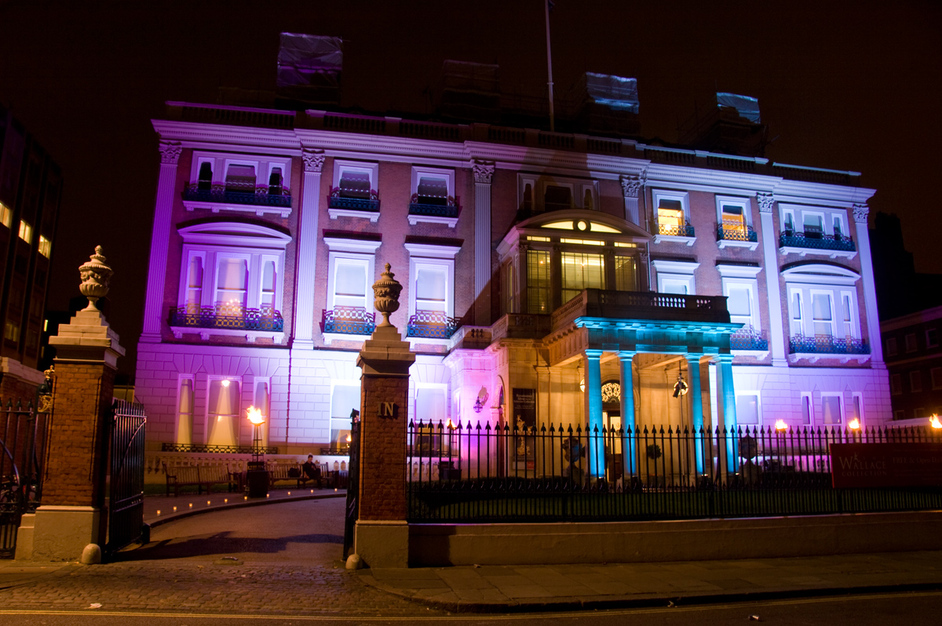
There is a moment of uncertainty when you reach the gates because they are still locked at that time and it depends on the presence of the doorman whether you have to hang about outside or not. This was fine. He came quickly and let me in. Other poets were already there, some smartly dressed for the occasion, I in the same clothes as I had worn the night before.

Our photographs are taken as we pass through into the covered hall which is empty at first but soon fills up with poets and friends of poets.

Some people say that poets are waspish company. I haven't ever found that to be so - perhaps people are less waspish with me, but I doubt it. We drift through the crowded hall and recognise each other, stop for brief conversations and are swept on by others to more brief conversations. Inevitably, by the end, there is a good number of people we should have said hello to but now there is only time to say goodbye.

And who are these people? Who are we?

I am going to generalise now.

Few of us live by poetry alone. Being poets means we are temperamentally thin-skinned and alert to all kinds of nuance but are rarely aloof, haughty or cold if only because our economic condition is unlikely to impress anyone, and, because, outside the world of poetry itself, we enjoy no particular status.  Our neuroses, our obsessions, our slight touches of madness, are socialised and under control. Most of us are not noticeably vain or of such delicate sensibility as to be floored by a stray remark. Mostly we are other people. Mostly we are anyone. There are poets hiding inside many people besides us. We do not own the realm of the poetic. Who knows where the next poet is hiding?

Are we jealous of each other's status? Not as much as people might think. Most of us understand the brittle nature of the world that awards us whatever small status we might enjoy. I know no self-satisfied poets if only because no poet can afford self-satisfaction. The poetry would dry up. There is instead a kind of anxiety and thrumming energy as well as pleasure in production which is rather life-enhancing. The room is, in efffect full of various flickering lights of various colours and intensities.

I wrote earlier of how I enter these situations with zero-hope. That may be because I still can't quite believe I am one of these 'poet' creatures. Surely I am a foreigner who hasn't even been to university. I have a constant background apprehension that, one day, I will be unmasked as an impostor who has bummed his way in. So you go on like that till your life is over.


From Eliot to Daumier and back 2


The current Daumier exhibition is the only one I can remember where I have both laughed out loud and been moved to tears (yes, really). If Daumier (1808-1879) hadn't been a cartoonist as well as a painter, I suspect we would recognise him as the great artist he really is. And yet it is precisely the fact that he was both a political cartoonist and a painter of street life that defines his greatness. He bridges the gap between humour and tragedy.

There have been other artists who were, occasionally, caricaturists. Annibale Carracci and Bernini were predecessors as was William Hogarth, and Hogarth's suites of engravings are certainly social satire, but Daumier was a journalist cartoonist who worked as a commentator in the daily press (and was imprisoned for it.) His cartoons function in a different sphere from the paintings - the cartoons are by definition yesterday's news, evanescent, their occasions forgotten or, if remembered, as themes in specialised books or as footnotes in more general ones - but partake of the same vision.

Cartoon art retains, at best, some independence - for example the work of, say, Gillray and Rowlandson in the 18th C - but it arises out of contingency and is remembered as part of a totalising vision. Late twentieth century cartoons of the savage school, from  Scarfe and Brookes and Rowson through to Steve Bell, show brilliant draughtsmanship and are, no doubt, art works in their own right, but are oddly one dimensional, mostly in one gear. Everything gets splattered from some nominally ne plus ultra point of moral outrage: everyone's a monster or a victim. Brilliant as the cartoons are, they are in essence a kind of demagoguery.

Daumier is different. Few of his figures in the cartoons are wholly monstrous. Monstrosity is not his stock-in-trade. Those figures that do approximate to the monstrous move through symbolic events as actors and offices, but are depicted not very differently from the good, and neither is more than a shade away from the real as seen in the paintings. The humour in the best of them is removed both from the specific event and from the totalising vision of the Scarfe / Bell world. They are funny because the perfectly pinpointed human situation continues to be funny and free of a mannered generality.

I must be careful not to make this a long essay. I don't have the scholarship for that, so let me pass on to that which moves me.

It is, I think, the grasp of the whole human situation, which, in Daumier, is funny, brutal, noble, ridiculous, heartbreaking and heroic, often all at the same time. He is a wonderfully vigorous draughtsman whose vigour is as evident in the cartoons as in the paintings. His figures are often shown at full stretch, in looping but tense diagonals, or else shrunk into the darkness of themselves, their body weight convincingly planted on the ground, pressing in or out of it. They seem, at times, to have sprung out of earth, like plants possessed and driven by sheer living energy. The washerwomen, the Quixote figures, the crowds that foreshadow those of Edward Münch and Van Gogh, but are somehow less frenetic, less hallucinatory, are energies rendered out of the ordinary.

Nor is the vigour of the draughtsmanship an affected form of display. It comes from within.  Daumier's handling of paint, especially in those apparently half-finished studies and variations, establishes mood, volume, movement and empathy. His palette is like Rembrandt's, his brushwork a cross between Hals and Goya. His understanding of the body is very much like Goya's in fact, with an implied low centre of gravity. It is not that his furiously established solid figures resemble human beings: it is that we, as human beings, are part of the same fury and trudge of living. The drama is broad and elemental - you can pull back from the paintings and see, all the more clearly, the structural energy at play - yet the figures are still singular and fully characterised.

Technically he is one of the greats. Beyond that, yet integrally a part of that technical greatness, his vision is comprehensive - I have already mentioned how he bridges the gap between the comic and the tragic. He is a moral and political artist one can trust. The art of the Soviet era copied some of the formal aspects of Daumier - I think of those diagonal masses pressing towards some ideal goal - but they had no humour. They were, for the most part, technically competent dull propagandists.

Not so with Daumier. In Daumier the technique and vision are one. The morality is as much in the paint as it is in the head or heart. The yearning for justice is as much in the vigour of line as in what the line depicts. In Daumier the art and the man are of the same fabric.

If socialism is to have a great representative artist I would go for Daumier above anyone else. Daumier's justice springs neither out of loathing nor out of sentimentality: it arises out of an understanding of what we are, which is neither splatter-gun monsters (though of course we are that too on occasion) nor puny puppet-like victims (and we can be that too). In Daumier's world we are human energies, neither beautiful nor ugly but crowded, striving, various.

Hence the laughter and the tears.


From Eliot to Daumier and back 1


Sinead Morrissey, Winner of 1012 T S Eliot Prize


Ladies and gentlemen, I did not win. It was Sinead Morrissey what won it at fourth time of listing. She is a superbly gifted poet and it's a good thing. Any of the books would have been a good thing and to those who did not win on this occasion I sincerely wish all fortune on their next. I loved some particularly but that is beside the point. I was not a judge, though I was in 2003 (indeed chair) and the judges must have had a very hard time. Ian Duhig, as chair, made the speech and it was, as you'd expect from him, perceptive, humane, generous, and to the point. He should certainly win it some time himself. I hope he does.

The readings at the Royal Festival Hall were the best I've yet heard. The audience numbering over 2,000, the place was full, warm, responsive: a glorious place and occasion on which to read. Part of the pleasure was the variety because none of the poets was particularly like another on the list.  Ian McMillan was an ideal host because of his wit, intelligence, energy and sheer hard work in genuinely reading everything. Dannie Abse stole the show, with thunderous applause and affection pouring towards him from every part of the great auditorium. For me, personally, it was marvellous to have Clarissa, Tom and Helen there and, after the signing, I could join them and we made our way back together to Tom's house in Stratford by tube.

The full audio of all the readings is available here, my own in particular is here - and should you want the blessed actual vision of me reading for some 25 minutes at Poets and Players in Manchester on 9 January, that, I now discover (they don't tell you these things) is here.

The Poetry Book Society does a marvellous job of the Eliot Prize, the whole thing from finding judges and taking the event through to the remarkable success that it is. I am proud to be associated with it with Dave and David and James, and expecially Chris Holifield, the director who works her heart out.

*

Sunday was beautiful and sunny and we decided to go to the Royal Academy to see the Honoré Daumier exhibition. I didn't quite know - hadn't really thought - why I was so looking forward to this. Years and years of galleries had taken some of the edge off my pleasure in paintings, certainly in big blockbuster exhibitions.

It is like a pot full of your favourite jam. I thought I had extracted all the jam to be had under the circumstances, especially from the blockbusters, feeling that all big exhibitions were like coach tours or dashes through great cities, a desperate effort to cram in all the sights - in other words, largely pointless. There would, I thought, be instead the odd dart into this or that permanent exhibition, the National Gallery for instance, or any of the Tates, to sit or stand and stare at two or three particular paintings, when all the pleasure would come seeping back, but no vast crowds, no major playschool narratives of the Great Masters or the Great Civilisations.

A few weeks ago I dropped into the National Gallery just to look at three Goyas, because I knew that Goya would never fail me and would always go straight into the bloodstream. Goya is in any case my intravenous drug of choice. What that man doesn't understand about human character, the human predicament, and the too too solid flesh of humanity is not worth knowing. It is not the horror I love,  not the Black Paintings at the end, but those shimmers and premonitions of the early and middle work, the raw vulnerability yet overwhelming presence of his portraits and the foreshadowings of darkness of the genre paintings that seem to me what life  - historical life - actually is. And it is there as material - as paint, line, gesture - the fresh horror and beauty of which is just as much the message as the images themselves, the two being inseparable, one the twin life of the other.

But it is Daumier I want to think about, so will write a new post starting with him, and maybe end with a little more about the Eliot prize giving, about the society of poets, not The Society, just the society. People. So, onto part 2.


Sunday, 12 January 2014

To the Eliot Prize


Later this morning we'll start for London. As a performer I am to be at the Royal Festival Hall at 5:15 which means getting a 2pm train from Norwich. The readings start at 7.

This will be my third shortlist reading. I go, as I did the last two times, with zero expectation of winning, in fact I was so surprised to have won nine years ago that I was utterly lost for words. Zero expectation is quite nice. It means I am not holding even a soupçon of hope in reserve and that I will be genuinely pleased if any of those poets whose books I have properly read and admired wins it.

Do I feel nervous? Under the circumstances, definitely not, but I don't feel nervous about readings anyway. The poems are what they are - the way I read them is not going to change that. Ultimately poems live in the reader or listener's head not in the performer's mouth. People will either like them or not. Ingratiating oneself is loathsome. Playing up to an audience is loathsome. Treat the audience as you would any one single previously unmet human being. Be courteous, friendly, intelligent and no more expansive than you need to be. If that means being brief, then be brief. The RFH is no different.

Big audiences don't faze me: small ones are slightly more likely to do so, especially those with current students. It is, I think, more difficult to be 'a poet' when the relationship with the people in front of you has been as 'a teacher'. This suggests that both roles are performances, and indeed they are, and different, but that is saying no more than that one behaves differently in different circumstances. The advice to 'just be yourself' implies that there is a single all-purpose 'you'. The self is more various and being true to it is more a matter of being aware of its history than of some ever fixed mark. Your wardrobe is an extension of you. You wear it to occasion.

Prizes are great blessings if you receive one but to claim them as matters of deserving is putting it too strongly. All the judging panels I have been on have veered between choices during discussion and the winner that emerged was the product of a particular feeling at a particular moment. Speaking for myself I never thought I 'deserved' the Eliot for Reel. What I felt, intensely and clearly was: 'Heavens! They've chosen me!' I felt gobstoppingly lucky.

Prizes are both blessings and bollocks. To be considered at all is a thrill, not because it makes you great, but because those who had the power to choose at the time, chose you. Somebody thinks you're worth it. Lucky for you it's that somebody and not another. You don't write poetry to win prizes but to write the best poems you possibly can. Let what will come of that.

The abbey bells are ringing. Radio 3 is playing Schumann's Carnival. The sky is quite bright and there is hardly any wind.


Friday, 10 January 2014

To The Verb and back


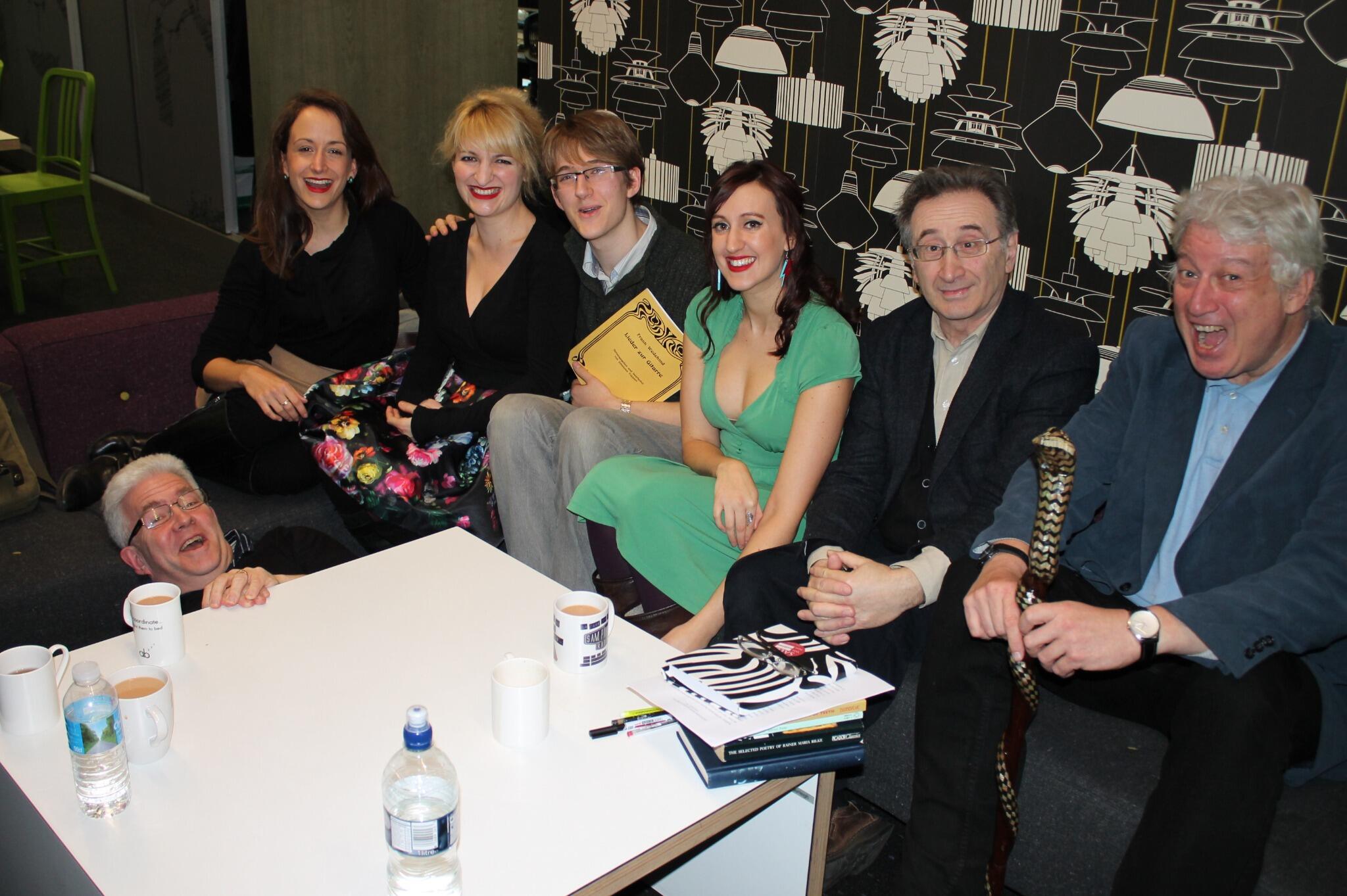
Ian under the table, Ruby Dolls, myself, and Kevin pre-recording.


It's a longish journey of some five hours to Manchester Oxford Road and slightly longer back, so altogether almost eleven hours travelling in the day. My nights have been a little rough over the last week so, having been down to London the day before, I was tired to start with, but a train is good for reading, looking, thinking and scribbling as I wrote last time, so it is not so much tiredness as a semi-soporific state one attains from which arrival and the concomitant weather conditions pluck you. From Wymondham where we live it is a train ride to Thetford, then a change to the two-carriage rough-and-ready Liverpool train that trundles all the way to Nottingham without refreshments proceeding then to Sheffield and Manchester, so it's best to take a thermos and something to nibble.

Manchester Oxford Road was damp rather than wet and the taxi sent by the BBC arrived within five minutes or so. The friendly driver gave me a fragmentary tour of the city, pointing out Old Trafford once we were in Salford. He himself had been a season ticket holder some years but had given up a few seasons ago because of the distance to his home. He had seen Best and Charlton, just as I had. Unfortunately he didn't quite know where to drop me, so instead of Dock House in the dauntingly named Mediacity he stopped at Dock Adminstration. Wrong Dock. Then he thought he should drop me at Holiday Inn, because that was where he was originally told, and we finished up at Costa Cafe from where it was a short walk.

Mediacity in the rain looked rather bleak to me, as though it had torn itself away from the Industrial Revolution to enter a postmodernity that wasn't quite going to work with the full chutzpah a name like that implies. Dock House itself is spectacular enough and the entrance hall has three or four gizmo-like booths displaying the latest technology though two of them were switched off. Almost everyone passing through the security doors looked very young so it felt like being in a sixth-form college.

Once upstairs it was decidedly more fun. Everyone was already there: Kevin Jackson and The Ruby Dolls (only three of the usual four), with their instrumentalist, Ben and of course Ian McMillan who does a wonderful job of the programme every week. Lucy Hughes Hallett was not in the studio but in London to talk about her prize-winning biography of D'Annunzio, The Pike. The Dolls were appropriately vivacious and bubbly, Kevin, whom I had met before (we had done a programme about Humphrey Jennings and possibly something of mine a few years ago), was delightful and encyclopaedic, carrying a whole library of books with him. The photograph above shows Ian under the table. We didn't put him there. It's just the way things happen.

In the studio we took our turns starting with The Ruby Dolls, then Kevin's imagined funny and moving scenario of a meeting between Proust, Rilke, Akhmatova, and D'Annunzio, then Lucy on The Pike, then me on Rilke and Békássy with a little Langoustine thrown in. The Dolls sang two songs from Frank Wedekind. You can see a clip here. They were marvellous, sharp and buzzy.

Afterwards there were cakes and tea, Ian remembered I had been on the pilot show for The Verb,  years ago, talking about George Barker on a programme that, being a pilot, was never broadcast. (Last time I was on it I had written a special short film-script in iambic pentameters about 'the numbers game' - the things one does!)

Then taxis. Or it should have been but they didn't turn up so we hung about outside The Holiday Inn. Eventually, after about half an hour,  one arrived and, because I had a specific reservation, was urged on heading for one station and one line, while the others all required the more frequent London train.

The ride back was long and slow, the train ever later with every stop, so by the time it got to Peterborough it was over 20 minutes late and I thought I'd be sure to miss my connection, but we made it with two minutes (rather than over twenty minutes) to spare. One the very last leg, at the very last station before Wymondham, two tall, glamourously dressed working girls got on, both drunk, one more than the other. The very drunk one was swearing profusely and was clearly in a mood to engage everyone's attention. We exchanged a few pleasantries, then she reeled off towards the toilet. Her friend, a very pretty blonde girl,  turned to me and apologised for her friend. 'She hasn't been out of Attleborough for ages.' I sympathised and wished them well.

Clarissa was waiting for me at the station. Just as well. I had very little energy left. I had started sniffling and sneezing.

On Sunday the Eliot Prize readings.


Wednesday, 8 January 2014

Travelling on trains:
amusements, intrigues and threats


Tired after a poor night - up two hours or more - then the trip down to London and back for meetings. Train journeys are generally somewhat dreamlike, between alertness and fantasy, and I am now in the habit of writing brief notes for much of the way. These may be simply descriptions - I must have seen Ely Cathedral a hundred times and seen it differently each time - or thoughts, or snippets from what I am reading (today it was Jenny Diski's marvellous What I Don't Know About Animals) or a set of absurd fantasies such as:


UNE DEUXIEME SEMAINE DE BONTÉ: Third Tale 

1. He wished he had an interesting face. He turned his head upside down. Promising. 
2. Two dogs on the pavement in the rain. Where's your umbrella, asks one. Up yours, the other retorts. 
3. The sun was lower than expected, the fields brighter. Life was an altogether different planet.
4. The sense of well-being is a phantasmal condition, wrote the desert father. Come in and finish your damn tea, the desert mother shouted.
5. His nose was growing like Pinocchio's yet he had told the truth all his life. Someone else must have been lying.
6. A horde of lemmings at the cliff edge. Don't worry it's all a cartoon, says one. Go for it, boys! You can walk on air!
7. The secret of long life is dread, he whispered. You can never have too much in our climate.
8. Are those frozen wastes, the stranger asked the goatherd. How should I know, the goatherd replied. Ask the goats.
9. Lugubrious and Censorious were standing at the bus stop when the Tartar hordes arrived, two at once again.
10. A solemn row of lampposts were contemplating the pavement. Life is hell, one remarked. Lighten up, another replied. It's not all lollipops.


I have hundreds of them now. I don't know whether these are particularly good but this is as they came out today. I write in sets of ten, usually very fast. Why do it? I aim to amuse, intrigue and threaten myself.  I cannot quite tell what they add up to but it doesn't really matter now. My reputation is such as it is and ventures into tangential territory won't make any difference to that.  I publish the series on Twitter and Facebook and a lot of people seem to read and like them. More than buy my books in fact. Some will become booklets.  I suppose they are vignettes of a sort, tiny windows onto other worlds that have haunted my earlier poems but were rarely given space to themelves. 

In any case, who knows how long life is to be? Why stand around pretending to be yourself when you could pretend to be someone just as interesting, maybe stranger and more surprising.

I have no great trust in British trains and have often missed connections. The service is not exactly what would once have been called 'third world' but it isn't leading technology either  - nothing like China or Japan - and there are frequent problems with signals. The railway staff remain resiliently good natured as if the whole service were a chummy version of the Blitz. The result is that most travelling is done in the head. 

Meanwhile the train rushes on and I look out of the window or read or do a crossword. I buy a hot drink at Cambridge where I change trains.

- Now then, Mr Norris, where are you going?
- Home, dear fellow. 
- Comfy train? 
- Functioning.
- The world's your oyster then.
- All pearls.

ps In the Tenniel illustration above my avatar is the man with the paper hat on the left.


Monday, 6 January 2014

Lukas's Birthday


He is two. The world is beginning to look familiar and challenging. He wants to run. He wants to be swung. He wants to decide what he will eat and he will not. His latest love is Thomas the Tank Engine so his mother has made him a birthday cake in the shape of an engine bearing two candles. He blows them out and the engine gets sliced up.

Cake is one of his favourite words at the moment, but also car and cat. He doesn't yet realise that all these words begin with the same sound. That is not part of his concern. He will run to his grandfather, whom he calls Papa, or to his grandmother, whom he also calls Papa although he knows that she is really Nudgie, the phonetic version of the Hungarian nagyi, meaning granny. He will point out Nudgie but won't say her name. Papa must feel more appropriate for him.

Cars are good news. You can never have too many. They are, after all, not just in the house in a big box, but out in the street too, so this act of accumulation through the good will of others is a way of keeping a tab on the real world, especially those parts of it that move. Cars are good things.

So are cats. There is a ginger cat called Cosmo at home (another k sound) and here there are two more, though he only ever sees the stumpy one called Pearl. Naturally he chases her and want to stroke her. Pearl's ears flatten which is not a good sign but she remains patient for a while before finally scuttling off, miffed, through the cat flap.

It's exciting having a birthday but he is not quite sure what it is. He is coaxed to help unwrap presents and suspects the things inside are now his. Who knows what he thinks is his? He can claim anything he wants to but knows there are limits to claiming. His sister, who is only a year and a half older is, naturally, interested in his presents and has immediately absorbed them into her own realm of activity. She has a better understanding of the meum-tuum world but he's only little and his attention strays, so if the gift is genuinely interesting she can appropriate it for a while, he won't mind.

His biggest present is a small tent that is easy to set up, but it is sister who crawls into it first. He is absorbed in cars and cats but eventually enters the tent and points out the toy animals she has brought in. A toy gazelle is a goat. A hen is a chicken.

At one point he has an accident and bangs his jaw which is a shock - a moment of silence is followed by distressed bawling There is a little blood where he bit himself but a cuddle from father quickly fixes it. He is like a wind-up toy that comes to grief but is then righted, re-wound and soon sets off again.

We go for a walk. Having walked and run happily enough he suddenly decides he wants to run in the opposite direction and is cross when he has to turn round.

Because he calls Nudgie Papa he gets this poem from the Papa in question.


WHICH IS WHICH
for Lukas, aged 2


Which is Nudgie, which is Papa?
Daddy Rich, make us a cuppa

And let’s decide this if we can.
Papa is, we think, a man,

Nudgie’s status is less shady,
She is, decidedly, a lady.

In that case it can hardly be
that both are Papa as you see.

Ask Mummy H, ask Daddy Rich:
They will tell you which is which,

And if they don’t, you could just go
to Nudgie and Papa. They both know.

Both of them might be a blessing
Once you know who you’re addressing