Saturday, 22 August 2015

Answers to questions about the Holocaust, violence and the arts


These questions were part of scholarly research and were sent to me by email. I have the questioner's permission to reproduce this part of the questionnaire she sent me.


How have you or your family been directly affected by the events of WW2?

All my mother's family except my mother were murdered. She herself was incarcerated in two concentration camps (Ravensbruck and Penig)*. I think her suicide in 1975 was indirectly linked to that time. My father's father was killed in Auschwitz. His mother and sister found shelter in a protected house in Budapest though that was raided in late 1944 which was the occasion my mother was taken away (some of this is covered in the long poem 'Metro' 1988). My father served in Hungarian labour battalions serving just behind the front line in the Soviet Union. He was one of only three survivors of his own battalion. 

How do you think current attitudes towards the Holocaust, and the way that historical material is presented, can help us to avoid it happening again?

As survivors die our relationship to the events is bound to change and already has changed over the years. The best book on that is Eva Hoffman's 'After Such Knowledge' which is essentially about the second generation - my generation - and their perception of their parents' fate. The whole question is now tangled up with the situation in the Middle East and Israel in particular. Those who dislike Israel play down or question the Holocaust. There are, as you will know, books on this such as The Holocaust Industry which suggest that the idea has been exploited by some Jews for reasons of their own, and particularly by the USA and Israel. I myself disagree with that hypothesis as a general truth though there are probably instances where it has happened if only because there is always a range of human behaviour and there is no reason why Jews should be more saintly than anyone else. As to the question of historical presentation, all history is a mixture of presentation and misrepresentation, of proposition, adjustment, and re-adjustment on a groundwork of selected facts or available facts as recorded. Despite everything it could happen again. There are those who deny it happened the first time but would quite like it to happen now. That won't go away. 
  
What are the possible ethical implications of referencing the Holocaust when attempting to communicate concerns about prejudice today?

It is too easy to do that, just as it is too easy to leap to cries of Hitler! and Nazi! We all dislike prejudice, including the prejudiced. Prejudice, we think, is what the other person feels. Societies lay down legal norms and establish definitions and descriptions. We operate by those generally and modify those laws and norms as we go along. Instances of prejudice can be legally defined, described and argued over. Where people claim parallels with the Holocaust these should, I feel, be put forward and examined as neutrally as possible. Every moral claim can be 'weaponised' to put it in a particular contemporary way but no moral claim should be dismissed before being examined.

How do you feel that the context in which a message is delivered affects to response of the viewer - have we become de-sensitized to images of brutality?

The shock of brutality depends on the context. Violence of one sort or other is an aspect of human survival. As with prejudice, societies develop definitions, descriptions, and laws that are under constant revision. We are desensitised to some brutality not to others. Most of the time our senses adjust and readjust to forms of communication. A fist fight in an old Western worked within a convention that would be ineffective now. Are the viewers of the latest equivalent violence more brutalised than the viewers of Tom Mix and John Wayne? I doubt it. Messages, media, presentations, are just one part of a mass of other factors, general and individual. Images of brutality can be very powerful in one context and almost insignificant in another.

What are your thoughts about the role of the artist in society who deals with dark narratives?

It is not the darkness of the narrative but the capacity of the artist that is important. A great artist can paint nothing but cups and saucers yet the complex and ambivalent interaction of light and dark and, indeed, of cosmic distance, may well be present in such an image. Similarly, an artist dealing with 'dark narratives' may be trivialising the whole and turning it into melodrama or propaganda. Goya's greatest work deals with terrible human actions, especially in the etchings, but the early paintings convey the potential of such darkness in apparently quite playful scenes. Our attitude to artists dealing with dark narratives may also be influenced by how we perceive the artist's relation to the darkness. Goya is never smug about his own distance from the dark event. That makes a considerable difference.


*I discovered the film of the relief of Penig a few years ago. It was less complete than my link at that stage and without commentary. I kept wondering whether I was actually seeing my mother in it but I could not be sure. The Penig Film sequence of poems from The Burning of the Books works on the notion that history is a film director, Clio, who flits from festival to festival and that the Penig film is a discarded cut (among many others) from her blockbuster epic


Thursday, 20 August 2015

BCLT / Writers Centre Summer School:
Translating Poetry 7: Postscript Lesley Lawn


Lesley Lawn was the only one to attempt the short poem by Zsuzsa Rakovszky I handed out at the beginning as a potential extra task. The text I gave them was in Hungarian with a word for word glossary and a few notes on what they might ask if they had a chance. It was a poem I myself translated for my book of selected poems by Zsuzsa Rakovszky, New Life (OUP 1994).

Much might have been asked but there was no time and yet it is amazing on what slender evidence we begin to construct the possible poem in the unfamiliar words. Here is the Hungarian text:

Avart égettek…
Avart égettek. Dőlt a must saga,
buzgott a kátrány.
Bogáncson ellenfény holdudvara,
tépett szivárvány.

Az utca erdő – mélyebb ősz fele
lejtett az este.
A szélső ház – a hánytorgó zene
majd szétvetette.

Még egyszer ezt, csak ezt, és mást sosem
többé: leszállnék
az őszi alvilágba, jobb kezem
kezedben, árnyék –

Lesley's version ran like this.

Dead Leaves Burning

Dead leaves burning. Smell of must rising
crackling in the brazier. 
Halo lighting a thistle burr –
a jagged rainbow
The road a forest – night dipped
toward darker autumn
The furthest house 
bursting with music 
Yet, just this, once more, and 
never again would I to go down
into the autumnal underworld 
my right hand in your hand, shadow -
This is what I did back in 1994:

They Were Burning Dead Leaves
They were burning dead leaves. Must oozed with scent
tar bubbled and blew.
The moonlight glow behind the thistle bent
like a torn rainbow. 
The street was a forest, night slid into the heart
of deepest autumn.
A guilty music blew the house apart
with its fife and drum. 
To have this again, just this, just the once more:
I would sink below
autumnal earth and place my right hand in your
hand like a shadow.

Each new version could add more, subtract more, seek its own priorities, take its own risks. But we would all be on the trail of something we ourselves felt as the words worked through us and returned in our own receiving language.

Lesley also brought a poem about translation. We read it at the last session as a kind of grace before the meal of the workshop. I like it very much so will end this series on it. Some modifications on earlier posts might follow. I know Chiara wanted to say something about her own work. But this is by Lesley.

Thoughts on Translating Poetry

Playing Bach can be faithful to the note
it can be looser Loussier or variations of the Variations
early Glenn Gould frantic youthful
or not – say the purists
Is a poem lost
if you can hear the translator hum
or is the music still the same?
So many airs on a G string none wrong nor right
Miles Davis’ riff on Porgy’s song
another version though
not Willard White’s deep tones.
So many poets have sung Achilles’ rage
as implacable ruinous or baneful wrath
transposing Homer through the ages
And Baudelaire whose Spleen results in many forms
Moore’s roi d’un pays pluvieux an ancient king a too-old king
ruling a rainy hell or a flooded empire
Each voice unique springs from the same source
sings the same song in jazz or blues
Mood Indigo has many shades from Ellington to Monk
No mood no blues the same
Playing Bach faithful or way off beat
Playful remix of a familiar tune
New harmonies new voices
in a different time

It's in that looser Loussier.


Tuesday, 18 August 2015

BCLT / Writers Centre Summer School
Translating Poetry 6 Morawski / Parra


On this occasion I have received an account from Carmen Morawski, the translator, herself so it makes sense to allow her to tell the story of her translation of The Flight of Icarus by Josefa Parra The translation I give here is the last version I have from Carmen. Judging by her commentary there may be a later one.

El Vuelo de Ícaro

¿Hace falta equipaje
más allá del fervor?
¿No basta con las alas del deseo?
Mírame, Padre, cómo deslizo
por encima del barro de los días posibles.
Mírame levantarme hasta las nubes,
y envídiame la muerte.

The Flight of Icarus

What luggage necessary
beyond fervour?
Are not the wings of desire enough?
Watch me, Father, as I slide
above the clay of possible days.
Watch me as I soar up to the clouds,
and covet my death.


Although “The Flight of Icarus” is short, a mere seven lines, the very brevity of this poem demands great care in the selection of each translated word. I've struggled over each line of the poem: before the workshop, during our workshop, and since. Even now, I am not entirely satisfied with the poem. I find myself fussing over some of the decisions that initially seemed most simple.

Beginning with the decisions I find most pleasing, what follows is a discussion of some of the decisions that I considered in translating this poem. Given the time limitations in our workshop, not all of these were fully discussed as a group:

I'm happy with the decision to go with the word clay for the word barro. The most common translation would be mud, but given the context of this poem, I thought that clay added just the right touch. I was happy that our workshop members were in agreement.

If only all translation decisions were so easy... the Spanish idiom, Hace falta means that something is missing, or needed. But to translate this line as Is missing luggage would obviously not work. Another possibility that could work is, What luggage is needed, but I wasn't initially happy with the way the poem sounded when I read it this way. Oddly enough, as I read this today, it sounds like the better choice, and it would open the poem in a way that more closely matches the simple, accessible language register in the original Spanish.

Another interesting problem was in deciding how to translate Mírame. Deciding to use the phrase, Watch me, maintains the reflexive nature of the original Spanish in a way that isn't possible with the word, Look, but in doing so, it also necessitates translating the word como into as instead of how

There is also a subtle difference in the resulting meaning. In the end, I decided to go with Watch me, Fatheras because I thought it conveyed the meaning in a more assertive tone than would Look, Father, how.

The final problem I'd like to discuss here has to do with translating the last line of the poem. This is the most powerful line and also the most problematic. In Spanish, the word, envídiame is reflexive, something for which I don't believe there is a suitable English equivalent. Additionally the literal translation for la muerte is the death. For this reason, the literal translation for this line would be envy me the deathObviously, this translation would not do. However, I believe that this might be best translated as covet me death, despite its strangeness. The translation we arrived upon in our workshop, covet my death may feel more natural in English, but it does not mean the same thing as covet me death, a line which begs for a slight pause between the words me and death in a way that does not occur in covet my death. 

In Spanish, the pronoun, la provides both this breath space and a certain cognitive distance. It also gives the word death a more substantive and less abstract feeling, in the same way the definite article, the functions in English when one refers to the desk, the chair, but not the death. For both these reasons I believe that maintaining the reflexive nature of the original, despite its strangeness, now seems like the better translation. As for the decision to go with the word covet over envy, this was something we discussed at some length in our workshop, a discussion for which I am very grateful.

*

This concludes the posts on the individual translators and the discussion of one of the poems each translated. I will post one more, using Lesley Lawn's translation from the (to her unfamiliar) Hungarian and her poem on translation.


Friday, 14 August 2015

BCLT / Writers Centre Summer School
Translating Poetry 5 Salomoni / Ramat


Bronzino: Allegory of Venus and Cupid

Chiara Salomoni speaks several languages. She is herself a poet who now lives in London but is Italian.  Beside Italian and English she also has French, Spanish and Chinese. Her poems are written in English and she is particularly attentive to the music of poetry.This music, for her (as I understood it), was mostly a matter of sound formation and of echo, the way a part-rhyme or an alliteration shifts across lines, and something to do with pace as well. The question of metre and prosody were probably a little behind those main considerations.

The poet she wanted to work on was Silvio Ramat (the link is to the Wiki translation of an Italian Wiki page so beware). She translated two of his poems but the one we spent most time on was Come Guardare, published fairly recently, in 2007. Here it is. I am pleased that Silvio Ramat has approved its appearance on this blog.

Come guardare
una vetrata dipinta, una tela,
un affresco, un cartone -
essere in due,
accesi, dentro, da un’idea di pioggia
(fuori, la grande aria della città)
stringersi a contemplare non capire
forse le stature le allegorie
dirsi quel che si sa o che si presume
memoria e fantasia facendo lume
e sentirsi pareti così tènere
da penetrarvi il chiodo detto amore.


Chiara had sent ahead a preliminary translation and some notes, as here:

How to look
a stained glass window, a canvas,
a fresco, a cartoon -
lit. being two people/the two of us
burning from the inside, for a thought of rain
(outside the large air of the city)
clung together to admire without understanding
maybe the stature/importance the allegory
telling each other what we know or what we guess
our memory and imagination throwing some light
and feeling walls so soft
to pierce that nail called love.

1) in Italian the verbs are infinitive while in English is not possible to use the infinitive in this case
2) I am not sure if ‘large’ works here (also in Italian ‘grande’ used together with ‘air’ is unusual)
3) ‘forse le stature le allegorie’ translated with ‘maybe the stature/importance the allegory’. Do you have any suggestions for this line?
4) In the last two lines there is an anthises (walls so soft/ to pierce...) Would it work for you?


She read us the poem in Italian twice. We began by wondering where we were and what was going on. Were we with two lovers who are contemplating their relationship to the art they have seen in the context of the world outside? Was it primarily a poem about love, or about art? What did the art have to say about love and what was that mysterious paradoxical image at the end where soft walls pierce nails?

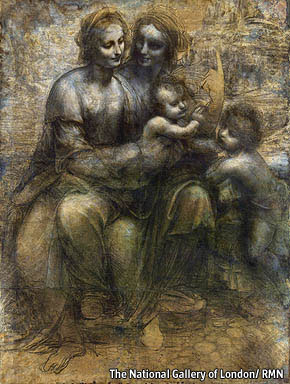
Taking the poem line by line we began with the question of where. In a church or a gallery? There were doubts about the word cartoon. It might make some people think of strip cartoons or cartoon films. Having taught art history for a good number of years I simply assumed the poem meant cartoon in the sense of the Leonardo cartoon, that is to say a preparatory work for something not yet started but it is a mistake to think that everyone knows what one knows (on the other hand no one knows everything, not even the poet). Then there was the issue of essere in due and the use of the infinite, and various possibilities suggested themselves here. But what did it mean to burn inside for a thought of rain. Was it love, desire, or the passion for art that was burning? Was there a desire for rain? For a thought of rain? Was rain symbolic in the way it is in romantic films, a mixture of the mystical and the erotic? We discussed the function of the allegory in the poem. What was the allegory? What was an allegory for what? Was it a specific painting. Was it like Bronzino's Allegory (see above) I wondered.

And was the grande aria a reference to music or was it simply the air, as simply the big or large air, and if it was what actually is large air? Is it to do with the size of the city, the natural world outside the confines of art, the idea of an endless air? Fortunately (though only after the course was over) Chiara was able to get in contact with the poet himself and ask whether he meant aria as in an opera. He said no. (Having living authors to hand is an advantage in many ways though not invariably so. The text is less a matter of the author's specific intention, or even of what the author happened to be thinking when a line occurred to him or her, than in what the words say and suggest.)

Lastly, the great puzzle of the end where a soft thing pierces a hard thing. In reverse it might be read in terms of sexual penetration but Chiara didn't think so. However we read it it remained enigmatic. Perhaps the most persuasive notion was the possibility that the idea of love, as communicated in the allegories, was a source of 'soft power' that might alleviate or redeem the hard imperatives of desire or simply romantic love.

This is the version, after all the discussion and hard thinking, that Chiara sent on after the course.

How to look
a stained glass window, a canvas,
a fresco, a drawing -
it takes two
burning, inside, an idea of rain
(outside the large air of the city)
to cling to admire to not understand
maybe the statures the allegories
telling each other what we know or what we guess
memory and imagination shedding light
and feeling like walls so soft
they pierce that nail called love.


This version shortens breath and has grown in ardency as a result. It sings and has music.

But one could discuss the poem and its translation for ever. The analogy I often used in conversation was the mixing deck in music. You can turn up this or that instrument within the poem. Finally you settle on something because it sounds right, or persuasive, or powerful. That's as good as it gets. If the original poem turns out to be attractive to other translators their own remix will provide a slightly different experience. As of course will the original poem to its various Italian readers.

The image we occasionally returned to was the Venn diagram where the combined overlaps indicated broad agreement as to the 'location' and 'core' of the poem, those versions with some element in the common overlap indicated individual readings and those outside all of them suggested an idiosyncrasy of some sort.


Thursday, 13 August 2015

BCLT Summer School:
Translating Poetry 4: Lawn / Pirotte


Toilet graffiti (source)

I left the translation blogs at the point where I had looked at two of the poems that the translators from the various languages were looking to translate. That leaves three. The questions in these three were more conventional in the sense that the three languages - French, Italian and Spanish - are not so culturally removed from us as Japanese and, in its own way though to a lesser degree, Bengali.

That doesn't mean there were no interesting problems. Translation is full of them. Lesley Lawn was looking at two poems by J-C Pirotte. Here is one of them from the collection La Boîte à musique (2004)

le mot poésie dans les latrines
de la vieille école primaire
était efface le matin
par la maitresse enturbanné
ensuite venait vers midi
le pauvre pion de Francis Jammes
déballer sur le bois du siège
le saucisson et les tartines
de son repas très aviné
or par le trou de la serrure
apparaissait un autre monde
òu la main de l’homme à la craie
 dessinait le profil d’un ange
 et sur la paroi maculée
 écrivait le mot poésie
It is a poem about finding the word poetry written on the walls of a school toilet, the word being scrubbed out by a schoolmistress, then the word being written back on by either the writer as a schoolboy or by someone else. It is about the persistence of poetry in any circumstance.

The most obvious problem was what to do with Francis Jammes. Was it the poet? A school named after the poet? A poet particularly important to the writer? Hard to know. Leave out the name altogether, gloss it, substitute another well known name, insert the word 'school'? And then there was that lunch, the saucisson et les tartines très aviné. The aviné doesn't sound too much like a schoolboy's lunch, assuming pion meant prefect and a prefect was a student, as in England, not a junior member of staff. Beyond that was the schoolmistress who was enturbanné. What kind of turban was intended, if it was literally a turban, not a kind of pedagogic hat, and what was its significance?

These might relatively small or incidental details. (Are there merely incidental details in a poem?) The dynamic of the poem, we might argue, depends on the central event, in which case the order of lines would seem important. In the French the word poésie is in the same line as the word latrines. The two are in close proximity. Should the translator register that proximity as a matter of sensibility. It's awkward conveying the same information in the same order in English. Although Jammes, the turban and that copious quantity of lunchtime wine were subjects of intense discussion it was the who-what-how-in what order that was thought to be most important.

Lesley eventually came up with this interim solution. 

in the toilets of the old primary school
the word
poetry                   
was rubbed out this morning

by the schoolmistress
then around midday
the unhappy prefect
unwrapped his lunch on the wooden bench
garlic sausage and bread
and a good deal of wine
so through the keyhole
another world appeared
whereby the hand of the man with the chalk
drew the outline of an angel
and on the smudged and grubby wall wrote
the word poetry

The turban has gone, Jammes has gone, but there is a nicely disapproving tone in and a good deal of wine. The word poetry and the toilets were not on the same line but were as close as Lesley could get them for now. Smudged and grubby was a possibly useful elaboration on maculée. The word poetry was now in a different typeface to draw attention to its status as graffiti. A good deal of the original poem's force and pathos remained. It had a touch of Jacques Prévert in its clarity and purity of perception. 

Read in English, the poem has a good deal of sharpness and pathos. It might be that the details lost in the French would be more of a distraction than a help to the English version. I think it was Valéry who suggested that a poem was never finished only abandoned. How much truer that is of a translation! There are possible version in which turbans, Jammes and a maculate (or bespattered wall) might take their place.

But we beg to claim that the English poem is a poem, which might be the main thing. The translation is performing a poetic act in its new language. It sings and dances. It doesn't pretend to be Astaire. But it might be Donald O'Connor.


Monday, 3 August 2015

BCLT Summer School:
Translating Poetry 3: Tanaka / Buson


A Copper Pheasant

With Tagore we had a Bengali script but we also had a poem whose form and tone we seemed to recognise, and while the form was modified in the translation the tone drew ever closer to the register of the Biblical Psalms and, according to our dual language Bengali-English speaking and writing translator, that was not far off the mark. The form itself was adapted from international models: the voice and the plea were far from unfamiliar.

With Japanese we faced an altogether different set of problems. We gave a lot of time to the nature of the language itself and its relation to Chinese. We talked of the primarily visual nature of it, its pride in calligraphy,  its clarity and brevity, of its privileging of the visual over the auditory and of the kind of feelings it arouses in its readers. 

In talking of a couple of haiku by Yosa Buson (1716-1783) Aya Tanaka emphasised the sense of comfort she experienced when reading them. So much was familiar and deep rooted but could not be discounted merely as cliché. We briefly considered the many translations of Basho's famous haiku about the frog leaping into the water (Furuike ya/ kawazu tobikomu /mizu no) of which many variants exist. There was also the by-now long tradition of the English-language haiku and of the countless haiku societies established all over America and Britain. The English-language haiku may not be what a Japanese haiku is but it has certainly made a home here. And there were the early translations of Japanese verse by Pound and Fenollosa.

In other words the haiku is strange yet not altogether so. This is what Aya herself has to say about it.
Recreation of the image of the poem was the most difficult task for me in the translation process. 

For me, reading Haiku is always a visual experience. Haiku often describe one striking moment of daily life, especially an experience in nature, and the deep, quiet joyous feeling evoked by that moment. 

Traditional Haiku should contain at least one word which implicates the season. Those keywords works like a trigger in my head, and my childhood memories (or shared images among Japanese people) revisit me. 
Here is one of the two haiku we looked at:
山鳥               
Copper pheasant  of 
尾をふむ

Step on the tail

春の入日    
Spring sunset oh
The reading in Japanese of the poem is over in a flash. The seventeen syllables of the formal structure sound as though they were compressed into no more than a dozen at most. The sensory or onomatopoeic quality of the poetry was clearly secondary. 

The discussion was long and fascinating . What was the function of the "oh" at the end? Was it a cry of pleasure and surprise? No. It was a traditional way of ending a haiku meaning simply something like "the end".

In what way did the sun "step" on the tail of the copper pheasant. Was it like someone stepping on your feet at a dance? Aya suggested it might have been the shadow of the bird's tail on the ground.  

And what of grammar and syntax? The apparatus of English requires all kinds of connecting words in order to create sequence and relation but how far was this necessary and desirable in the case of the haiku as described by Aya? Was not the classical haiku about a certain kind simultaneity?

As we returned to the poem in a later session Aya provided us with a list of emotions and associations she experienced in the poem. These included "soft, spring, warm, light, shadow, copper, brown, movement, stillness, gentle, slightly funny, etc." So these were important qualities to capture or hint at. This led us to explore the possibility of multiple translations in order to create a three-dimensional space for the poem to exist in. This is how she went about it. She looked out an existing translation by R H Blyth:
treading on the tail
of the copper pheasant 

the setting sun of spring 
then offered three versions of her own. 
spring sunset 
alights on the tail 

of a copper pheasant
 
copper pheasant’s tail
spring sunset
shadow 
copper pheasant’s tail
caught by 
a spring sunset
Between the three (and potentially many more) translations we might be approaching something like the effect of the original on its Japanese reader. Is that one of the tasks of translation? Is that in fact a model for poetry translation generally? (I myself think it might be and have experimented with several translations as variations). 

This is what Aya said about the process as a whole.

Working with people with shared interests and passion was exhilarating in itself, but translating haiku and recreating it with people without prior knowledge of the Japanese language was an outstanding experience since I discovered many fresh viewpoints which I could never had on my own. Because I was translating into my second language I was particularly grateful that members of the group helped me to generate English words that might go some way to recreating the Japanese original image, even the idea of the image of one letter in one word in the form of an ideogram since the use of ideographs plays a crucial role in the poem.

There are, of course insurmountable problems. The whole project is in some ways one insurmountable problem. What we know is that both the original and the translation are reaching after something beyond either and that, paradoxically, helps us perform the impossible task of seeing together while retaining and respecting our distance.


Saturday, 1 August 2015

BCLT Summer School:
Translating Poetry 2: Tagore / Alam


Rabindranath Tagore

BCLT Summer School ended yesterday with readings and dinner and, for me, a great wave of tiredness. I am sure this will have been the case for everyone involved, especially the workshop leaders, not to mention the organisers. There is always a developing sense of excitement and a naturally intensifying inward pressure that draws in deep reserves of energy. 'Stay alert! stay alert!' says the mind. To be alert is to remain in a state of tension.

I had, however, a lovely group of poets, Aya (from Japan, translating Japanese into English) ​, Lesley (English but translating from French into English), Carmen (American-Spanish-Polish translating from Spanish into English) , Chiara (Italian, living in England, writing poetry in English but translating from Italian to English) and Pushpita (from Bangladesh, translating from Bengali into English), with visitor Orsolya (working on Dutch into Hungarian)​ from Hungary dropping in for three of the sessions, Ceci  (from Argentina, translating from Spanish into English but also writing in English) for a couple, and others for one.

Having worked through Psalm 23, Catullus and Celan, in our first two sessions, we launched into the individual poems chosen by the individual translators in the third. (There were eight two hour sessions in all.)

I can't possibly go through every poem and translation discussed so I am picking a couple of fascinating instances as case studies and will write separate posts on them. This is the first.


Pusphita Alam translating Rabindranath Tagore's Proshno

Proshno
Rabindranath Tagore

প্রশ্ন

ভগবান , তুমি যুগে যুগে দূত , পাঠায়েছ বারে বারে
দয়াহীন সংসারে ,
তারা বলে গেলক্ষমা করো সবে ', বলে গেলভালোবাসো
অন্তর হতে বিদ্বেষবিষ নাশো '
বরণীয় তারা , স্মরণীয় তারা , তবুও বাহির-দ্বারে
আজি দুর্দিনে ফিরানু তাদের ব্যর্থ নমস্কারে

আমি-যে দেখেছি গোপন হিংসা কপট রাত্রিছায়ে
হেনেছে নিঃসহায়ে ,
আমি-যে দেখেছি প্রতিকারহীন শক্তের অপরাধে
বিচারের বাণী নীরবে নিভৃতে কাঁদে
আমি-যে দেখিনু তরুণ বালক উন্মাদ হয়ে ছুটে
কী যন্ত্রণায় মরেছে পাথরে নিষ্ফল মাথা কুটে

কণ্ঠ আমার রুদ্ধ আজিকে , বাঁশি সংগীতহারা ,
অমাবস্যার কারা
লুপ্ত করেছে আমার ভুবন দুঃস্বপনের তলে ,
তাই তো তোমায় শুধাই অশ্রুজলে
যাহারা তোমার বিষাইছে বায়ু , নিভাইছে তব আলো ,

তুমি কি তাদের ক্ষমা করিয়াছ , তুমি কি বেসেছ ভালো


Pushpita, whose home is Dhaka in Bangladesh chose one poem by Tagore and another by a more recent poet but we got stuck on the very first word of the Tagore for some twenty minutes and did not proceed much faster from there. She had brought along a literal translation of Proshno which was translated by her as Question. The poem was in three stanzas of six lines each in Bengali script which, when she read it, had both rhyme and a serious pulsing rhythm.  The poem was addressed to a God but not one associated with a specific religion. She read it in Bengali first (all original poems were read several times in the original language) then in her literal version. The poem was essentially a lament for the poisons and hatreds and treachery of the time. It ended by asking whether God could love and forgive even workers of evil.

After all the initial questions about the script, the language, the poetic tradition, and the status and nature of Tagore as poet and public figure we had got to line three at the end of the first session. The initial mapping of ground is bound to be slow especially in a group where intuition has to be made articulate in order to be evaluated. We asked Pushpita to produce a verse version for the next time, which she did.    It did not attempt to reproduce all the rhyme but it did suggest analogies with the biblical psalms, in which David (as it is traditionally believed) talks and sings his troubles, fears, hopes and joys, directly to God. Both form and voice followed the psalmist model. As the translation evolved it grew ever more sophisticated and convincing in its rhythm, diction and rhetorical articulation. When Pushpita read it to the group on the last morning everyone was impressed by its beauty and authority.

Authority is key to both work and translation. What authority says is that the work is fully achieved in itself. We can't know whether the authority of the translation matches the authority of the original but  we are aware of the beauty and authority of that which we understand in our own language. Is that a good thing? Is that a betrayal of the original?

I doubt it. The translation works on us as poetry. It is a beautiful new object throwing light back on the unknown original. It is itself a creation of which we are glad.


Question
Rabindranath Tagore
Translated by Pushpita Alam

O God, age after age, you sent your messengers
to this pitiless world
“Forgive all,” they preached, 
“Purge your hearts of wickedness.”
“Love,” they said.
They were revered and remembered, still, 
On this dark day, I am forced to turn them away
At the gate with no homage to offer

I have seen masked greed strike the powerless
In the dark guile of night
I have seen offences of the strong go unpunished 
While the word of justice wept in silence
I have seen the youth mad, dying
beating his head vainly against stone

Today, I find my voice strangled, my flute without tune,
I’m imprisoned by the moonless night
They have shrouded my world in a nightmare
So through my tears, I ask you
Have you forgiven those who poisoned your air,
extinguished your light? Do they have your love?