
Tuesday, 16 February 2016
Une Semaine de Bonté: A Week in Papworth
Diagnosis and Preparation (2)
Diagnosis and Preparation (2)
On the rational and fully conscious level I have always expected to die, not necessarily at the end of my ‘natural’ span, but at any perfectly arbitrary time. Life is simply like that, I feel in my bones. My parents’ lives bear witness to it in the most dramatic way imaginable. The result is that I have always assumed that living well in stable times is not the norm but exceptional good fortune. I was a lucky man: my parents were not. So, if I didn’t dwell on the possibility of dying on the operating table - in the case of a multiple by-pass the chances of that happening are roughly 100/1 - it was because there was always the possibility of dying any old how.
My most pressing thoughts were for Clarissa and our children, Tom and Helen. What would happen to them? How would they feel? How would it affect them? Clarissa and I have been married for over forty-five years and are so close we are almost extensions of each other. I don’t thinhk any man could have made a better marriage. In the case of the children my worst nightmares have always been those in which they are endangered. I would want my wife, children, and indeed grandchildren, to lead lives at least as fortunate as mine.
I looked for practical things to do in case I died. We checked our wills, I ordered my computer files as far as I could, I contacted my literary executors (Cambridge University Library has most of my papers) and I tidied up, as best I could, the three books I am due to publish this year. The first, a collaboration with another poet, Carol Watts, is now ready for printing. The second, the book of poems for children, has been handed in to the publisher but still needs to be illustrated. There was no point in trying to complete the drawings before the operation so I wasn’t even going to start. The third, my new poetry collection, is due in October. The material for this has long been ready and lodged with Bloodaxe but a decent number of extra poems have accumulated since, poems that would not in themselves make a book, so - in consultation with my editor, Neil Astley - I prepared an alternative extended collection in case of death, that would include the later poems. It was the oddest thing I felt I had to do, but I did it because it was practical.
*
I am writing this in the luxury of an almost empty Orchard Ward, Papworth where I am being attended by two nurses. I consciously deliver myself over to them, doing their bidding with a smile. The surgeon and the anaesthetist call for visits. One nurse explains what needs be done before the operation: I need to have two showers with antiseptic and must shave my body, arms, legs, chest and groin. That will be done at 6 am. At that point my blood will be tested, then I’ll be sedated and finally put under anaesthetic ready for surgery. The operation will begin at 8 am and I will be unconscious until about 5pm. Once I am unconscious a tube will be inserted down my throat which will be removed while I am drowsy after the operation. Some days later the ‘drains’ would be removed.
Clarissa, who had driven me in for my 4 pm admission, was renting a room in a house made available for relatives. While I wolfed down the lasagne provided in Orchard Ward, she ate the food she had brought with her at the house. After that she returned at 9pm to watch the seond of half of Derby versus Manchester United live FA Cup tie on TV. with me. This has been a bad year for United and the result was in doubt. We watched the match with an anxiety that was probably greater than I was feeling about my operation.My heart rate went up as result.
After the match she returned to the house and I was left alone with the less tender but perfectly competent night staff. Before lying down to sleep I was introduced to the young Indian male nurse who would shave me.
Being alone is natural. Clarissa and I had been talking about just that, about how we are creatures of both relationship and solitude. Relationships (mother, father, brother, sister, son, daughter, husband, wife, lover, employer, employee, and so on) stabilise us There are places we must be and are fortunate to be, glad to be wanted and needed. But a part of us floats free of every engagement hurtling through space like a rogue meteor. It was that part that took over now.
It had gone midnight. No drinks or food. Nil by mouth. I tried to read one of the books I had brought with me, a Joseph Roth, but the book was too heavy to hold and concentrate on. So I did the codeword, the simpler sudoku and shorter crossword in the I I had brought with me. Then I took out the exercise book I had brought with me and started to write.
Writing calms me. Verse particularly calms me. The ward was humming with heating and air-conditioning systems. I was awake a long time.


Une Semaine de Bonté: A Week in Papworth
Diagnosis and Preparation (1)
Diagnosis and Preparation (1)
My condition had originally been diagnosed in April 2104 as diabetes type 2 to be treated through diet modifications and exercise. The diagnosis was a surprise but it did explain my increased difficulty in walking fast, especially when laden down with luggage or moving uphill, or indeed walking at all straight after a meal.
I did as advised, much supported by Clarissa, but continued life as normal including working, reading, taking part in discussions, and travelling here and abroad, including shorter and longer periods in Malaysia, India, Singapore, Scotland, Ireland, and Hungary. Travel had become an ever more regular part of my writing life, particularly after my retirement from teaching at the end of 2013.
For October 2015 I had invitations to China (two distinct but overlapping ones in fact, one a month-long residency) and, later, more briefly, to India and Baghdad. The trouble was that, despite much improved figures on blood sugar and the rest so I was practically normal, the symptoms that first led to the diagnosis were rapidly growing worse. To combat them I was given more drugs including the ‘in-case of difficulty‘ spray-under-the-tongue Glycerin Trinitrate.
Doubts were rising about China all through August and September. There were suggestions of angina now and I was strongly advised, by three different doctors, to cancel the China residency, so, just a few days before the booked flight on 14 October, I did cancel it. I felt dreadful about this since both invitations had been modified to fit in with my own diary. My hosts were very understanding and assured me the invitations would be renewed next year.
In the meantime I was waiting for an angiography appointment at the NNH and that came through for the 21st.
That entailed a day at the nearby hospital, mostly spent in waiting, mostly in just a t-shirt, mostly cold. The cardiollogist was a severe woman whose look and manner reminided of Carol Brown Janeway who once gave me coffee at Claridge’s and clearly thought I was not quite up to the class of the place. I’ll call the cardiologist Dr CBJ. Eventually I was ushered into the surgery, laid flat on a bed, kitted out with various needles and pins, sedated through a cannulae, then a catheter was applied through my wrist and a dye pumped through it. The X-Ray machine moves all over the naked upper body. It takes about half an hour. None of this hurts: the little pin-pricks are as nothing. It is just that in a t-shirt one grows colder and colder.
Dispatched into the waiting room, empty now by the end of the day shift. I waited another 50 minutes or so, still in the t-shirt, still with the cannulae in place. Eventually Dr CBJ returned. What do you do? she asked. I am a writer. I write poems. She sniffed. This was not impressive. If this had been an interview I would have failed right there. I must tell you something, she continued in her crisp manner. You will need a multiple by-pass, a triple or quadruple. You had better have it soon, let’s say November / December, at Papworth. You understand? Yes, I said. There was little to misunderstand though it hadn’t really sunk in. Right, you can get dresed now and go home. A nurse took out the cannulae. Goodbye, said Dr CBJ.
She left. I rang a shocked Clarissa and, there being no bus or available taxi, waited for her to pick me up.
You may ask - I do ask - what I made of this. It is hard to say. My constitution is such that dramatic events immediately enter a deeper level, passing through surface emotions so fast, I don’t really notice them. All my life it has been like this. Anxiety - even terror - exist at the level of dreams and unarticulated tension, presumably the kind of tension that eventually led to this very diagnosis.
Une Semaine de Bonté: A week at Papworth
1. Foreword
1. Foreword
My dearest friend in Hungary, on hearing that I was to have a mutiple by-pass advised me to read a book, one he had translated from the Swedish into Hungarian by the Hungarian-born oncologist, immunologist, cell biologist and essayist, George Klein. I already had the book since he had sent it to me with a warm recommendation some months before, but I had only nibbled at it. Do read two particular essays, he said, the one titled A New Meeting with Peter Noll and the one at the end of the book, titled A Third Meeting with Peter Noll.
Who was Peter Noll? He was a Swedish professor of law, known to Klein, who, learning that he had cancer of the bladder, decided not to have it treated or operated because, as he wrote in a book in the time available, he believed that knowledge of the certainty of death gives the life remaining extra dimensions, more sheer content. Trivial things no longer mattered. One spent more time with those one loved and less with those one didn’t. As Dr Johnson once remarked, Sir, when a man knows he is to be hanged in a fortnight it concentrates his mind wonderfully. Noll operated on the same principle but there is a difference. Johnson’s remark was made while he was in a healthy condition. It also took more dramatic form. Noll’s was a more deliberate way of proceeding: a conscious facing of death and walking directly into it.
Klein tells us how much he admired Noll for this, then goes on to relate his own experiencce with by-pass surgery as an emergency procedure. It was an emergency far greater than mine since he had onlya few days notice before the operation. The meeting with Noll that Klein refers to is between himself as a man and his late admired exemplar. To meet Noll is, in essence, to meet the prospect of death. Noll is the symbol of that prospect. Klein’s account of his operation is minute in detail, philosophical in nature, and beautifully written (or translated). It is a pleasure to read. If I begin with Klein it is because my friend did and because, in some respects, his case and mine are comparable. I too was so much involved with international travel that I had to cancel three events at short notice. I too wondered what I might squeeze in before the necessary operation.
Beyond that Klein and I differ somewhat. I found the whole hospital experience fascinating. It was less my personal mortality as the lives of others around me that took my attention. This is an account of that experience. I record it for the pure curiosity value - to me at least - of recording it, not just as a personal experience but as a social and institutional one.
I hav written most of it, with only a final section to go but will wait to write that until most of the present material (over 7,000 words) is up.
Friday, 22 January 2016
The Australia Episode

The original idea of leaving Hungary was to go to Australia - we declared as much to the immigration officer on the day we landed in England - where my father had a cousin willing to accommodate and find employment for him. There was at the time a £10 assisted passage whereby approved immigrants could make their way there by sea.
The book is not a personal memoir but an attempt to understand my rather extraordinary mother by running her history backwards from her death by suicide in 1975 to her birth in 1924. She had had a heart condition since the age of fourteen and this was to be the deciding factor in what happened next.
The book is not a personal memoir but an attempt to understand my rather extraordinary mother by running her history backwards from her death by suicide in 1975 to her birth in 1924. She had had a heart condition since the age of fourteen and this was to be the deciding factor in what happened next.
Among my father’s papers after his death I discovered a sequence of letters that traced the process of application. The first is from Australia House on 13 March 1957. It informs my parents of the necessity of medical and x-ray examinations and covers the expense at least until permission has been received. The two that follow bear the same date, 13 May. Both are from the Jews‘ Temporary Shelter office in Aldgate. The first tells us that we have a berth on the SS Sydney, sailing on the 27th and advises us to apply for a visa. The second cancels the berth saying Australia house cannot provide a visa in time but assures us that as soon as the visa is issued “transportation to Australia will be arranged”.
Then there is a wait until 10 July when Australia House wants more medical information, and names the doctor who is to conduct the examination. This time it is we who have to pay for it.
By the 30 July the medical must have taken place because the letter from Australia House informs us that my mother’s application has been rejected. No reason is given. But the case has been referred to Departmental Headquarters in Canberra for a decision.
By the 30 July the medical must have taken place because the letter from Australia House informs us that my mother’s application has been rejected. No reason is given. But the case has been referred to Departmental Headquarters in Canberra for a decision.
So hope, then suspense, then disappointment, now again a little hope. On 25 September we receive a letter from Canberra on blue airmail paper. Apparently there had been an objection to the permit on the 10th but now the objection has been withdrawn and we can go ahead. We prepare to leave.
But there is another long wait until 18 November when Australia House write again. They refer to a previous letter of 10 October rejecting our application but also to the earlier letter from Canberra. They tell us they were aware of the Canberra decision at the time of the 10th (a letter my parents must have queried) but have rejected the application anyway, adding:
But there is another long wait until 18 November when Australia House write again. They refer to a previous letter of 10 October rejecting our application but also to the earlier letter from Canberra. They tell us they were aware of the Canberra decision at the time of the 10th (a letter my parents must have queried) but have rejected the application anyway, adding:
I would advise you that it is not the practice for the Office to inform unsuccessful applicants of the reasons why their applications have not been approved.
And that would seem to be the end of it but on 3 April 1958 comes another letter from Australia House asking my father to come in for a discussion and telling him to bring all his ID papers with him. Nothing comes of it and there is no further correspondence.
It’s a cruel business. The tortuous process, the encouragements then the refusals, the way the whole thing drags out all witness to my parents‘ desperation. And it is her fault, she thinks. It is the state of her heart that prevents us. She wanted out of Hungary but now we are stuck.
The house we are stuck in is the first proper house, the one in Kingsbury. We had been there since the second week of February 1958. The WVS Civil Defence office tells us:
It’s a cruel business. The tortuous process, the encouragements then the refusals, the way the whole thing drags out all witness to my parents‘ desperation. And it is her fault, she thinks. It is the state of her heart that prevents us. She wanted out of Hungary but now we are stuck.
The house we are stuck in is the first proper house, the one in Kingsbury. We had been there since the second week of February 1958. The WVS Civil Defence office tells us:
We have been able to obtain some beds, bedding, floor covering, chairs and cupboards for your new house - also some china and saucepans.
So it could be worse.
Sunday, 13 December 2015
Working on a libretto: an account 2
What I immediately wrote was three pages of more or less one-line colloquy preceded by an introductory prologue:
Prologue: The Story of the Resident of the Black Pavilion
A: Once upon a time a king in China travels to a town
the residents of which dress exclusively in black.
B: Why are they in black?
A: After living a year in that city without disclosing
his own identity, he gains the confidence of a butcher
who agrees to disclose the mystery of the town to him.
C: He takes the king to the outskirts of the town
to some ruins. There, he places the him in a basket
and lets him be transported to the land
of the Queen of Magical Beings
D: The queen welcomes the king with embraces
but when he wishes to make love to her
she offers him one of her handmaidens instead.
A: He enjoys the handmaiden and returns to the queen,
wooing her again but once more she rejects him
and offers him another of her handmaidens.
C: Returning to her again the Queen seems to promise
him satisfaction but when he moves to touch her
she disappears into thin air along with her attendants
B: and the king finds himself in the same basket
descending to the butcher?
A: In memory of his unrequited love, from then on
he, too, dresses himself in black,
even after he returns home.”
Nothing had to come of this but it would introduce the Black Dome / Queen of Enchanted Beings theme. It gave me four speakers / singers. Because the idea was to dispense with dramatic narrative we could use the cast of four for exchanges like the following:
Episode 1: It exploded in my hand
A: When I opened my hand it exploded…
B: Was that yesterday?
A: No, some years ago, I forget now.
C: I was there with him.
D: The walls were covered with it.
A: It exploded right there on the wall
B: Like graffiti.
A: But black.
C: I was there with him.
D: The walls were covered with it.
Episode 2 could follow and begin to home in on the central figure of the writer and the idea of guilt.
Episode 2: It is only fair
D: We were elsewhere, altogether elsewhere.
A: It was my book. My words.
C: They made him eat his words.
B: It is only fair one should eat one’s words
A: It was a dark country.
C: The room was dark.
B: It was night. It was only fair the room should have been dark.
C: I was there with him.
D: We were all with him.
A: It was, some said, a good book.
D: I told you it was good.
B: Then it is only fair someone should eat it.
That's very brief but it gives an idea of context. The figures are not yet prisoners but they coule be. Then we return to the idea of the Queen:
Episode 3: The Queen of Magical Beings
A: The Queen invited me into her chamber
D: Her pillows, her curtains, her carpets, her scent.
C: I was there with him.
A: I sang her clothes, her eyes, her hair, her body
D: You sang her voice, her hand, her foot, her gesture of welcome and command
B: You wrote of pleasures promised and removed
A: I wrote of the king in his black gown. Of the city of black gowns
C: I was there with him.
B: But when you opened your hand…
A: When I opened my hand it exploded.
B: It is only fair that your hand should have exploded.
None of this was to provide a text as such but to explore ways of fragmentation and recapitulation and to see if anything caught Richard's eye. He liked it all as a first stab - as a technique - but what caught his eye was the idea of the writer being made to physically eat his words.
So there we had an image we could return to - and might yet. But nothing for music yet.
Wednesday, 9 December 2015
Working on a libretto: an account 1
 |
| Lorenzo da Ponte 1740-1848 |
As with all blog posts one has an odd sense of keeping a private diary but with a reader over one's shoulder. Hello, reader. Welcome. Here are some one-line thoughts on being a librettist among composers, conductors, singers and players of various musical instruments.
A poet among musician is an electrician among plumbers.
Hearing your words treated by musicians is like becoming silence.
A librettist is not a poet but dots on a page.
A librettist is not a producer of words but an occasion of sounds.
A librettist is not a presence but a room filled by other people.
I have yet to see the advertisement: DON GIOVANNI by LORENZO DA PONTE, music by W A Mozart
For well over a year now I have been engaged on a project run by the English National Opera (ENO for short) in which they put together a composer they admire, one who has not previously written an opera, with a poet, so that together they might produce some fifteen minutes of a potential opera, enough at least, to attract a commission. There were at some, stage, so I understand, four such pairings. I was paired with Richard Causton who is currently University Lecturer in Composition at King's College, Cambridge and whose music, readily available on YouTube, is rich, lyrical and - so it sounded to me - Romantic at root. We hadn't met before so I took a train and we had some preliminary discussions.
Richard, who had, I think, had some two years contact with the ENO before this point, already had a source text, the late Iranian writer, Hushang Golshiri's The King of the Benighted but he was also excited by the work of another Iranian, Marjane Satrapi's Persepolis, originally a graphic novel but then a film. It was reading Golshiri's obituary rather than the book that first excited his interest. We talked good deal about style and scope but the core subject remained unclear. Was it Iran? No. Was it the Ayatollah Khomeini regime that imprisoned Golshiri just as the Shah's had done earlier? No. Was it about the not-uncommon phenomenon of being punished - imprisoned, tortured - by one side then being punished all over again by the other side? No. Was it a way of reconceptualising The King of the Benighted as an opera? Closer, but no. Was it about political freedom? Not exactly. About religious freedom? No. About the freedom of the imagination? Probably. In a way.
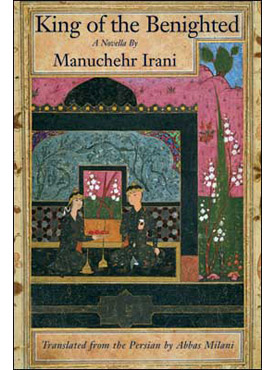 | ||
| Manuchehr Irani was Golshiri's prison psudonym |
I left with a clear idea of what certain specifics were to be. The whole was to be a set in a prison and include an interrogation, maybe several interrogations. The interrogations would be attempts to crush the imagination but the imagination would survive.There would be certain visual images. Some specific noises and effects. There would certainly be a Golshiri figure. We could have five or six on-stage singers / actors, perhaps an off-stage female choir (that might have transpired later). The setting would be bare with not much grand dramatic / operatic action (it shouldn't be too much like 'opera'). It would all be in black and white.
But would there be a story? Maybe. Not at the moment. Not for now. Seeing that Golshiri was to appear should we at least follow some of the lines in The King of the Benighted? An interrogation is not an opera, is it? No plot, no direct political or religious reference. Then why is one man interrogating and beating another in prison? What does he want from him? What has the prisoner got that is valuable? Is it the story of the legend within King of the Benighted?
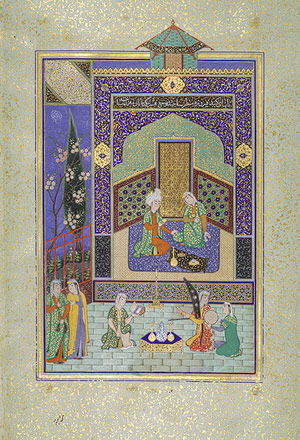
But what is the signficance of the legend? Why is it important? Do we know why it is important? In what way is it a symbol of something central to the imagination? Could that significance be an opera that is not exactly an opera? Perhaps it is.
Let's see. Richard's instinct, it seemed, was meditate, meditate: mine is write, write.
Fair enough. I had to go away and write something. Some germ of an idea. Early days.
Saturday, 5 December 2015
The Poetry of Eastern Europe:
A talk at The Athenaeum Club, 2 December 2015
A talk at The Athenaeum Club, 2 December 2015

This is the list of poems read and talked about. The talk was about 45 minutes long plus about 20 minutes of questions.
1. Zbigniew Herbert: The Rain
2. Tadeusz Rozewicz: Pigtail
3. János Pilinszky: Fable
4. Zbigniew Herbert: The End of a Dynasty
5. Gyula Illyés: One Sentence on Tyranny (excerpt)
6. Vasko Popa: The Nail
7. Vasko Popa: He
8. Vasko Popa: The Hunter
9. István Vas: The Translator’s Vote of Thanks (excerpt)
10. Daniela Crasnaru: Orphic
11. Zbigniew Herbert: Pebble
12. Ágnes Nemes Nagy: Winter Trees
13. Vasko Popa: The Rose Thieves
14. Vladimir Holan: Glimpsed
15. Miroslav Holub: Wings
16. Miroslav Holub: A Boy’s Head
17. Miroslav Holub: The Door
18. György Petri: Gratitude
19. Ottó Orbán: A Roman Considers the Christians
It was, of course, a very small selection from the material available, but even so it was a squeeze for the time available. As it turned out, since most of the poems were short, it was just right, given the introduction to each poem.
The introduction to the poems was intended to provide a frame or map for seeing them together. It presented them, as and when translated, in terms of 'cold war poetry', the poetry of a bipolar world that has since passed and might not make much sense to those born after the period ended. That period might be defined as 1945 or a few years before, up to 1989. In terms of theme there were four main phases: the war / the Holocaust, the era of Stalinism, the post Stalin period (including 1968), and around and beyond 1989. Most of the poets were born in the 1920s, a few earlier, two or three later.
The poems were
all in translation of course and a good many were taken from volumes of
the Penguin Modern European Poets series. The interest in the unofficial
poetics of Eastern Europe was partly political, partly a matter of
assumed public interest, partly literary fascination. The early work of Danny Weissbort and Ted
Hughes was vital in begetting the Penguin series. Hughes's introduction to the
Vasko Popa volume of 1969 makes strong reference to humanism, politics,
precision, the sense of direct witness and to the west's own sense of "civilised
liberal confusion". He compares 'their' world - the world of Popa, Holub
and Herbert - with the world of Beckett and, for him, "theirs seems
braver, more human, and so more real". As to Popa "No poetry could carry
less luggage than his". There was, I think, (and I have argued this in
print before) a sense of moral envy. Iron curtain poets carried moral
authority because their pressures were direct. Their work therefore had
greater tension, greater urgency.
There were certain shared characteristics of the period that were not specifically the product of the cold war as such. There was still a belief in modernity, indeed in Modernism as a redemptive idea. Associated with it was a shared, left-leaning intellectual humanism. It was a world in which (unlike today) theology had no place. It was a world in which you could appeal to European values as embodied, say, in the School of Paris, in Sartre, Camus, Beauvoir and the rest. It was a world that had first hand communal experience of extreme violence in the name of totalitarian ideological systems.
As to differences, the nations of Eastern Europe did not suffer from post-colonial guilt though they had (and have) yet to deal with war guilt. The first years after the war the pressure of officially approved socialist realism - often traditional in form - meant that 'unofficial' art and poetry was best expressed through modernism: no formal prosody, no rhyme, disposable punctuation or capitalisation, no ornate metaphors, no declamatory first-person singular. The freedoms offered by surrealism also offered complex ways of addressing politics. This encouraged a belief in codes, in secret complicities, in a common energy. Under repressive conditions certain fields remained open for play. These include the grotesque, the folk tale, the erotic, the fantastical, the indirect elegy.
The first four poems were primarily about the war, the next four about conditions under arbitrary and savage totalitarianism, the next four about ways of surviving under those conditions, and the rest about hope, erotics,and scepticism. The Crasnaru was out of chronology but circumstances in Ceausescu's Romania were not dissimilar to those under early Stalinism.
I think this made a decent, not unrealistic package for a one-off talk to a privileged, highly intelligent but non-specialist audience most of whom would not have heard of most of the poets - or may not have read much poetry at all.
The first four poems were primarily about the war, the next four about conditions under arbitrary and savage totalitarianism, the next four about ways of surviving under those conditions, and the rest about hope, erotics,and scepticism. The Crasnaru was out of chronology but circumstances in Ceausescu's Romania were not dissimilar to those under early Stalinism.
I think this made a decent, not unrealistic package for a one-off talk to a privileged, highly intelligent but non-specialist audience most of whom would not have heard of most of the poets - or may not have read much poetry at all.
Subscribe to:
Posts (Atom)